5.00
(3 Ratings)

1 Month AI / ML Training & Internship

Categories: Training & Internship
Wishlist Share

About Course

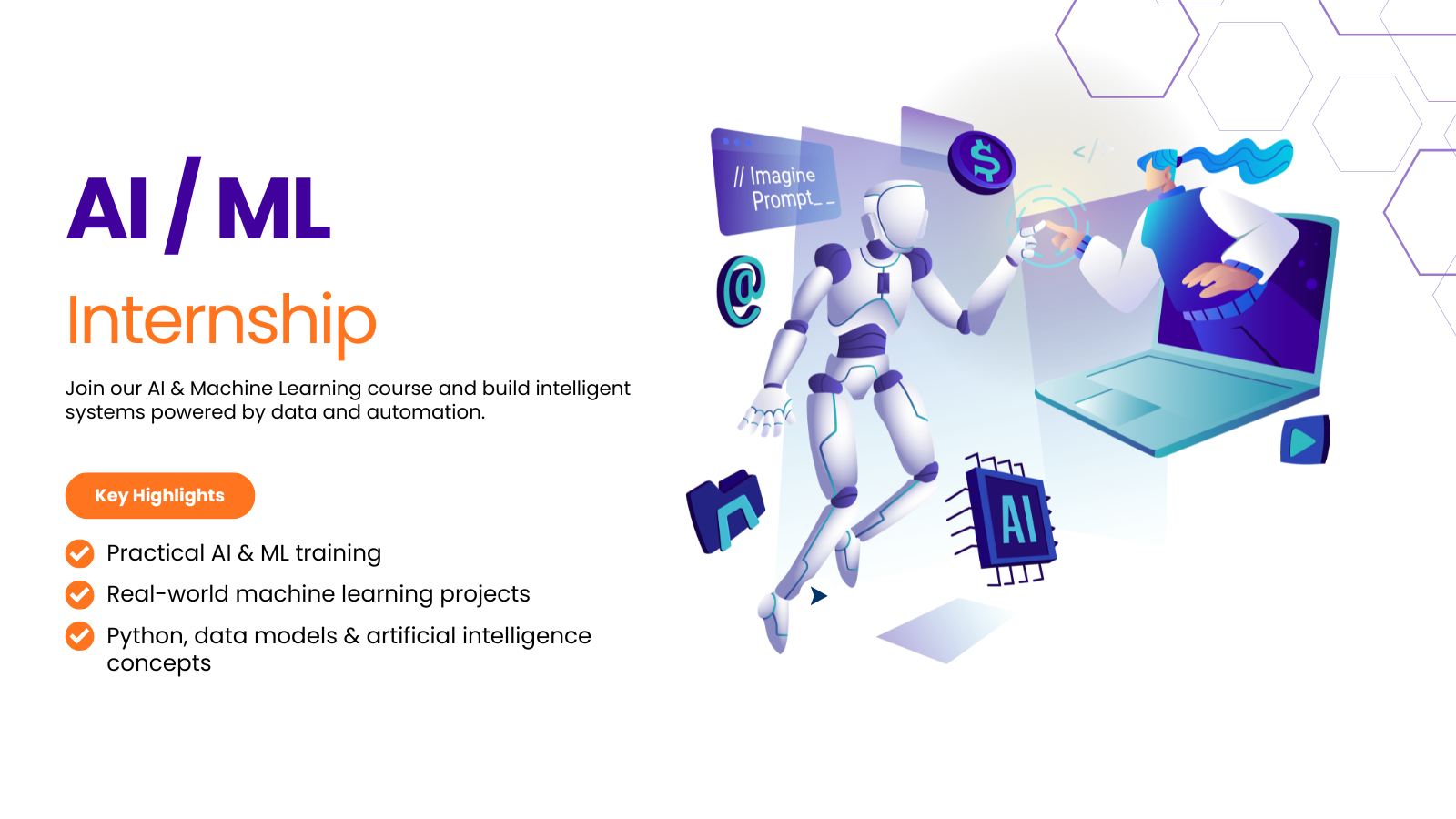
The 1-Month AI/ML Internship is a fast-track, structured training program designed to introduce beginners to the core concepts of Artificial Intelligence and Machine Learning through practical implementation and project-based learning.

This internship focuses on building strong foundational skills in Python programming, data analysis, machine learning workflows, and AI model development. The program follows a hands-on learning approach where participants work on datasets, train models, and build mini AI applications.

The internship is carefully designed to help students understand how real-world AI systems are created while giving them practical exposure to modern AI tools and technologies.

🚀 What This Internship Covers

The internship begins with an introduction to Artificial Intelligence, Machine Learning, and Data Science fundamentals, where learners understand AI concepts, real-world applications, and the overall machine learning lifecycle.

Next, students learn Python for AI/ML, including variables, loops, functions, libraries, and data handling using Pandas and NumPy. This creates the programming foundation required for machine learning development.

The program then moves into Data Preprocessing and Cleaning, where participants work with datasets, handle missing values, remove duplicates, and prepare clean data for model training.

After that, learners are introduced to Machine Learning Basics, including supervised learning, classification, regression, model training, and evaluation using Scikit-learn.

The internship also covers Data Visualization and Analytics, where students create graphs and insights using Matplotlib to understand patterns and trends in datasets.

In the final stage, participants build a Mini AI Project, where they apply everything learned throughout the internship to create a basic machine learning application.

🧠 Learning Approach

This internship follows a practical and beginner-friendly learning approach. Each module includes:

  • Structured AI/ML lessons
  • Hands-on coding exercises
  • Dataset-based practice
  • Machine learning implementation tasks
  • Module-wise quizzes
  • Mini project development

The program is designed to help learners build confidence through continuous implementation and guided exercises.

🏆 Skills You Will Gain

By the end of this internship, participants will be able to:

  • Understand AI and Machine Learning fundamentals
  • Work with datasets using Python
  • Perform data preprocessing and cleaning
  • Train basic machine learning models
  • Analyze and visualize data
  • Build simple AI applications
  • Understand the AI project workflow

🎯 Who This Internship is For

This internship is ideal for:

  • Beginners interested in AI and ML
  • Students exploring Data Science careers
  • Python learners wanting practical projects
  • Engineering and IT students
  • Anyone starting their AI journey

No prior AI experience is required, but basic computer knowledge and consistent practice are recommended.

💼 Internship Outcome

After completing this internship, learners will have practical exposure to machine learning workflows and basic AI application development. They will also complete a mini AI project that can be added to their portfolio for internships and beginner-level opportunities.

Show More

Course Content

Module 1: Introduction to AI, Python & Machine Learning Foundations
This module builds the core foundation required to enter the field of Artificial Intelligence and Machine Learning. Students will understand what AI and ML actually are, how machines learn from data, and how Python is used to build intelligent systems. The module starts from absolute basics and gradually introduces programming logic, data handling, and machine learning workflows. Students will learn the difference between Artificial Intelligence, Machine Learning, and Deep Learning along with understanding how industries use them in real-world systems like recommendation engines, fraud detection, autonomous vehicles, healthcare diagnosis, and chatbots. The module also introduces Python programming because Python is the most widely used language in AI development due to its simplicity and powerful ecosystem. Students will learn variables, loops, functions, libraries, and data structures with practical examples. By the end of this module, students will be capable of writing Python programs, handling datasets, understanding the machine learning pipeline, and building their first simple ML model. This module acts as the technical base for all advanced AI and ML concepts covered later in the internship. Students will also learn industry tools like Jupyter Notebook, NumPy, Pandas, and Matplotlib which are heavily used by Data Scientists and ML Engineers worldwide. This module is extremely important because weak fundamentals destroy long-term AI development capability. Strong basics make advanced topics like Deep Learning, NLP, and Computer Vision easier to understand later.

  • Introduction to Artificial Intelligence & Machine Learning
  • Python Basics for AI & ML
  • NumPy and Data Handling
  • Introduction to Pandas and DataFrames
  • Check what have you learnt about AI & Python Fundamentals Quiz
  • Build a Student Data Analysis Program Using Python

Module 2: Data Analysis, Data Preprocessing & Supervised Learning
This module focuses on one of the most critical parts of Machine Learning: working with real-world data and building predictive models using supervised learning algorithms. Most AI projects fail because of poor data preprocessing, weak feature engineering, and incorrect model selection. This module solves those problems by teaching students how to clean, analyze, transform, and prepare datasets professionally. Students will learn how machine learning models consume data and why preprocessing directly affects prediction accuracy. Real-world datasets are messy, inconsistent, incomplete, and noisy. Therefore, understanding preprocessing is mandatory before moving into advanced AI systems. The module introduces exploratory data analysis (EDA), handling missing values, encoding categorical data, feature scaling, train-test splitting, and supervised learning techniques such as Linear Regression and Logistic Regression. Students will also understand how algorithms internally learn patterns from historical data and use mathematical relationships to make future predictions. They will learn evaluation metrics used by ML engineers to measure model performance. By the end of this module, students will be capable of preparing datasets, visualizing data, training machine learning models, evaluating predictions, and improving model accuracy using industry-standard workflows. This module is highly relevant in industries like finance, healthcare, e-commerce, cybersecurity, and marketing where predictive analytics and data-driven decisions are heavily used. Students will also gain practical experience with Scikit-learn, Matplotlib, and Seaborn alternatives used in modern AI development environments.

Module 3: Deep Learning, Neural Networks & Model Optimization
This module introduces students to Deep Learning, one of the most powerful branches of Artificial Intelligence responsible for modern breakthroughs such as ChatGPT, image recognition systems, autonomous vehicles, speech assistants, recommendation engines, and medical AI systems. Students will learn how Neural Networks work internally and how machines simulate brain-like learning through interconnected computational layers. This module explains neurons, activation functions, forward propagation, backpropagation, loss functions, and optimization techniques in a structured and beginner-friendly manner. The module also introduces TensorFlow and Keras, two of the most widely used deep learning frameworks in the AI industry. Students will build and train neural networks using real datasets and understand how deep learning models improve through iterative learning. A major focus of this module is understanding model optimization because training deep learning models incorrectly often causes overfitting, underfitting, poor convergence, and unstable predictions. Students will also understand practical concepts such as epochs, batch size, gradient descent, dropout, and hyperparameter tuning which are essential in real-world AI engineering. By the end of this module, students will be able to build basic neural networks, train deep learning models, optimize performance, and understand the internal mathematics behind modern AI systems. This module is highly valuable for careers in AI Engineering, Computer Vision, NLP, Robotics, Generative AI, and Research Engineering.

Module 4: Real-World AI Project Development & Deployment
This final module focuses on building, managing, and deploying a complete real-world Artificial Intelligence application using industry-standard workflows. Students will transition from learning isolated concepts to engineering production-level AI systems capable of solving actual business problems. The module covers the full AI project lifecycle including project planning, dataset collection, preprocessing pipelines, model development, API integration, deployment strategies, monitoring, and optimization. Students will understand how AI systems are transformed from experimental notebooks into scalable applications used by real users. This module also introduces practical engineering concepts such as REST APIs, Flask deployment, model serialization, cloud deployment fundamentals, and real-world architecture design. Students will learn how trained models are integrated into applications and exposed through APIs. The final project included in this module simulates a professional AI engineering workflow where students design and implement a complete AI-powered solution from scratch. Students will also understand deployment challenges such as latency, scalability, security, inference speed, and model maintenance which are critical in enterprise AI systems. By the end of this module, students will be capable of developing complete end-to-end AI applications, deploying machine learning models, and understanding professional AI system architecture. This module prepares students for real-world AI/ML internships, freelancing, startup development, and junior AI engineering roles.

Final Module Project
The Smart AI-Powered Student Performance Prediction & Analytics System is an intelligent educational analytics platform designed to monitor, evaluate, and predict student academic performance using Artificial Intelligence and Machine Learning techniques. The system collects and analyzes data such as attendance, assignment scores, exam results, classroom participation, learning behavior, and historical academic records to identify patterns that influence student success. Using predictive analytics models, the platform can forecast student performance, detect students who may be at academic risk, and provide early intervention recommendations to teachers, parents, and administrators. The system also generates interactive dashboards, visual reports, and personalized insights to support data-driven decision-making in educational institutions.

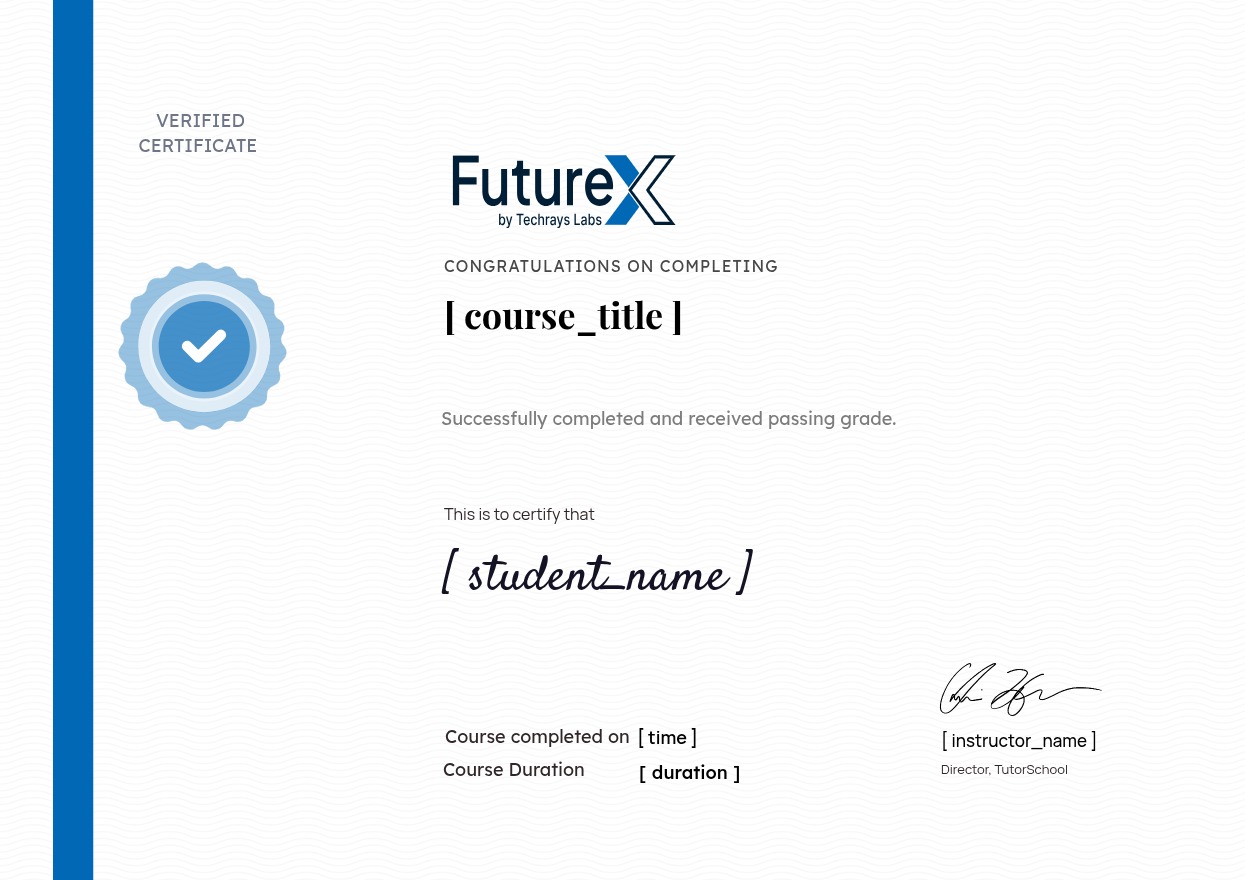
Earn a certificate

Add this certificate to your resume to demonstrate your skills & increase your chances of getting noticed.

selected template

Student Ratings & Reviews

5.0
Total 3 Ratings
5
3 Ratings
4
0 Rating
3
0 Rating
2
0 Rating
1
0 Rating
K
1 week ago
Course was professional, and makes learning great
VK
2 weeks ago
it is very good intership platform for the students who wants to study the course like AI-ML and python .
R
2 months ago
very helpful to learn and solve new problem