6 Months QA / Software Testing Training & Internship

Categories: Training & Internship
Wishlist Share

About Course

The 6-Month Q/A Software Testing Internship is a comprehensive professional training program focused on advanced software quality assurance, automation engineering, API testing, performance testing, and production-level QA workflows.

This internship is designed to simulate real-world software testing environments where participants work on enterprise applications, automation frameworks, testing pipelines, and collaborative Agile development systems.

The program combines manual testing, automation engineering, API validation, database testing, performance testing, and QA process management into one structured industry-oriented learning experience.

🚀 What This Internship Covers

The internship begins with strengthening Advanced Software Testing and QA Engineering concepts, creating a strong foundation for enterprise-quality software validation.

Participants work on:

  • Advanced Manual Testing
  • Requirement analysis
  • Risk assessment
  • Defect lifecycle management
  • Enterprise QA documentation

Learners then move into Automation Testing Engineering including:

  • Selenium WebDriver
  • Automation frameworks
  • TestNG/JUnit basics
  • Data-driven testing
  • Hybrid framework concepts
  • Cross-browser automation

The program also covers Advanced API & Database Testing including:

  • REST API testing
  • Postman workflows
  • API validation automation
  • SQL-based database testing
  • Backend validation systems

Participants learn Performance & Security Testing Fundamentals such as:

  • Load testing concepts
  • JMeter basics
  • Stress testing workflows
  • Security testing awareness
  • Test optimization techniques

The internship includes CI/CD and DevOps-integrated QA workflows where learners:

  • Work with Git/GitHub
  • Understand Jenkins basics
  • Execute automated pipelines
  • Monitor testing workflows

Students also learn Professional QA Engineering Practices including:

  • Agile & Scrum methodologies
  • QA reporting systems
  • Test management workflows
  • Team collaboration
  • Quality metrics & analytics

In the final stage, participants complete a Major Industry-Level QA Capstone Project simulating enterprise software testing and automation implementation.

🧠 Learning Approach

This internship follows a highly practical and execution-focused learning model including:

  • Industry-level testing projects
  • Real-world applications
  • Automation implementation
  • Team-based workflows
  • Continuous testing practices
  • QA documentation standards
  • Performance evaluations
  • Capstone project development

The focus is on creating job-ready QA Engineers and Automation Testers through hands-on implementation and professional workflow exposure.

🏆 Skills You Will Gain

By the end of this internship, learners will be able to:

  • Perform enterprise-level software testing
  • Build automation testing frameworks
  • Execute API and database validation
  • Understand performance testing fundamentals
  • Work with CI/CD-integrated QA systems
  • Create professional QA reports
  • Collaborate in Agile development teams
  • Manage professional software quality workflows

🎯 Who This Internship is For

This internship is ideal for:

  • Serious QA/Testing learners
  • Engineering and Computer Science students
  • Aspiring QA Engineers & Automation Testers
  • Developers transitioning into testing
  • IT professionals building QA expertise

Basic programming and software testing knowledge is strongly recommended.

💼 Internship Outcome

After completing this internship, participants will have strong industry-level QA engineering experience and the ability to test, automate, validate, and manage real-world software applications confidently. They will also complete multiple portfolio projects and a capstone QA system suitable for professional opportunities in Software Testing, QA Engineering, and Automation Testing careers.

Show More

Course Content

Module 1: Introduction to Software Testing & QA Fundamentals
This module builds the foundation of Quality Assurance (QA) and Software Testing by introducing students to the purpose, process, and importance of testing in software development. Students will learn what software testing is, why it is essential, and how QA ensures software quality before products reach users. This module is critical because every software product—whether a mobile app, website, or enterprise platform—must be tested to prevent failures, bugs, security issues, and poor user experience. Students will understand the difference between QA and QC, explore the software development lifecycle (SDLC), and learn how testing fits into each stage of product development. This module also introduces the Software Testing Life Cycle (STLC), core testing principles, and different types of defects found in real-world applications. By the end of this module, students will understand how professional QA teams operate, how testing contributes to product reliability, and how testers think critically to identify issues before end users do. This module establishes the mindset and technical vocabulary required for every advanced QA topic in later modules.

  • Introduction to Software Testing
  • QA vs QC (Quality Assurance vs Quality Control)
  • SDLC and Role of Testing in Software Development
  • Software Testing Life Cycle (STLC)
  • Check what have you learnt about QA Fundamentals & Testing Basics
  • QA Process Blueprint for a Login System

Module 2: Manual Testing Fundamentals
This module introduces Manual Testing, the core foundation of software quality validation and the starting point of every QA career. Students will learn how to test software manually by interacting with applications the same way real users do. Manual testing teaches observation, logic validation, defect detection, and critical thinking—skills that remain essential even in highly automated QA environments. Manual testing is important because every software feature must first be understood and validated by human reasoning before automation can be applied. It helps testers discover usability issues, visual defects, workflow failures, and edge-case bugs that automated scripts often miss. In real-world projects, manual testing is heavily used in exploratory testing, UI validation, requirement verification, ad-hoc checks, and early-stage feature testing. This module explains how manual testing works, how to write test scenarios and test cases, how to execute tests properly, and how to identify software defects systematically. Students will also learn how testers think while validating business flows, forms, and user journeys. By the end of this module, students will be able to manually test real software applications, write structured test cases, execute tests professionally, and report findings with clarity. This module forms the operational base for all future QA work.

Module 3: Defect Management & Bug Reporting
This module focuses on one of the most critical responsibilities in QA: identifying, documenting, tracking, and managing software defects professionally. Finding bugs is only one part of testing. A QA engineer is valuable when they can report defects clearly, provide reproducible evidence, communicate impact, and ensure defects are tracked until closure. Students will learn what a defect is, how bugs are classified, how severity and priority are assigned, and how defect life cycles work in real software teams. This module is essential because poor bug reporting leads to wasted developer time, misunderstood issues, delayed releases, and unresolved production risks. In real-world QA teams, defect management is not just about logging bugs—it is about structured communication between testers, developers, product managers, and stakeholders. A badly written bug report causes confusion. A well-written one saves engineering time and speeds up fixes. This module teaches students how to write professional bug reports, classify issues correctly, manage defect states, and communicate issues using industry-standard QA practices. By the end of this module, students will be able to report defects like professional QA engineers and manage bug workflows effectively.

Module 4: Test Case Design Techniques
This module focuses on structured test design techniques used to create effective, optimized, and high-coverage test cases. Writing random test cases is inefficient and leads to poor validation. Professional QA engineers use formal test design techniques to reduce redundant tests, improve defect detection, and ensure maximum coverage with minimum effort. Students will learn how to design test cases using industry-standard techniques such as Equivalence Partitioning, Boundary Value Analysis, Decision Table Testing, and State Transition Testing. These techniques help testers systematically identify test inputs, expected outcomes, and critical edge cases that are often missed in naive testing. This module is essential because most software defects are found not by writing more test cases, but by writing smarter ones. In real-world projects, testers use these techniques to validate forms, calculations, workflows, business rules, user permissions, and application states. By the end of this module, students will be able to design efficient and high-value test cases using formal test design methods. This module significantly improves test quality, reduces redundancy, and strengthens analytical thinking in QA.

Module 5: Functional Testing & Non-Functional Testing
This module introduces two major categories of software validation: Functional Testing and Non-Functional Testing. These are core classifications in QA and every professional tester must understand the difference clearly. Functional testing verifies what the software does. Non-functional testing verifies how well the software performs. Students will learn how to validate software functionality against business requirements and how to assess software quality beyond functionality, including performance, usability, security, reliability, and scalability. This distinction is critical because software can be functionally correct and still fail in production due to slow performance, poor security, or bad usability. In real-world QA, functional testing ensures users can complete tasks correctly, while non-functional testing ensures they can do so efficiently, safely, and reliably. Both are essential for release quality. A login page that works but takes 20 seconds to respond is functionally correct but still a failure in production. This module teaches students how to identify, design, and execute both functional and non-functional test validations. By the end of this module, students will understand how modern QA teams validate both software behavior and software quality characteristics.

Module 6: API Testing Fundamentals
This module introduces API Testing, one of the most important skills in modern QA. Most modern applications rely on APIs to exchange data between frontend, backend, mobile apps, third-party services, and databases. A UI may look correct while the backend silently fails. API testing catches those failures directly. Students will learn what APIs are, how API communication works, how to test APIs using requests and responses, and how to validate backend functionality without relying on UI. This module is critical because modern QA is no longer limited to clicking interfaces. Professional testers must validate data flow, backend logic, integrations, and service responses. In real-world projects, API testing is used to validate authentication, payments, user data, search, dashboards, mobile apps, and system integrations. It is faster than UI testing, more reliable for backend validation, and essential for identifying hidden failures before they reach users. By the end of this module, students will understand API structure, HTTP methods, status codes, request/response validation, and practical API testing workflows using real QA methods.

Module 7: Database Testing Fundamentals
This module introduces Database Testing, a critical QA skill used to validate data integrity, consistency, and correctness in backend systems. Most software applications depend on databases to store users, transactions, products, orders, logs, and business records. If the database is wrong, the application is wrong, even if the UI looks fine. Students will learn how databases support software systems, how QA validates stored data, and how to test whether backend operations correctly insert, update, retrieve, and delete records. This module is important because many software defects are invisible in the UI but exist in the database layer—duplicate records, broken relationships, missing updates, incorrect calculations, and corrupted data. In real-world QA, database testing is used in banking, e-commerce, healthcare, ERP, SaaS, and every system where business-critical data must remain accurate. Testers use database validation to confirm that frontend actions correctly affect backend records and that business logic is reflected in stored data. By the end of this module, students will understand how to validate database operations, write basic SQL for testing, verify data integrity, and identify backend data defects using QA workflows.

Module 8: Automation Testing with Selenium
This module introduces Automation Testing using Selenium, the most widely used open-source framework for web application test automation. Manual testing is essential, but repetitive regression work becomes slow, expensive, and error-prone at scale. Automation solves this by executing repeatable tests faster and more reliably. Students will learn what automation testing is, where it is useful, and how Selenium automates browser actions like clicking buttons, filling forms, validating text, and navigating workflows. This module is important because modern QA teams rely on automation for regression, smoke, sanity, and repetitive UI validations. In real-world QA environments, Selenium is used to automate login flows, search validation, checkout journeys, admin panels, dashboards, and repetitive business-critical user flows. It reduces execution time, improves consistency, and supports faster releases. By the end of this module, students will understand the basics of automation testing, Selenium architecture, browser interaction, locators, and how to write simple automated UI tests using Selenium.

Module 9: Performance Testing Fundamentals
This module introduces Performance Testing, a critical non-functional testing discipline used to measure system speed, stability, responsiveness, and scalability under different workload conditions. Software that works correctly but slows down, crashes, or becomes unstable under user load is not production-ready. Students will learn what performance testing is, why it matters, and how QA evaluates system behavior under normal, peak, and extreme conditions. This module is important because production systems fail less often from missing buttons and more often from slow APIs, overloaded servers, broken concurrency handling, memory leaks, and poor scalability. In real-world QA, performance testing is used to validate login traffic, checkout spikes, concurrent transactions, LMS usage peaks, search latency, dashboard load, and backend stability. It helps teams detect bottlenecks before users experience failure. By the end of this module, students will understand performance metrics, load testing, stress testing, bottleneck analysis, and how to approach performance validation in real QA environments.

Module 10: Bug Reporting & Defect Lifecycle
This module focuses on Bug Reporting and Defect Lifecycle Management, one of the most important practical responsibilities in QA. Finding defects is only part of the job. A defect has no value if it is poorly reported, impossible to reproduce, incorrectly prioritized, or badly tracked. Professional QA is judged not only by what bugs are found, but by how clearly and effectively they are communicated. Students will learn how to identify defects, write professional bug reports, classify severity and priority, and track a defect through its full lifecycle from discovery to closure. This module is essential because unclear bug reports waste developer time, delay fixes, create miscommunication, and allow defects to escape into production. In real-world QA, bug reporting is used daily across all teams. Testers log UI bugs, backend failures, business logic issues, security flaws, validation defects, and performance issues. Developers rely on QA to provide accurate reproduction steps, evidence, expected vs actual behavior, and defect impact. By the end of this module, students will be able to write high-quality bug reports, classify defects correctly, and manage defect flow professionally across development and release cycles.

Final Module: End-to-End QA Testing Capstone Project
This final module is a full real-world capstone project designed to combine everything learned throughout the internship into one complete QA workflow. This is not theory. This is execution. Students will apply manual testing, test case design, API validation, database verification, automation basics, performance thinking, and defect reporting in a single integrated project. The purpose of this module is to simulate real QA work in a professional software team. Students will test a complete product like a real QA engineer, document findings like a real QA analyst, and report defects like a production-facing tester. This module is the practical conversion point from learner to entry-level QA professional. In real-world software teams, QA is not separated into isolated topics. Test cases, APIs, databases, bugs, and performance are connected. This module forces students to validate an application end-to-end exactly the way real QA teams work before release. By the end of this module, students will have completed a portfolio-grade QA project demonstrating practical industry readiness across core testing disciplines.

Earn a certificate

Add this certificate to your resume to demonstrate your skills & increase your chances of getting noticed.
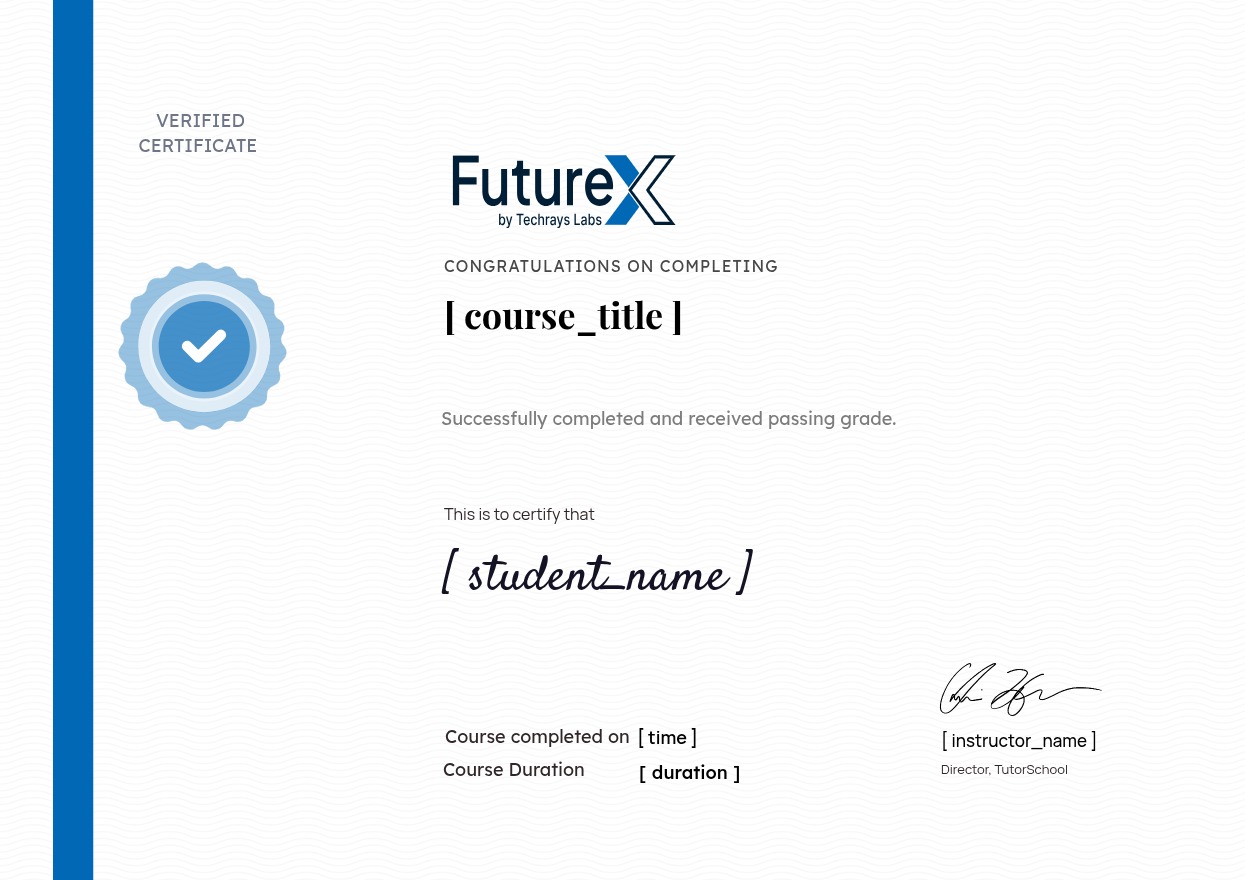
selected template

Student Ratings & Reviews

No Review Yet
No Review Yet