About Course
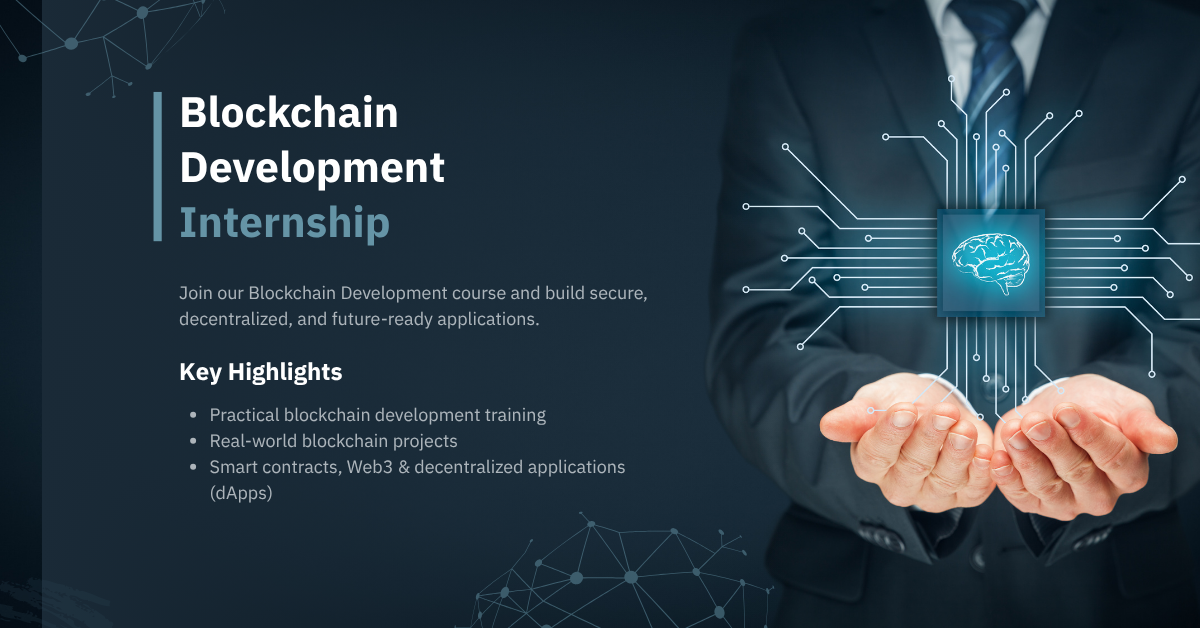
The 6-Month Blockchain Development Internship is a comprehensive professional training program focused on advanced blockchain engineering, smart contract development, decentralized application architecture, Web3 integration systems, and production-ready blockchain deployment workflows.
This internship is designed to simulate real-world blockchain industry environments where participants work on scalable decentralized platforms, secure smart contract systems, blockchain integrations, and collaborative Web3 engineering practices.
The program combines blockchain fundamentals, smart contract engineering, decentralized application development, deployment systems, security practices, and production blockchain workflows into one structured industry-oriented learning experience.
🚀 What This Internship Covers
The internship begins with strengthening Advanced Blockchain and Web3 Engineering concepts, creating a strong technical foundation for scalable decentralized systems.
Participants work on:
- Blockchain architecture and ecosystems
- Ethereum and EVM fundamentals
- Consensus algorithms
- Blockchain security principles
- Distributed systems concepts
Learners then move into Advanced Smart Contract Engineering including:
- Solidity advanced concepts
- ERC-20, ERC-721, and ERC-1155 standards
- DAO and governance basics
- Smart contract optimization
- Access control systems
- Upgradeable contract concepts
The program introduces Advanced DApp Development workflows including:
- React + Web3 integration
- Wallet authentication systems
- Ethers.js/Web3.js advanced workflows
- Blockchain transaction handling
- Real-time blockchain event management
Participants also work on Decentralized Finance (DeFi) and NFT fundamentals such as:
- Token systems
- NFT marketplace concepts
- Staking and liquidity basics
- Decentralized exchange workflows
- Web3 ecosystem integrations
The internship includes Full Blockchain Deployment Workflows where learners:
- Use Hardhat/Truffle frameworks
- Deploy smart contracts
- Perform contract testing
- Work with blockchain testnets
- Understand production deployment concepts
Students also learn Production Blockchain Engineering Practices including:
- Smart contract auditing basics
- Security testing fundamentals
- Gas optimization techniques
- CI/CD concepts for blockchain
- Team-based blockchain development
In the final stage, participants complete a Major Industry-Level Blockchain Capstone Project simulating real decentralized product development.
🧠 Learning Approach
This internship follows a highly practical and execution-focused learning model including:
- Industry-level blockchain projects
- Real-world decentralized systems
- Smart contract implementation
- Deployment workflows
- Team-based project collaboration
- Continuous assessments
- Code reviews and optimization
- Portfolio and capstone development
The focus is on creating job-ready Blockchain Developers and Web3 Engineers through implementation-heavy professional learning.
🏆 Skills You Will Gain
By the end of this internship, learners will be able to:
- Build production-ready blockchain applications
- Develop secure smart contracts
- Create scalable decentralized applications
- Integrate wallets and blockchain networks
- Understand NFT and DeFi ecosystems
- Deploy and manage blockchain systems
- Optimize blockchain workflows
- Follow professional Web3 engineering practices
🎯 Who This Internship is For
This internship is ideal for:
- Serious blockchain and Web3 learners
- Engineering and Computer Science students
- Aspiring Blockchain Developers & Web3 Engineers
- Developers transitioning into blockchain technology
- Freelancers and professionals building Web3 expertise
Basic JavaScript and blockchain knowledge is strongly recommended.
💼 Internship Outcome
After completing this internship, participants will have strong industry-level blockchain development experience and the ability to build, deploy, and manage real-world decentralized applications confidently. They will also complete multiple portfolio projects and a capstone blockchain system suitable for professional opportunities in Blockchain Development, Web3 Engineering, and Smart Contract Development careers.
Course Content
Module 1: Introduction to Blockchain & Decentralized Systems
This module builds the foundation of blockchain development by introducing students to the core principles of blockchain, decentralization, distributed systems, and how modern blockchain networks function. Students will begin by understanding why blockchain was created, what problems it solves, and how it differs from traditional centralized systems used in banking, web applications, and digital services.
The module focuses on making blockchain approachable for beginners by breaking down technical concepts into practical and understandable lessons. Students will learn how blocks are created, how transactions are validated, why immutability matters, and how decentralization changes trust in digital systems. These concepts are critical because every advanced blockchain topic—smart contracts, DeFi, NFTs, DAOs, and Web3—depends on this foundation.
By the end of this module, students will clearly understand the internal structure of blockchain networks, their real-world applications, and the reason blockchain has become one of the most important technologies in finance, security, and digital ownership. This module prepares students to move from theory into actual blockchain development in upcoming modules.
-
What is Blockchain?
-
Centralized vs Decentralized Systems
-
How Blockchain Works Internally
-
Real-World Applications of Blockchain
-
Check what have you learnt about Blockchain Fundamentals Quiz
-
Blockchain Explorer (Conceptual Version)
Module 2: Cryptography Fundamentals for Blockchain
This module introduces the cryptographic foundation that makes blockchain secure, verifiable, and tamper-resistant. Blockchain does not work because data is simply stored in blocks. It works because every transaction, block, and identity inside the network is protected by cryptographic mechanisms that guarantee integrity, ownership, and trustless verification.
Students will learn the core cryptographic concepts used in blockchain systems, including hashing, digital signatures, private keys, public keys, and wallet cryptography. These concepts are essential because every blockchain transaction depends on them. Without cryptography, blockchain would be nothing more than a shared database with no security guarantees.
This module is critical because blockchain development is impossible without understanding how cryptographic primitives work internally. Students will learn why SHA-256 matters, how wallets generate ownership, how signatures prove authorization, and why private keys must never be exposed. These concepts directly power Bitcoin, Ethereum, smart contracts, DeFi, NFTs, and Web3 authentication.
By the end of this module, students will understand how blockchain secures data, verifies ownership, protects transactions, and prevents unauthorized manipulation. This module gives students the cryptographic foundation required before moving into blockchain architecture and smart contract development.
-
Hashing in Blockchain
-
Public Key and Private Key Cryptography
-
Digital Signatures
-
Wallets and Cryptographic Ownership
-
Check what have you learnt about Blockchain Cryptography Basics Quiz
-
Blockchain Wallet Simulator
Module 3: Blockchain Architecture & Network Components
This module focuses on the internal architecture of blockchain systems and the network components that make decentralized systems function in real-world environments. After learning blockchain basics and cryptography, students now move into how blockchain networks are actually structured, how participants interact, and how data flows across decentralized systems.
Students will learn the architectural building blocks of blockchain such as nodes, blocks, chains, ledgers, peer-to-peer networking, mempools, and consensus flow. These are the components that make blockchain operational. Without understanding them, students may know blockchain conceptually but will not understand how a real blockchain network behaves under actual usage.
This module is critical because blockchain development is not just writing smart contracts. A blockchain developer must understand the network underneath the application layer. This includes how nodes communicate, how transactions propagate, how blocks are created, how pending transactions are stored, and how consensus moves data into final state.
By the end of this module, students will understand how blockchain networks are structured internally, how data travels through the network, how decentralized communication works, and how blockchain systems maintain consistency across globally distributed participants.
-
Blockchain Nodes and Their Roles
-
Peer-to-Peer (P2P) Network in Blockchain
-
Mempool and Transaction Lifecycle
-
Blocks, Chain Structure, and Ledger State
-
Check what have you learnt about Blockchain Network Architecture Quiz
-
Blockchain Network Simulator
Module 4: Consensus Mechanisms & Blockchain Validation
This module explains how blockchain networks agree on what is valid without relying on a central authority. In traditional systems, one server decides what is correct. In blockchain, thousands of distributed participants must agree on a single valid state of the ledger. That agreement process is called consensus.
Students will learn how blockchain networks validate transactions, agree on valid blocks, prevent fraud, and maintain one shared version of truth across decentralized participants. This module covers the logic behind trustless coordination and explains why consensus is one of the most important parts of blockchain architecture.
This module is critical because decentralization breaks without consensus. Nodes may store copies of the ledger, but without a rule system for deciding which transactions are valid and which block becomes final, the network cannot function. Consensus is what turns a distributed network into a reliable system.
By the end of this module, students will understand how blockchain networks reach agreement, how major consensus models work, why validation matters, and how consensus directly affects decentralization, security, speed, and energy efficiency.
-
What is Consensus in Blockchain?
-
Proof of Work (PoW)
-
Proof of Stake (PoS)
-
PoW vs PoS Comparison
-
Check what have you learnt about Blockchain Consensus Quiz
-
Consensus Simulator
Module 5: Introduction to Ethereum & Smart Contracts
This module introduces Ethereum, the most widely used blockchain platform for decentralized applications and smart contracts. While Bitcoin introduced decentralized money, Ethereum expanded blockchain into programmable infrastructure by allowing developers to write code that runs directly on-chain. This shift made blockchain useful far beyond payments and enabled decentralized finance, NFTs, DAOs, gaming systems, and Web3 applications.
Students will learn what Ethereum is, how it differs from Bitcoin, why smart contracts matter, and how Ethereum executes decentralized logic. This module marks the transition from blockchain theory into actual blockchain development. Until this point, students have studied blockchain as a system. Now they begin learning how to build on top of it.
This module is critical because Ethereum is the foundation of most blockchain application development. Students will understand Ethereum accounts, gas, transactions, smart contracts, and the Ethereum Virtual Machine (EVM). These are the core concepts required before writing Solidity and building decentralized applications.
By the end of this module, students will understand how Ethereum works internally, how smart contracts execute, why gas exists, and how Ethereum became the core platform for blockchain development.
-
What is Ethereum?
-
What are Smart Contracts?
-
Ethereum Accounts and Transactions
-
Gas and the Ethereum Virtual Machine (EVM)
-
Check what have you learnt about Ethereum Fundamentals Quiz
-
Ethereum Transaction & Smart Contract Flow Simulator
Module 6: Solidity Programming Fundamentals
This module introduces Solidity, the primary programming language used to write smart contracts on Ethereum and EVM-compatible blockchains. Solidity is the core skill required for blockchain application development because every smart contract, decentralized protocol, token, NFT, DAO, and DeFi system on Ethereum begins with Solidity code.
Students will learn Solidity syntax, contract structure, variables, functions, visibility, data types, control flow, and storage behavior. This module is where blockchain development becomes practical. Students stop studying blockchain only as architecture and begin writing actual on-chain logic.
This module is critical because Solidity is the direct interface between developers and the Ethereum Virtual Machine. Poor Solidity fundamentals lead to broken contracts, gas inefficiency, and severe security flaws. Strong Solidity fundamentals are mandatory before building production-grade smart contracts.
By the end of this module, students will be able to write, read, and understand basic Solidity smart contracts, define and manage state, create functions, control access, and build the foundation needed for advanced contract development.
-
Introduction to Solidity and Contract Structure
-
Variables and Data Types in Solidity
-
Functions and Visibility
-
Storage, Memory, and State Variables
-
Check what have you learnt about Solidity Fundamentals Quiz
-
Simple On-Chain Profile Contract
Module 7: Advanced Solidity – Structs, Arrays, Mappings & Modifiers
This module expands Solidity fundamentals into practical contract design patterns used in real-world smart contracts. Writing useful blockchain applications requires more than variables and basic functions. Developers must organize data properly, enforce rules safely, and structure smart contracts in a scalable way. This is where Solidity begins to resemble production software instead of simple demos.
Students will learn how to model structured on-chain data using structs, manage collections using arrays, create efficient key-value storage with mappings, and enforce reusable access/security rules using modifiers. These are core building blocks used in nearly every serious smart contract including tokens, NFTs, DAOs, voting systems, marketplaces, and DeFi protocols.
This module is critical because most real smart contracts fail at design, not syntax. Poor data modeling leads to expensive contracts, broken logic, and impossible upgrades. Poor access control leads to exploits. Students must understand how to structure data and enforce rules before building advanced applications.
By the end of this module, students will be able to design structured smart contracts, manage collections efficiently, implement ownership rules, and build more realistic on-chain systems using production-style Solidity patterns.
-
Structs in Solidity
-
Arrays in Solidity
-
Mappings in Solidity
-
Modifiers in Solidity
-
Check what have you learnt about Advanced Solidity Data Structures Quiz
-
On-Chain Student Registry System
Module 8: Smart Contract Development with Remix IDE
This module focuses on practical smart contract development using Remix IDE, the most accessible browser-based development environment for Solidity. After learning Solidity fundamentals and contract design patterns, students now begin writing, compiling, testing, debugging, and deploying real smart contracts in an actual development environment.
Students will learn how to use Remix IDE professionally, write and compile contracts, deploy them to test environments, interact with deployed contracts, inspect transactions, debug execution, and test function behavior. This module is where Solidity moves from theory into real developer workflow.
This module is critical because writing Solidity code is only one part of blockchain development. Developers must also know how to compile contracts, inspect deployment artifacts, test logic, debug failures, and interact with contracts exactly the way real blockchain developers do.
By the end of this module, students will be able to use Remix confidently to build, compile, deploy, test, and debug smart contracts in a complete beginner-to-intermediate Solidity development workflow.
-
Introduction to Remix IDE
-
Compiling Solidity Contracts in Remix
-
Deploying and Interacting with Contracts
-
Debugging and Testing in Remix
-
Check what have you learnt about Remix IDE Smart Contract Workflow Quiz
-
On-Chain Task Manager
Module 9: ERC Standards – ERC-20, ERC-721 & Token Development
This module introduces Ethereum token standards and teaches students how standardized smart contracts power the token economy of blockchain ecosystems. Most blockchain applications do not invent token behavior from scratch. They follow predefined standards that make tokens interoperable across wallets, exchanges, protocols, and decentralized applications.
Students will learn what ERC standards are, why token standards matter, and how to build fungible and non-fungible tokens using ERC-20 and ERC-721. These standards are foundational to DeFi, NFTs, DAOs, gaming assets, loyalty systems, tokenized ownership, and digital economies.
This module is critical because token standards are one of the most important practical layers in blockchain development. Without standardization, wallets would not know how to display tokens, exchanges would not know how to trade them, and dApps would not know how to interact with them. Standards make blockchain ecosystems usable.
By the end of this module, students will understand token standards, build ERC-20 tokens, create ERC-721 NFTs, and understand how standard interfaces create interoperability across the Ethereum ecosystem.
-
What are ERC Standards?
-
ERC-20 Fungible Tokens
-
ERC-721 Non-Fungible Tokens (NFTs)
-
ERC-20 vs ERC-721 Comparison
-
Check what have you learnt about ERC Standards & Token Development Quiz
-
Token Suite – Fungible + NFT Demo
Module 10: Web3 Integration – Wallets, MetaMask & Frontend Interaction
This module bridges smart contracts and user-facing applications by teaching how blockchain applications connect to frontend interfaces. Writing a smart contract alone is not enough to create a usable decentralized application. Users need a way to connect wallets, sign transactions, read blockchain data, and interact with deployed contracts through a frontend interface.
Students will learn how Web3 applications connect frontend interfaces to blockchain smart contracts using wallets, MetaMask, providers, signers, and contract instances. This is the layer where blockchain becomes a real product rather than just backend code.
This module is critical because decentralized applications depend on seamless interaction between users and smart contracts. If users cannot connect wallets, sign transactions, or view on-chain data from a frontend, the application is not usable. This module teaches the actual user interaction layer of Web3.
By the end of this module, students will be able to connect MetaMask, access wallet accounts, connect to Ethereum from frontend code, read smart contract data, send transactions, and build the interaction layer required for real decentralized applications.
-
Understanding Web3 Frontend Architecture
-
MetaMask Wallet Integration
-
Reading Smart Contract Data from Frontend
-
Sending Transactions from Frontend
-
Check what have you learnt about Web3 Frontend Integration Quiz
-
Web3 Counter dApp
Module 11: Final Module – Full Real-World Blockchain Project
This final module combines everything learned across the internship into one complete real-world blockchain application. Students now move beyond isolated examples and build a complete decentralized application with smart contracts, token logic, wallet integration, frontend interaction, and real product architecture.
This module is designed to simulate actual blockchain product development. Instead of building isolated Solidity examples, students will design and implement a production-style decentralized application from planning to deployment. The project forces students to apply blockchain fundamentals, Ethereum architecture, Solidity, ERC standards, Remix workflow, and Web3 frontend integration in one connected system.
This module is critical because real blockchain development is not about writing isolated contracts. It is about building usable systems where smart contracts, wallets, tokens, and user interfaces work together as a real product.
By the end of this module, students will have built a complete blockchain project suitable for portfolio use, technical interviews, client demos, and real-world blockchain development practice.
-
Decentralized Crowdfunding dApp
-
Check what have you learnt about Final Blockchain Project Quiz
-
Build and deploy the full Decentralized Crowdfunding dApp.
Earn a certificate
Add this certificate to your resume to demonstrate your skills & increase your chances of getting noticed.
Student Ratings & Reviews