About Course
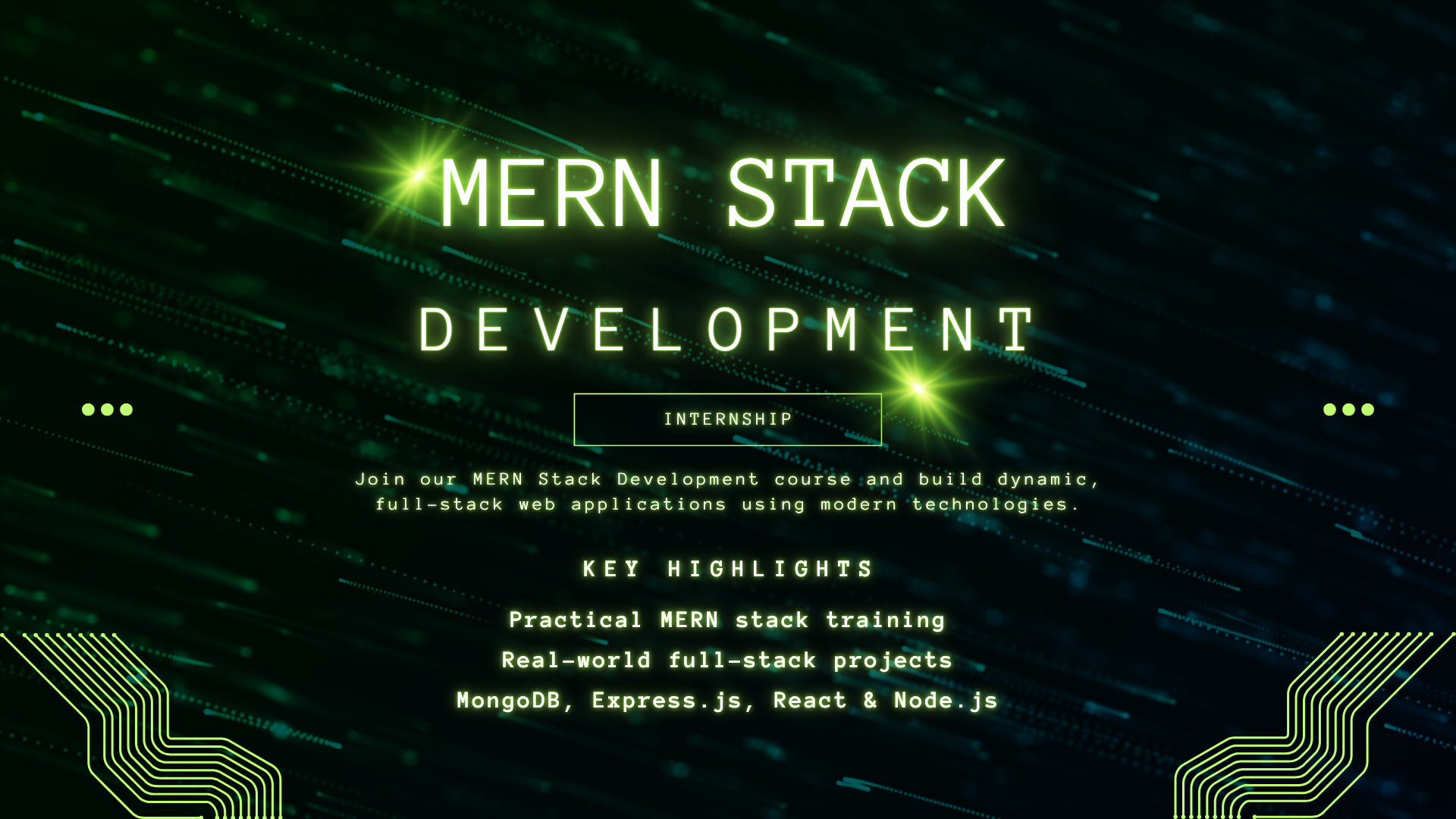
This 3-Month MERN Stack Developer Internship is a comprehensive and practical training program designed to transform beginners into job-ready full-stack web developers using the MERN stack — MongoDB, Express.js, React.js, and Node.js. The internship focuses on building strong frontend, backend, database, and problem-solving skills through structured learning and real-world project development.
The program follows a progressive learning approach, starting from core programming and web development fundamentals and gradually advancing toward scalable full-stack application development. Learners gain both conceptual understanding and hands-on implementation experience through coding exercises, assignments, quizzes, mini-projects, and industry-style capstone projects.
🚀 What This Internship Covers
The internship begins with the fundamentals of web development and modern JavaScript programming. Learners understand essential concepts such as variables, data types, operators, loops, arrays, objects, functions, DOM manipulation, ES6 features, asynchronous programming, promises, async/await, and API handling. This phase helps students develop strong logical thinking and coding confidence.
Once the JavaScript foundation is established, the program moves into frontend development using React.js. Students learn how to build interactive and responsive user interfaces using reusable components and modern frontend architecture.
Frontend topics include:
-
Components and JSX
-
Props and State Management
-
Event Handling
-
React Hooks
-
Forms and Validation
-
Conditional Rendering
-
Routing using React Router
-
API Integration
-
Reusable UI Structure
-
Responsive Design Basics
Learners also understand how frontend applications communicate with backend APIs and manage application flow in real-world projects.
The next phase focuses on backend development using Node.js and Express.js. Students learn how to build scalable server-side applications and RESTful APIs while understanding backend architecture and request handling.
Backend topics include:
-
REST API development
-
Routing and Middleware
-
Request and Response handling
-
Error handling
-
Authentication and Authorization basics
-
JWT authentication fundamentals
-
Backend project structuring
-
Environment configuration
-
API testing using Postman
Alongside backend development, learners gain practical experience with MongoDB, understanding how NoSQL databases work in modern applications. Students learn schema design, CRUD operations, relationships, validations, indexing basics, and database integration using Mongoose.
The internship also introduces learners to important development tools and workflows used in professional software development environments, including:
-
Git and GitHub for version control
-
Project structuring and clean code practices
-
Debugging and development workflows
-
Frontend-backend integration
-
Deployment fundamentals
-
Real-world development practices
As learners progress, they begin working on mini-projects and practical assignments to strengthen their understanding of full-stack development concepts.
In the final stage of the internship, students build a complete real-world MERN stack application such as an E-Commerce Platform, Task Management System, Learning Management System, Booking Application, or Social Media Backend System. This project includes frontend development, REST APIs, authentication, database integration, protected routes, and production-style application architecture.
🧠 Learning Approach
This internship is designed around hands-on implementation and continuous evaluation rather than theory-only learning. Every module includes:
-
Structured lessons and guided learning
-
Practical coding exercises
-
Real-world implementation examples
-
Assignments and mini-projects
-
Module-wise quizzes and assessments
-
Debugging and problem-solving practice
-
A final industry-style capstone project
The learning progression is sequential, ensuring learners build strong fundamentals before advancing toward complex full-stack development topics.
🏆 Skills You Will Gain
By the end of this internship, participants will be able to:
-
Write clean and modern JavaScript code
-
Build responsive frontend applications using React.js
-
Create scalable RESTful APIs using Node.js and Express.js
-
Work with MongoDB and Mongoose for database management
-
Implement authentication and authorization basics
-
Connect frontend and backend applications efficiently
-
Structure full-stack applications professionally
-
Use Git and GitHub for collaborative workflows
-
Debug and test full-stack applications
-
Build real-world MERN stack projects independently
🎯 Who This Internship is For
This internship is ideal for:
-
Beginners starting a career in web development
-
Students pursuing computer science or IT-related fields
-
Learners interested in full-stack application development
-
Developers wanting practical MERN stack experience
-
Students preparing for internships and placement opportunities
-
Anyone aiming to become a professional full-stack developer
No prior programming experience is required, though consistency, practice, and dedication are important for successful completion.
💼 Internship Outcome
Upon successful completion of this internship, learners will have strong practical experience in MERN stack development along with the ability to build complete full-stack web applications independently. They will also complete an industry-level project that can be showcased in portfolios, resumes, and interviews, significantly improving their readiness for internships, freelance opportunities, and junior full-stack developer roles in IT companies.
Course Content
Module 1: Web Development Fundamentals & JavaScript Mastery
-
How the Web Works (Client-Server Architecture & HTTP)
-
JavaScript Variables, Data Types & Operators
-
Functions & Scope in JavaScript
-
Arrays & Objects
-
ES6+ Features (Modern JavaScript)
-
Check what have you learnt about JavaScript & Web Basics
-
User Data Fetcher App
Module 2: Frontend Foundations – HTML, CSS, Responsive Design & Git
Module 3: JavaScript in Depth – DOM, Events & Async Programming
Module 4: React.js Fundamentals – Components, Props, State & Hooks
Module 5: Backend Development with Node.js & Express.js
Final Module : Capstone Project – Full MERN Stack Application
Earn a certificate
Add this certificate to your resume to demonstrate your skills & increase your chances of getting noticed.