6 Months MERN Stack Development Training & Internship

Categories: Training & Internship
Wishlist Share

About Course

This 6-Month MERN Stack Developer Internship is a comprehensive, industry-focused training program designed to transform beginners into job-ready full-stack developers using the MERN stack — MongoDB, Express.js, React.js, and Node.js. The internship emphasizes strong programming fundamentals, real-world application development, backend architecture, frontend engineering, and practical software development workflows used in modern IT companies.

The program follows a structured and progressive learning path, starting from core programming and web development fundamentals and gradually advancing toward enterprise-level full-stack application development. Learners gain both conceptual understanding and extensive hands-on experience through coding exercises, assignments, quizzes, mini-projects, debugging sessions, and industry-style capstone project development.

🚀 What This Internship Covers

The internship begins with the fundamentals of programming and modern web development using JavaScript. Learners build strong logical thinking and coding skills by understanding concepts such as variables, data types, operators, loops, arrays, objects, functions, DOM manipulation, ES6 features, asynchronous programming, promises, async/await, error handling, and API communication.

This foundational phase ensures students become comfortable with problem-solving and modern JavaScript development before moving into advanced full-stack technologies.

Once the fundamentals are established, the program transitions into frontend development using React.js, one of the most widely used frontend libraries in the industry. Students learn how to build scalable, dynamic, and responsive user interfaces using component-based architecture.

Frontend development topics include:

  • Components and JSX

  • Props and State Management

  • Event Handling

  • React Hooks

  • Forms and Validation

  • Conditional Rendering

  • Context API and state sharing

  • Routing using React Router

  • API Integration

  • Reusable UI Architecture

  • Responsive Design Principles

  • Frontend optimization basics

Learners also understand how professional frontend applications are structured and connected with backend services in real-world systems.

The next phase focuses on backend development using Node.js and Express.js, where students learn how server-side applications and APIs are built in production environments. Learners understand backend architecture, request-response lifecycle, middleware systems, and API structuring.

Backend topics include:

  • RESTful API development

  • Routing and Middleware

  • Authentication and Authorization

  • JWT Authentication

  • Role-based access concepts

  • Error Handling and Validation

  • File Upload Handling

  • Backend Architecture and Layered Structure

  • Environment Variables and Configuration

  • API Testing using Postman

  • Logging and Debugging

  • Security and backend best practices

Alongside backend development, students gain practical expertise in MongoDB, understanding how NoSQL databases work in modern scalable applications. Learners work with schema design, CRUD operations, validations, indexing basics, aggregation fundamentals, relationships, and database optimization concepts using Mongoose.

The internship also introduces learners to important software engineering tools and workflows used in professional development environments, including:

  • Git and GitHub for version control

  • Collaborative development workflows

  • Clean code practices

  • Project structuring and modular architecture

  • Debugging techniques

  • Deployment fundamentals

  • Application environment management

  • Real-world development practices

As learners progress through the program, they work on assignments, coding challenges, and mini-projects that strengthen their understanding of frontend, backend, and database integration.

In the advanced stages of the internship, students are introduced to concepts such as:

  • Scalable application architecture

  • API optimization basics

  • Secure authentication workflows

  • State management concepts

  • Reusable component architecture

  • Backend modularization

  • Production-level project structuring

  • Performance optimization fundamentals

In the final phase of the internship, learners build a complete industry-level MERN stack application such as an E-Commerce Platform, Learning Management System, Booking System, Social Media Application, Job Portal, or Multi-Role Management Platform.

The capstone project includes:

  • Responsive frontend development

  • RESTful API architecture

  • Authentication and authorization

  • Protected routes and role handling

  • Database integration

  • File upload functionality

  • Real-world backend workflows

  • Structured frontend-backend communication

  • Production-style application architecture

This project simulates real software development environments and gives learners practical exposure to professional full-stack development workflows.

🧠 Learning Approach

This internship is designed around practical implementation, real-world development practices, and continuous evaluation rather than theory-only learning. Every module includes:

  • Structured lessons and guided learning

  • Hands-on coding exercises

  • Real-world implementation examples

  • Assignments and mini-projects

  • Module-wise quizzes and assessments

  • Debugging and problem-solving sessions

  • Project-based learning

  • A final industry-level capstone project

The learning progression is sequential, ensuring learners build strong conceptual clarity before moving toward advanced full-stack development concepts.

🏆 Skills You Will Gain

By the end of this internship, participants will be able to:

  • Write clean and modern JavaScript code

  • Build responsive and scalable frontend applications using React.js

  • Develop RESTful APIs using Node.js and Express.js

  • Work with MongoDB and Mongoose professionally

  • Implement authentication and authorization systems

  • Structure scalable full-stack applications

  • Integrate frontend and backend efficiently

  • Manage application state and API communication

  • Use Git and GitHub for professional workflows

  • Debug and optimize full-stack applications

  • Understand production-level application architecture

  • Build complete real-world MERN stack projects independently

🎯 Who This Internship is For

This internship is ideal for:

  • Beginners starting a career in web development

  • Computer science and IT students

  • Learners interested in full-stack application development

  • Developers wanting strong MERN stack fundamentals

  • Students preparing for internships and placement opportunities

  • Anyone aiming to become a professional full-stack developer

No prior programming experience is required. However, consistency, dedication, and regular coding practice are essential for successful completion of the internship.

💼 Internship Outcome

Upon successful completion of this internship, learners will have strong practical expertise in MERN stack development and hands-on experience building production-style full-stack applications using modern development workflows and tools. They will also complete a portfolio-ready industry-level project that demonstrates their technical and problem-solving abilities, significantly improving their readiness for internships, freelance opportunities, and full-stack developer roles in IT companies.

Show More

Course Content

Module 1: Introduction to Web Development & JavaScript Fundamentals
This foundational module is designed to build a strong base for aspiring MERN stack developers by introducing them to the core concepts of web development and JavaScript programming. Students will begin by understanding how the web works, including the roles of browsers, servers, and HTTP protocols, which is crucial before diving into coding. The module then transitions into JavaScript, the backbone of the MERN stack, enabling students to write dynamic and interactive web applications. You will learn variables, data types, operators, control structures, and functions in depth. Understanding JavaScript fundamentals is essential because it is used across the entire MERN stack—from frontend (React) to backend (Node.js). By mastering these basics early, students will be able to confidently move into advanced topics like asynchronous programming, APIs, and frameworks. This module also emphasizes real-world usage, showing how JavaScript powers websites like dashboards, forms, and dynamic UI interactions. By the end of this module, students will be able to write clean, logical JavaScript code and understand how web applications function at a fundamental level. Additionally, this module prepares students for debugging, logical thinking, and problem-solving, which are essential skills in software development careers.

  • How the Web Works (Client-Server Architecture)
  • Introduction to JavaScript & Variables
  • Data Types and Operators
  • Control Structures (If-Else, Loops)
  • Functions in JavaScript
  • Check what have you learnt about JavaScript Fundamentals
  • Basic User Info App

Module 2: Advanced JavaScript & ES6+ Concepts
In this module, students will move beyond basic JavaScript and explore modern JavaScript (ES6+) features that are essential for building scalable and maintainable MERN stack applications. This module is crucial because modern frameworks like React and backend systems in Node.js heavily rely on ES6+ syntax and concepts. Students will learn about advanced topics such as arrow functions, destructuring, spread/rest operators, template literals, and modules. These features help developers write cleaner, shorter, and more readable code. Additionally, this module introduces asynchronous JavaScript, which is one of the most important concepts in web development. Students will understand callbacks, promises, and async/await—key tools used for handling API calls and database operations. Understanding asynchronous behavior is critical because most real-world applications involve fetching data from servers, processing user input, and performing background tasks. By the end of this module, students will be able to write modern JavaScript code, manage asynchronous operations, and structure their code efficiently for real-world applications.

Module 3: HTML5 & CSS3 – Building the Structure and Styling of Web Pages
In this module, students will learn how to build the visual and structural foundation of web applications using HTML5 and CSS3. Before diving into React and advanced frontend frameworks, it is essential to understand how web pages are created from scratch. HTML (HyperText Markup Language) is used to structure content on the web, while CSS (Cascading Style Sheets) is used to style and design that content. Together, they form the backbone of all web interfaces, including modern applications built with React. Students will learn how to create semantic, accessible, and SEO-friendly web pages using HTML5. They will also explore modern CSS techniques such as Flexbox and Grid, which are essential for responsive design. This module is highly practical and focuses on real-world UI development. You will understand how layouts are built, how responsiveness works across devices, and how professional websites achieve their design. By the end of this module, students will be able to build fully responsive web pages, style them professionally, and prepare layouts that can later be converted into React components.

Module 4: Git, GitHub & Version Control for Developers
In this module, students will learn how to manage and track their code using Git, a distributed version control system, and GitHub, a cloud-based platform for hosting repositories. Version control is a critical skill for any developer working in teams or even individually on real-world projects. Students will understand how to track changes, collaborate with other developers, manage code history, and avoid losing work. Git enables developers to revert to previous versions, create branches for new features, and merge changes safely. GitHub adds another layer by enabling collaboration through pull requests, issue tracking, and repository management. It is widely used in the industry and is often required knowledge for job roles. This module also introduces best practices such as commit messages, branching strategies, and resolving conflicts—skills essential for working in professional environments. By the end of this module, students will be able to confidently use Git and GitHub for personal and team projects, contributing to open-source or managing their own codebases.

Module 5: React.js Fundamentals – Building Dynamic Frontend Applications
In this module, students will begin working with React.js, one of the most popular JavaScript libraries for building modern user interfaces. React is a core part of the MERN stack and is widely used in industry-level applications like dashboards, SaaS platforms, and mobile-responsive web apps. Students will learn how React works using a component-based architecture, which allows developers to break down UI into reusable, independent pieces. This approach improves scalability, maintainability, and performance. The module introduces JSX (JavaScript XML), which allows writing HTML-like syntax inside JavaScript, making UI development more intuitive. Students will also understand how React renders components efficiently using the Virtual DOM. Additionally, this module covers props and state, which are essential for managing dynamic data and building interactive applications. By the end of this module, students will be able to create functional React applications, manage UI state, and build reusable components—laying the foundation for advanced frontend development.

Module 6: Advanced React – Hooks, Routing & State Management
In this module, students will advance their React skills by learning powerful concepts that are essential for building real-world, scalable frontend applications. While the previous module focused on fundamentals, this module dives into how React applications manage side effects, navigation, and complex state. Students will learn about React Hooks such as useEffect, useRef, and custom hooks, which allow functional components to handle lifecycle events, side effects, and reusable logic efficiently. The module also introduces React Router, which enables navigation between different pages without reloading the browser—an essential feature for Single Page Applications (SPAs). Additionally, students will explore state management techniques, including lifting state up and using Context API to manage global data across components. These concepts are widely used in production-level applications such as dashboards, SaaS platforms, and multi-page applications. By the end of this module, students will be able to build multi-page React applications, manage complex data flows, and write clean, scalable frontend code.

Module 7: Node.js Fundamentals – Backend Development Basics
In this module, students will transition from frontend development to backend development using Node.js, a powerful JavaScript runtime environment that allows developers to run JavaScript outside the browser. Understanding backend development is crucial because it handles business logic, database operations, authentication, and API creation—all essential parts of real-world applications. Students will learn how Node.js works internally, including its event-driven, non-blocking architecture, which makes it highly efficient and scalable for handling multiple requests. The module will also introduce core Node.js modules, file handling, and how to build basic servers using Node.js without frameworks. This module is important because Node.js forms the foundation for Express.js (which will be covered next), enabling students to build full-stack applications using a single language—JavaScript. By the end of this module, students will be able to create basic servers, handle requests, work with files, and understand how backend systems operate.

Module 8: Express.js – Building Scalable Backend APIs
In this module, students will learn Express.js, a minimal and flexible Node.js framework used to build robust backend APIs and web applications. While Node.js provides the core runtime, Express simplifies server creation, routing, middleware handling, and request/response management. Students will understand how to build RESTful APIs, which are essential for communication between frontend (React) and backend systems in MERN applications. Express.js is widely used in real-world applications such as e-commerce platforms, SaaS tools, and mobile app backends. This module focuses on structuring backend applications professionally, handling routes, managing middleware, and processing incoming requests. Students will also learn about request validation, error handling, and API best practices. By the end of this module, students will be able to build structured, scalable backend APIs that can handle real-world application logic and communicate effectively with frontend applications.

Module 9: MongoDB & Mongoose – Database Design and Integration
In this module, students will learn how to work with MongoDB, a NoSQL database widely used in MERN stack applications, and Mongoose, an Object Data Modeling (ODM) library that simplifies interactions with MongoDB. Unlike traditional relational databases, MongoDB stores data in flexible, JSON-like documents, making it ideal for modern applications where data structures may evolve over time. Students will understand how to design schemas, perform CRUD (Create, Read, Update, Delete) operations, and integrate MongoDB with a Node.js/Express backend. Mongoose provides a structured way to define schemas, enforce validation, and interact with the database efficiently. This is crucial for building scalable and maintainable applications. This module also emphasizes real-world practices like data modeling, relationships (referencing vs embedding), and performance considerations. By the end of this module, students will be able to design databases, connect backend APIs to MongoDB, and perform efficient data operations.

Module 10: Authentication, Authorization & Security in MERN Applications
In this module, students will learn how to implement authentication and authorization systems in MERN stack applications, which are critical for securing user data and controlling access to resources. Authentication is the process of verifying a user's identity (login/signup), while authorization determines what actions a user is allowed to perform (roles, permissions). Students will explore JWT (JSON Web Tokens), password hashing using bcrypt, and secure session handling. These are industry-standard practices used in real-world applications like e-commerce platforms, SaaS products, and social media apps. The module also covers backend security best practices such as protecting routes, validating user input, and preventing common vulnerabilities like XSS, CSRF, and injection attacks. Understanding security is essential because real-world applications deal with sensitive data, and poor security practices can lead to data breaches and system failures. By the end of this module, students will be able to build secure login systems, protect APIs, and implement role-based access control in MERN applications.

Module 11: Deployment, DevOps Basics & Performance Optimization
In this module, students will learn how to deploy MERN stack applications to production, making them accessible to real users over the internet. Building an application is only half the job—deploying, monitoring, and optimizing it is what makes it production-ready. Students will explore deployment platforms, environment configurations, and how frontend and backend are hosted together or separately. This includes understanding build processes, environment variables, and server configurations. The module also introduces DevOps basics, including CI/CD (Continuous Integration/Continuous Deployment), version-based deployments, and automation practices used in professional environments. Additionally, students will learn performance optimization techniques for both frontend and backend—such as caching, lazy loading, code splitting, and database optimization—to ensure fast and scalable applications. This module is essential because poorly deployed or slow applications can fail even if they are well-built. Industry-level developers must understand deployment pipelines and performance tuning. By the end of this module, students will be able to deploy full-stack applications, manage production environments, and optimize performance for real-world usage.

Final Module: Capstone Project – Full MERN Stack Application
This final module is designed to bring together everything learned throughout the internship into a complete, production-ready MERN stack application. Students will build a real-world project that demonstrates their ability to design, develop, secure, and deploy a full-stack application. This module simulates an industry-level development process, including planning, architecture design, database modeling, API development, frontend integration, authentication, and deployment. Students will not only build features but also follow best practices such as modular architecture, clean code, error handling, and scalability considerations. The goal is to make students job-ready by giving them hands-on experience in building a complex application similar to what is expected in real companies. By the end of this module, students will have a complete portfolio project that they can showcase to employers, demonstrating proficiency in the MERN stack.

Earn a certificate

Add this certificate to your resume to demonstrate your skills & increase your chances of getting noticed.
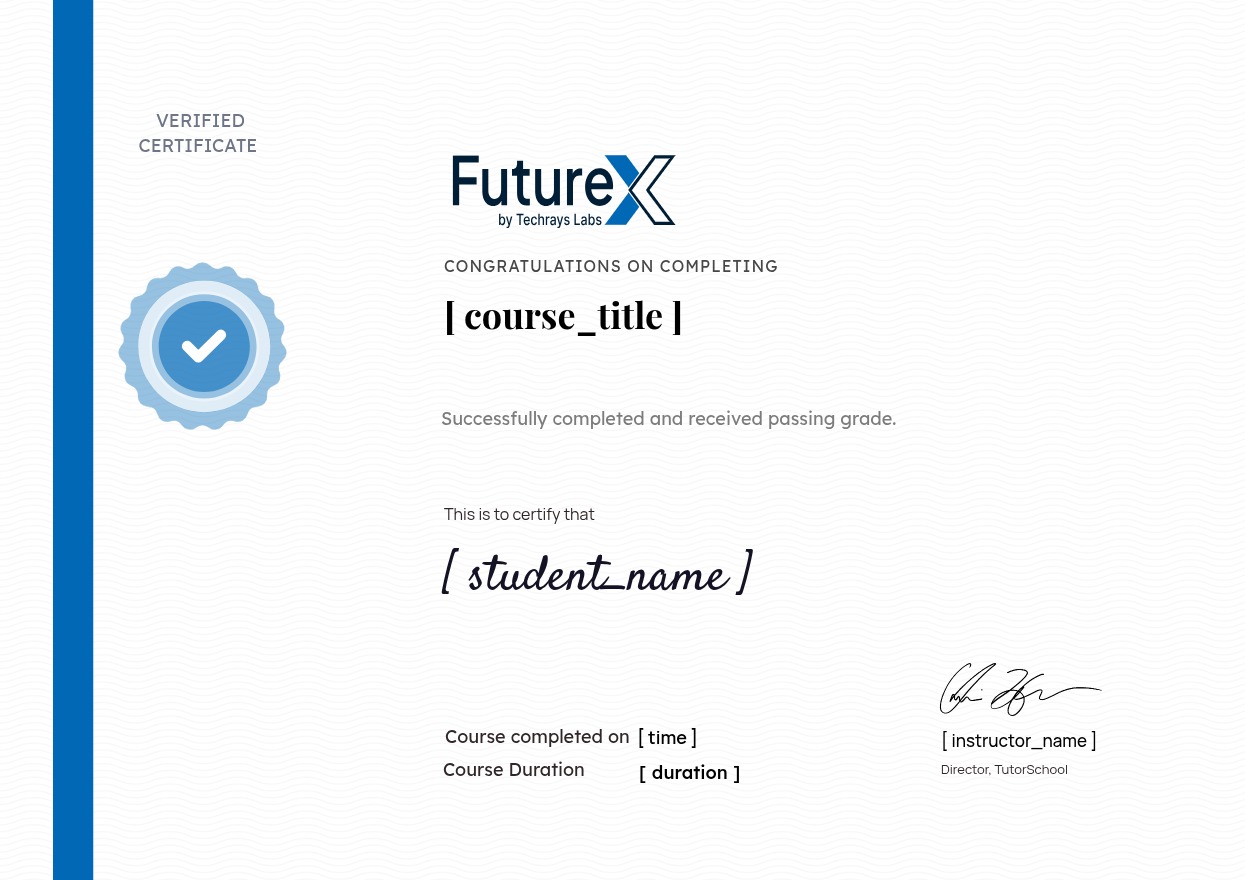
selected template

Student Ratings & Reviews

No Review Yet
No Review Yet