6 Months Python / Data Science Training & Internship

Categories: Training & Internship
Wishlist Share

About Course

This 6-month Python / Data Science Internship is a comprehensive, structured, and industry-oriented training program designed to transform beginners into job-ready Python developers and data science professionals with strong analytical thinking, programming expertise, and real-world data problem-solving skills.

The program follows a progressive learning approach, starting from Python programming fundamentals and gradually advancing toward professional data analysis, machine learning, and real-world data science project development. It is carefully designed to provide both conceptual clarity and hands-on practical experience through coding exercises, assignments, quizzes, mini-projects, datasets, and project-based learning.

The internship focuses heavily on practical implementation and real-world analytical workflows, ensuring learners gain the technical and problem-solving skills required for professional data science and Python development roles.

🚀 What This Internship Covers

The internship begins with the fundamentals of Python programming, where learners understand core concepts such as variables, data types, operators, loops, functions, conditional statements, and problem-solving techniques. This strong foundation ensures that even beginners with no prior programming experience can comfortably begin their Python development journey.

Once the basics are established, the program moves into Object-Oriented Programming (OOP) in Python, which is essential for writing scalable and maintainable applications. Learners gain deep understanding of classes, objects, inheritance, polymorphism, encapsulation, abstraction, modules, packages, and reusable code structures. These concepts are reinforced through practical coding examples and hands-on exercises.

Next, students are introduced to Data Structures and Algorithms, where they learn how to efficiently organize and process data using:

  • Lists
  • Tuples
  • Dictionaries
  • Sets
  • Stacks
  • Queues
  • Searching and sorting algorithms
  • Problem-solving techniques

Alongside this, learners gain hands-on experience with SQL and relational databases, learning how to:

  • Perform CRUD operations
  • Write SQL queries
  • Work with joins
  • Normalize data
  • Handle structured datasets
  • Perform database-driven analysis

The internship then transitions into Data Analysis using Python libraries such as:

  • NumPy for numerical computing
  • Pandas for data manipulation
  • Matplotlib for visualization
  • Seaborn for advanced data plotting

Students learn how to clean, process, transform, and visualize real-world datasets while understanding exploratory data analysis (EDA), missing data handling, statistical analysis, and feature engineering techniques.

As learners progress, they move into Machine Learning, one of the most in-demand areas in data science. Students gain practical understanding of:

  • Supervised learning
  • Unsupervised learning
  • Regression models
  • Classification models
  • Clustering algorithms
  • Model evaluation techniques
  • Feature selection
  • Hyperparameter tuning

Learners work extensively with Scikit-learn and understand how machine learning models are trained, tested, evaluated, and improved for production-level performance.

The internship also introduces learners to advanced data science workflows including:

  • Data preprocessing pipelines
  • Model optimization
  • Cross-validation
  • Performance metrics
  • Data storytelling
  • Business decision analysis
  • Practical problem-solving using datasets

In the final phase, learners apply everything they have learned by building a complete real-world Data Science project such as:

  • Customer Churn Prediction System
  • Sales Forecasting Dashboard
  • House Price Prediction Model
  • Student Performance Analyzer
  • Stock Market Trend Analysis
  • Recommendation System
  • Fraud Detection System

The final project includes:

  • Real dataset handling
  • Data cleaning and preprocessing
  • Visualization dashboards
  • Machine learning model training
  • Model evaluation
  • Performance optimization
  • Analytical reporting and insights presentation

This project simulates professional data science environments and helps learners gain real industry experience.

🧠 Learning Approach

This internship is not just theory-based; it is designed around practical implementation, coding practice, and continuous evaluation.

Each module includes:

  • Structured video/text lessons
  • Real-world coding examples
  • Hands-on Python exercises
  • Dataset-based assignments
  • Module-wise quizzes to test understanding
  • Mini-projects for practical implementation
  • Machine learning implementation practice
  • A final capstone project

Progression is strictly sequential, meaning learners must successfully complete quizzes and assessments before unlocking the next module. This ensures strong conceptual understanding before moving toward advanced analytical and machine learning concepts.

The internship also emphasizes modern professional practices such as:

  • Clean and efficient Python coding
  • Analytical problem-solving
  • Data-driven decision making
  • Model evaluation and optimization
  • Data storytelling and reporting
  • Industry-standard workflow structuring
  • Real-world project implementation

🏆 Skills You Will Gain

By the end of this internship, participants will be able to:

  • Write clean and efficient Python programs
  • Understand and apply Object-Oriented Programming principles
  • Work with data structures for analytical problem-solving
  • Design and manage relational databases using SQL
  • Perform professional data analysis using Pandas and NumPy
  • Visualize data using Matplotlib and Seaborn
  • Clean and preprocess real-world datasets
  • Build and evaluate machine learning models
  • Understand supervised and unsupervised learning techniques
  • Optimize and improve model performance
  • Extract insights from business datasets
  • Build complete data science projects
  • Present analytical findings professionally
  • Work on real-world data science workflows

🎯 Who This Internship is For

This program is ideal for:

  • Beginners who want to start a career in Python development or data science
  • Students pursuing computer science, statistics, mathematics, or IT-related fields
  • Developers looking to strengthen analytical and machine learning skills
  • Professionals transitioning into data science roles
  • Anyone aiming for Python developer, data analyst, or data scientist roles in IT companies

No prior programming experience is required, but consistency, logical thinking, and regular practice are essential for successful completion.

💼 Internship Outcome

Upon completion of this internship, learners will have practical experience in Python programming, data analysis, and machine learning development, and will be capable of building production-level data-driven applications and analytical solutions.

They will also complete a strong portfolio-ready capstone project that can be showcased to employers, universities, freelance clients, or recruiters, significantly improving their chances of securing internships, freelance opportunities, and entry-level roles in Python development, data analytics, and data science.

Show More

Course Content

Module 1: Introduction to Python Programming
This module introduces students to Python, one of the most widely used programming languages in software development, automation, and data science. Students will learn the foundational building blocks of Python, including syntax, variables, data types, operators, and user input/output. This module is designed for absolute beginners, so no prior programming experience is required. Python is important because it is easy to learn, highly readable, and used in real-world domains such as web development, machine learning, data analysis, scripting, and automation. A strong understanding of Python fundamentals is essential before moving into advanced topics like data manipulation, machine learning, and real-world data science workflows. By the end of this module, students will be able to write simple Python programs, understand how Python executes instructions, store and manipulate data, and solve beginner-level programming problems. This module builds the mental foundation required for every technical concept that follows in the internship. Students will also begin thinking like programmers by understanding how to break problems into logical steps and translate them into code. These skills are critical not just in Python, but across all programming and data science careers.

  • Getting Started with Python
  • Variables and Data Types
  • Operators in Python
  • Check what have you learnt about Python Fundamentals Quiz
  • Basic Python Calculator

Module 2: Control Flow and Functions in Python
This module teaches students how to control the flow of execution in Python programs and how to organize reusable logic using functions. Up to this point, students have written linear code where each line runs one after another. Real programs do not work like that. They make decisions, repeat tasks, and execute specific logic only when needed. That is what control flow handles. Students will learn how Python makes decisions using conditional statements such as if, elif, and else, and how repetitive tasks are handled efficiently using loops like for and while. These concepts are fundamental because nearly every real-world program depends on conditions and repetition. The module also introduces functions, one of the most important concepts in programming. Functions allow developers to group logic into reusable blocks, reduce duplication, and write cleaner, more maintainable code. This is how professional codebases are structured. Understanding control flow and functions is critical in automation, scripting, backend development, and data science. Whether filtering records, validating user input, looping through datasets, or building reusable analytics logic, these concepts are used everywhere. By the end of this module, students will be able to write programs that make decisions, repeat tasks intelligently, and organize logic into reusable function blocks. This is the point where students stop writing simple scripts and start writing structured programs.

Module 3: Data Structures in Python
This module introduces Python’s core data structures, which are used to store, organize, and manipulate collections of data efficiently. Until now, students have worked with single values stored in variables. Real-world applications rarely deal with one value at a time. They process groups of values such as lists of users, sets of unique records, dictionaries of structured information, and tuples of fixed data. Students will learn the four primary built-in Python data structures: Lists, Tuples, Sets, and Dictionaries. These structures form the backbone of almost every Python program, especially in data science where data is rarely singular. Whether reading datasets, storing configurations, grouping records, or counting values, data structures are used constantly. Understanding when and why to use each structure is critical. Each one behaves differently, stores data differently, and solves different types of problems. Choosing the wrong data structure leads to inefficient, confusing, or error-prone code. This module is essential because data science depends heavily on organizing raw information into usable structures before analysis can begin. Students will learn how to store multiple values, access elements, modify collections, and use data structures effectively in real-world scenarios. By the end of this module, students will be able to select the correct data structure based on the use case, manipulate grouped data efficiently, and write more practical and scalable Python programs.

Module 4: File Handling and Exception Handling in Python
This module teaches students how Python works with external files and how to handle runtime errors safely. Until now, all programs have worked only in memory and only while the program is running. Real-world applications do not work like that. They read from files, write reports, store logs, load datasets, and recover from failures. This is where file handling and exception handling become essential. Students will learn how to create, read, write, append, and manage files using Python. File handling is a critical skill because data science workflows constantly interact with CSV files, text files, logs, reports, and configuration files. A program that cannot read or store data outside memory is not useful in production. This module also introduces exception handling, which is how Python prevents programs from crashing when something goes wrong. Errors happen constantly in real-world systems: files may be missing, user input may be invalid, calculations may fail, and external data may be corrupted. Exception handling allows programs to fail safely and recover cleanly. These concepts are heavily used in automation, ETL pipelines, reporting systems, backend systems, and data science workflows. Students will learn how to build programs that not only work, but also handle failure properly. By the end of this module, students will be able to work with files confidently, store and retrieve data externally, and write more robust Python programs that handle errors safely and professionally.

Module 5: Object-Oriented Programming (OOP) in Python
This module introduces Object-Oriented Programming (OOP), one of the most important programming paradigms used in professional software development. Until now, students have written procedural code where logic is executed step by step. That works for small programs, but it becomes difficult to manage as applications grow. OOP solves this by organizing code into reusable, structured objects. Object-Oriented Programming is based on the concept of objects, which combine data (attributes) and behavior (methods) into one logical unit. This makes code more modular, reusable, and easier to maintain. Students will learn how to create classes and objects, how constructors initialize data, and how core OOP principles like encapsulation, inheritance, polymorphism, and abstraction work in Python. OOP is heavily used in backend development, software engineering, automation systems, and data modeling. In data science, OOP is useful when building reusable pipelines, custom tools, ML workflows, and structured application logic. This module is critical because most real-world Python systems are not written as loose scripts. They are built using structured classes and reusable objects. Students must understand OOP to write scalable, maintainable code. By the end of this module, students will be able to design reusable classes, model real-world systems using objects, and write cleaner, more scalable Python applications.

Module 6: NumPy for Numerical Computing
This module introduces NumPy, the foundational numerical computing library in Python and one of the most important tools in the entire data science ecosystem. Until now, students have worked with Python’s built-in data structures such as lists and dictionaries. Those are useful for general programming, but they are inefficient for large-scale numerical operations. NumPy solves that problem. NumPy provides a powerful object called the ndarray (N-dimensional array), which is designed for fast and memory-efficient numerical computation. It allows data scientists to store large numeric datasets and perform mathematical operations far more efficiently than standard Python lists. This module is critical because almost every major data science library—Pandas, Scikit-learn, Matplotlib, TensorFlow—either depends on NumPy directly or is built on top of it. If students do not understand NumPy, they will struggle with real data science workflows. Students will learn how NumPy arrays work, how they differ from Python lists, how mathematical operations are vectorized, and how indexing, slicing, reshaping, and statistical operations are performed. By the end of this module, students will be able to work with numerical datasets efficiently, perform high-speed array operations, and build the numerical foundation required for data analysis, machine learning, and scientific computing.

Module 7: Pandas for Data Analysis
This module introduces Pandas, the most important Python library for data manipulation and analysis. If NumPy is the numerical foundation of data science, Pandas is the practical data handling layer built on top of it. It is the primary tool used for reading, cleaning, transforming, analyzing, and preparing structured data. In real-world data science, raw data rarely arrives in a clean or usable format. It comes in CSV files, Excel sheets, JSON APIs, SQL exports, and inconsistent records. Pandas is the tool used to convert that raw data into something analyzable. Students will learn how to work with Pandas Series and DataFrames, which are the core data structures used for tabular data analysis. They will learn how to load datasets, inspect data, clean missing values, filter records, transform columns, and generate meaningful summaries. Pandas is one of the most important libraries in data science because nearly every data workflow begins with it. Before machine learning, before visualization, before statistical modeling—data must first be loaded, cleaned, and structured. By the end of this module, students will be able to manipulate real-world datasets confidently, clean messy records, transform structured data, and perform practical exploratory analysis using Pandas.

Module 8: Data Visualization with Matplotlib and Seaborn
This module teaches students how to visualize data using Python, which is one of the most critical parts of data analysis and data science. Raw numbers are difficult to interpret at scale. Visualization converts data into understandable visual patterns, making trends, anomalies, and relationships easier to detect. Students will learn how to create charts using Matplotlib and Seaborn, the two most widely used Python libraries for data visualization. Matplotlib provides low-level plotting control and is the foundation of most Python visualizations. Seaborn is built on top of Matplotlib and provides cleaner statistical visualizations with less code. Visualization is essential because decision-makers rarely consume raw tables. They rely on graphs, charts, dashboards, and visual summaries to understand data quickly. Whether analyzing business metrics, customer trends, model performance, or survey responses, visualizations are central to communication. This module covers plotting basics, line charts, bar charts, histograms, scatter plots, and statistical visualizations. Students will also learn how to customize plots for readability and professional presentation. By the end of this module, students will be able to transform raw datasets into meaningful visual insights and present analytical findings clearly and professionally.

Module 9: Statistics for Data Science
This module introduces the statistical foundations required for practical data science. Writing code and using libraries is not enough. Data science depends on interpreting data correctly, and that requires statistics. Without statistical understanding, students can generate numbers and charts but fail to extract valid conclusions. Statistics is the mathematical framework used to summarize data, measure variability, detect relationships, and make decisions under uncertainty. In real-world data science, statistics is used in exploratory analysis, business reporting, A/B testing, forecasting, machine learning, and model evaluation. Students will learn descriptive statistics, probability basics, distributions, correlation, and hypothesis testing. These concepts are essential because nearly every data science workflow depends on them. This module is important because statistics turns raw numerical output into meaningful insight. It is what separates simple reporting from actual analytical reasoning. By the end of this module, students will be able to summarize datasets statistically, interpret distributions, measure relationships, and understand the statistical reasoning behind data-driven decisions.

Module 10: Machine Learning Fundamentals
This module introduces Machine Learning (ML), the field of building systems that learn patterns from data and make predictions or decisions without being explicitly programmed for every rule. This is where data science begins to move beyond analysis into prediction and automation. Machine learning is one of the most important domains in modern technology. It powers recommendation systems, fraud detection, customer segmentation, search engines, demand forecasting, predictive maintenance, and intelligent automation. Students will learn what machine learning is, how it differs from traditional programming, the core workflow of an ML project, and the most important supervised learning algorithms used in beginner-level predictive modeling. This module focuses on the practical foundations students need before moving into real model building. It introduces training data, features, labels, model fitting, prediction, and evaluation. Machine learning is critical because most real-world data systems do not stop at reporting what happened. They attempt to predict what will happen next. That is the role of ML. By the end of this module, students will understand how machine learning works, how models are trained, how predictions are generated, and how model performance is evaluated in practical business scenarios.

Module 11: Final Capstone Project – End-to-End Data Science Project
This final module is the capstone of the internship and combines everything learned across the previous modules into one complete real-world data science workflow. This is not a toy exercise. It is a full practical project designed to simulate how data science work is actually executed in professional environments. Students will take a real-world business problem, collect and process data, clean and analyze it, visualize patterns, apply statistics, and build a machine learning model to solve the problem. This mirrors the actual lifecycle followed in analytics teams, product teams, and machine learning workflows. The purpose of this module is to force practical integration. Most learners understand concepts separately but fail when required to connect them into one working pipeline. This module removes that gap. Students will build a complete end-to-end project using Python, NumPy, Pandas, Matplotlib, Seaborn, Statistics, and Scikit-learn. Every major concept from the internship will be used in one structured implementation. By the end of this module, students will be able to execute a full data science project independently, structure their workflow professionally, and build a portfolio-grade project suitable for interviews, internships, and client demonstrations.

Earn a certificate

Add this certificate to your resume to demonstrate your skills & increase your chances of getting noticed.
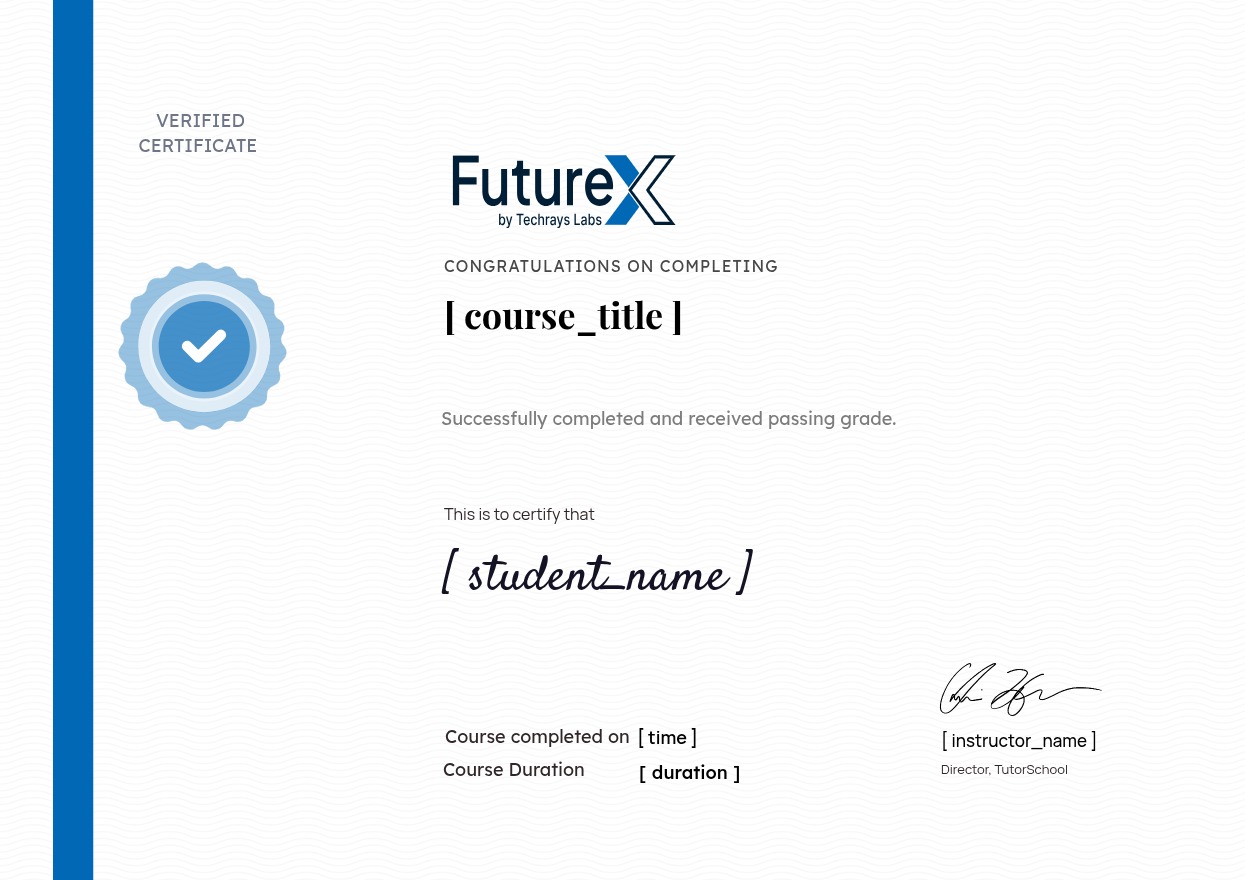
selected template

Student Ratings & Reviews

No Review Yet
No Review Yet