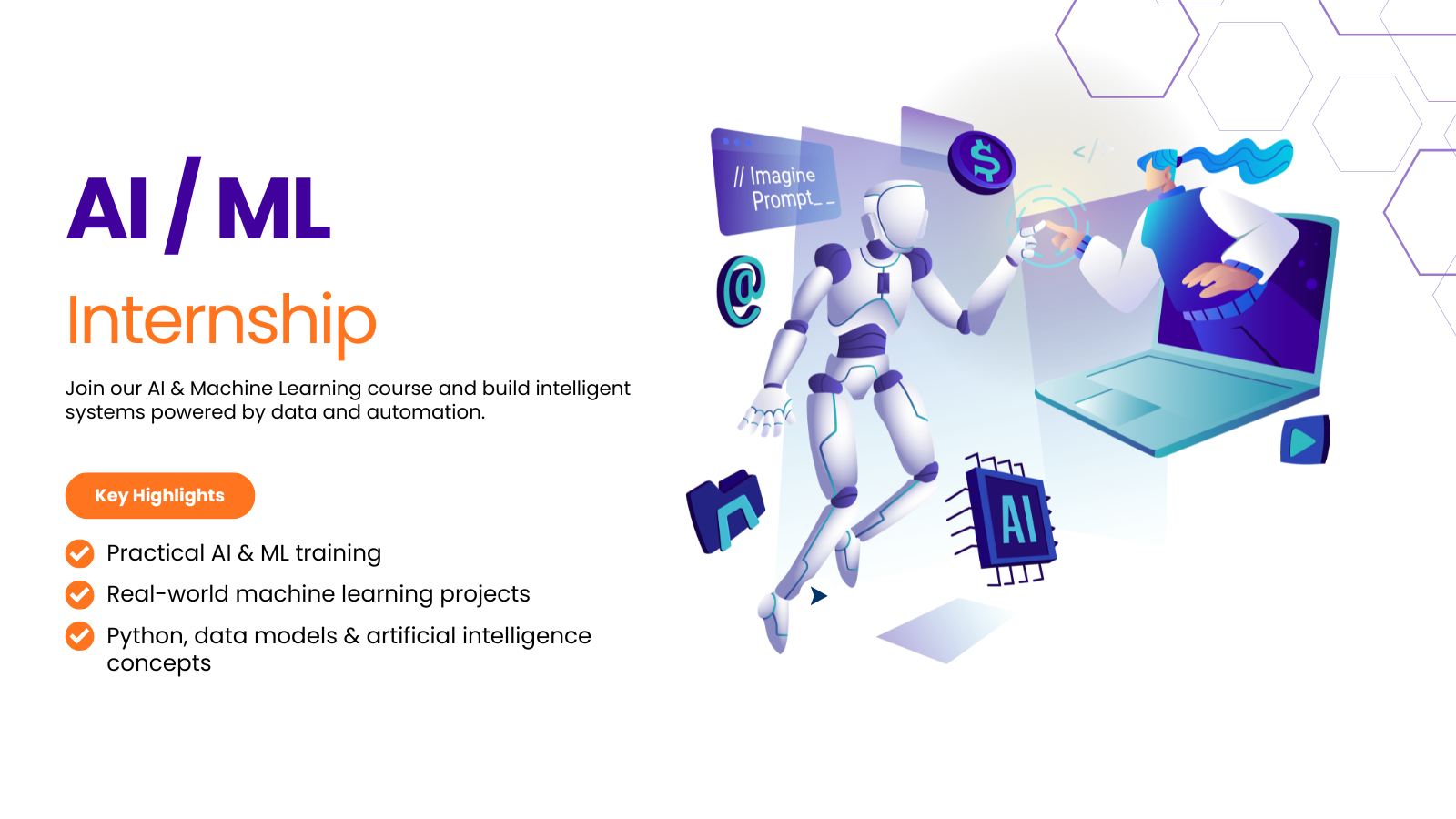
6 Months AI / ML Training & Internship

Categories: Training & Internship
Wishlist Share

About Course

The 6-Month AI/ML Internship is a comprehensive professional training program focused on advanced Artificial Intelligence, Machine Learning engineering, intelligent analytics systems, and production-ready AI application development.

This internship is designed to simulate real-world AI industry workflows where participants work on large-scale projects, deployment systems, intelligent automation, and collaborative development practices.

The program combines machine learning, deep learning fundamentals, deployment workflows, analytics systems, and production AI engineering into one structured learning experience.

🚀 What This Internship Covers

The internship starts with strengthening Advanced Python, Data Science, and Machine Learning concepts, creating a strong technical foundation for scalable AI systems.

Learners then move into Advanced Predictive Analytics, working on forecasting systems, recommendation engines, risk prediction models, and intelligent analytics dashboards.

The program introduces Deep Learning Fundamentals, including:

  • Neural Networks
  • TensorFlow/PyTorch basics
  • Image and text-based AI systems
  • Deep learning workflows

Participants also work on Natural Language Processing (NLP) and intelligent automation systems such as:

  • Chatbots
  • Resume screening systems
  • Sentiment analysis
  • AI recommendation engines

The internship includes Full AI Deployment Workflows, where learners:

  • Build Flask/FastAPI APIs
  • Deploy ML models
  • Monitor AI systems
  • Work with cloud deployment concepts

Students also learn Production AI Practices, including:

  • Model optimization
  • Workflow management
  • AI system architecture
  • Team-based development

In the final stage, participants complete a Major Industry-Level Capstone Project simulating real AI product development.

🧠 Learning Approach

This internship follows a highly practical and professional execution-based learning model including:

  • Industry-oriented projects
  • Real-world datasets
  • AI deployment workflows
  • Team-based project development
  • Code reviews and optimization
  • Continuous assessments
  • Portfolio and capstone development

The focus is on creating job-ready AI engineers through implementation-heavy learning.

🏆 Skills You Will Gain

By the end of this internship, learners will be able to:

  • Build production-ready AI systems
  • Develop advanced machine learning pipelines
  • Work with deep learning fundamentals
  • Create intelligent analytics dashboards
  • Deploy scalable AI applications
  • Build NLP-based systems
  • Optimize and monitor AI models
  • Understand professional AI workflows

🎯 Who This Internship is For

This internship is ideal for:

  • Serious AI/ML learners
  • Engineering and Computer Science students
  • Aspiring AI Engineers and Data Scientists
  • Developers transitioning into AI
  • Freelancers and professionals building AI expertise

Basic Python and machine learning knowledge is strongly recommended.

💼 Internship Outcome

After completing this internship, participants will have strong industry-level AI development experience and the ability to build, deploy, and manage real-world AI applications confidently. They will also complete multiple portfolio projects and a capstone AI system suitable for professional opportunities in AI, Data Science, and Machine Learning engineering.

Show More

Course Content

Module 1: Introduction to Artificial Intelligence, Machine Learning & Python Foundations
This module establishes the technical and conceptual foundation required for the entire AI / ML internship. Students begin by understanding what Artificial Intelligence (AI), Machine Learning (ML), and Deep Learning actually mean, how they differ, and why they are used across industries. Most beginners use these terms interchangeably and incorrectly, so this module fixes that first. Students will also learn why Python is the dominant programming language in AI and ML, and how its simplicity, readability, and massive ecosystem make it ideal for intelligent systems development. Before building models, students need clean logic, programming discipline, and the ability to think computationally. The module then introduces Python fundamentals specifically from an AI/ML perspective. Instead of generic programming theory, students learn Python in the context of data handling, automation, and model preparation. They will write practical code, understand syntax, variables, control flow, functions, and data structures that are used constantly in machine learning workflows. This module is important because most failures in AI/ML learning happen due to weak fundamentals, not advanced algorithms. Students who skip the basics struggle later with data preprocessing, model logic, debugging, and implementation. By the end of this module, students will clearly understand the AI ecosystem, the ML workflow, and possess enough Python fundamentals to start writing real machine learning code confidently.

  • Understanding AI, ML, and Deep Learning
  • Applications of AI and Machine Learning
  • Why Python for AI and Machine Learning
  • Python Basics for AI – Variables, Data Types, and Operators
  • Check what have you learnt about AI / ML Fundamentals and Python Basics
  • AI Career Explorer

Module 2: Python Programming for Machine Learning
This module moves from basic Python familiarity into practical Python programming used in machine learning workflows. Students stop treating Python as a beginner scripting language and start using it as a data-processing and logic-building tool for real AI systems. Machine learning is not just about training models. Most of the work happens before model training: cleaning data, organizing logic, writing reusable functions, handling edge cases, and structuring workflows. This is where weak Python skills break ML projects. Students will learn the Python constructs that are used constantly in AI/ML engineering: control flow, loops, functions, error handling, file handling, list comprehensions, and modular code. These are not taught as generic software concepts, but specifically in the context of preparing data and writing machine learning pipelines. This module is critical because machine learning code is mostly data manipulation code. Students who cannot structure Python properly cannot preprocess datasets, automate experiments, debug pipelines, or build scalable ML systems. By the end of this module, students will be able to write structured Python programs for data workflows, build reusable logic, read files, handle errors, and create clean code that is ready for ML tasks.

Module 3: Mathematics for Artificial Intelligence and Machine Learning
Mathematics is the operational backbone of AI and machine learning. Models do not “think”; they compute. Every prediction, optimization step, and learning update in machine learning is driven by mathematics. Students who ignore math eventually fail when models become more than copy-paste code. This module builds the mathematical foundation required to understand how machine learning actually works under the hood. Instead of treating algorithms as black boxes, students will learn the mathematical logic behind data representation, model behavior, optimization, and prediction. The module introduces the core mathematical domains used in AI/ML: linear algebra, statistics, probability, and calculus. These are not taught as academic theory. They are taught as practical tools used in feature representation, data analysis, model training, and optimization. Students will understand how data becomes vectors, how probability drives uncertainty, how statistics describes data, and how calculus helps models learn through optimization. This module is critical because machine learning without mathematical understanding turns into blind tool usage. Students who understand the math can debug models, interpret behavior, optimize performance, and move beyond beginner-level implementation. By the end of this module, students will understand the mathematical foundations behind machine learning and be able to interpret the numerical logic used by real ML systems.

Module 4: Data Handling and Preprocessing for Machine Learning
Raw data is almost never usable for machine learning. Real-world data is incomplete, inconsistent, noisy, duplicated, and often structurally broken. This module teaches students how to convert raw data into machine-learning-ready data. Most beginners assume machine learning starts with model training. It does not. In practical ML, data preprocessing consumes most of the project time because models are only as good as the data fed into them. Students will learn how to load datasets, inspect structure, clean missing values, handle duplicates, transform categorical data, scale numeric values, and prepare data for machine learning models. This module introduces the real work behind successful ML systems. This is one of the most important modules in the internship because poor preprocessing produces bad models regardless of algorithm quality. Students who skip preprocessing never understand why models fail. By the end of this module, students will be able to load, inspect, clean, transform, and prepare datasets for machine learning in a structured and reliable way.

Module 5: Data Visualization and Exploratory Data Analysis (EDA)
Before building machine learning models, data must be visually understood. Raw tables hide patterns. Visualization exposes them. Exploratory Data Analysis (EDA) is the process of investigating datasets using statistical summaries and visual techniques to identify trends, relationships, anomalies, and structure. This module teaches students how to inspect data visually before training any model. This is critical because many ML failures are caused by hidden problems in data: skewed distributions, outliers, imbalance, leakage, weak correlations, and irrelevant features. Students will learn how to use Matplotlib and Seaborn to create meaningful visualizations and how to interpret those visuals correctly in an ML context. Visualization is not decoration. It is diagnostic analysis. This module is one of the most important practical steps in machine learning because EDA directly influences preprocessing choices, feature engineering decisions, and model selection. By the end of this module, students will be able to visually inspect datasets, identify meaningful patterns, detect issues early, and make informed machine learning decisions based on evidence rather than assumptions.

Module 6: Supervised Machine Learning – Regression and Classification
This module introduces the first actual machine learning models students will build: supervised learning models. In supervised learning, the model learns from labeled data, meaning both input features and correct outputs are already known during training. This is the most important practical entry point into machine learning because it teaches how models learn patterns from historical data and use those patterns to make future predictions. Students will learn the two major categories of supervised learning: regression and classification. Regression is used when the output is numeric, such as salary prediction or sales forecasting. Classification is used when the output is categorical, such as spam detection or disease classification. This module teaches not only how to train these models, but how to understand what they are doing, when to use them, how to evaluate them, and where beginners make mistakes. By the end of this module, students will be able to build supervised learning models, understand regression vs classification, train models using Scikit-learn, and evaluate prediction quality using appropriate metrics.

Module 7: Unsupervised Learning and Clustering
Not all machine learning problems come with labeled data. In many real-world scenarios, there is no target column, no known output, and no predefined answer. This is where unsupervised learning becomes necessary. Unsupervised learning is used when the model must analyze data and discover hidden patterns without labeled outcomes. Instead of predicting known answers, the system identifies structure, grouping, similarity, and hidden relationships inside raw data. This module introduces unsupervised learning with a strong focus on clustering, one of the most widely used unsupervised learning techniques. Clustering is used to group similar data points together based on patterns and similarity. Students will learn how unsupervised learning differs from supervised learning, how clustering works internally, where it is used in business, and how to implement clustering models using Scikit-learn. By the end of this module, students will be able to understand unlabeled learning problems, build clustering models, interpret grouped data, and apply unsupervised learning for segmentation and pattern discovery.

Module 8: Feature Engineering and Model Optimization
Machine learning performance is rarely limited by algorithm choice alone. In real-world systems, model quality depends heavily on feature quality and optimization strategy. A weak model with strong features often outperforms a strong model with poor features. This module teaches students how to improve machine learning performance beyond basic model training. Students will learn how to create better input features, remove weak ones, reduce overfitting, tune model parameters, and improve generalization. Feature engineering is the process of transforming raw data into better signals for learning. Model optimization is the process of improving performance through tuning and validation. This is where machine learning becomes engineering instead of just running algorithms. Students move beyond default models and start improving performance deliberately. By the end of this module, students will be able to engineer useful features, select strong predictors, reduce overfitting, tune hyperparameters, and systematically improve model quality.

Module 9: Model Deployment and ML in Production
Building a machine learning model is not the end of the workflow. A model becomes useful only when it is deployed into a real system where users, applications, or business processes can interact with it. Model deployment is the process of making a trained machine learning model available for real-world use. This means converting a trained model into a usable service, exposing it through APIs, integrating it with applications, and ensuring it performs reliably in production. This module teaches students how machine learning moves from notebooks into production systems. Students will learn how to save trained models, load them in applications, build prediction APIs, and understand the operational challenges of production ML. This is the transition from machine learning experimentation to machine learning engineering. Students stop building models only for notebooks and start building systems that can serve predictions. By the end of this module, students will be able to package ML models, serve them through APIs, understand inference workflows, and deploy practical machine learning systems.

Module 10: Deep Learning Fundamentals
Traditional machine learning works well for structured data, but many modern AI problems involve images, audio, language, and highly complex patterns where conventional models struggle. This is where deep learning becomes necessary. Deep learning is a subset of machine learning built on artificial neural networks. These models are inspired by the structure of the human brain and are designed to learn complex patterns automatically from large amounts of data. This module introduces the foundations of deep learning, including neural networks, neurons, layers, activation functions, forward propagation, and backpropagation. These concepts form the core of modern AI systems such as image recognition, speech systems, recommendation engines, and language models. Students will learn how deep learning differs from traditional machine learning, how neural networks process information, and how to build basic neural networks using TensorFlow and Keras. By the end of this module, students will understand the foundations of neural networks, build simple deep learning models, and understand how modern AI systems learn complex representations.

Final Module: End-to-End AI / ML Capstone Project
This final module combines everything learned throughout the internship into one complete end-to-end real-world AI / ML project. Students will move beyond isolated exercises and build a full machine learning system from raw data to deployable prediction service. This module is designed to simulate how real machine learning projects are executed in production environments. It covers problem framing, data collection, preprocessing, exploratory analysis, feature engineering, model building, evaluation, optimization, deployment, and project presentation. The purpose of this module is not to teach one more isolated concept. The purpose is to force integration. Students must apply the full machine learning pipeline in one coherent project and justify every technical decision. This capstone is structured like a real production project, not a classroom toy example. Students must think like ML engineers: define the problem, build a reliable system, evaluate performance, and expose the model for real-world use. By the end of this module, students will have a portfolio-grade AI / ML project demonstrating practical capability across the complete machine learning lifecycle.

Earn a certificate

Add this certificate to your resume to demonstrate your skills & increase your chances of getting noticed.
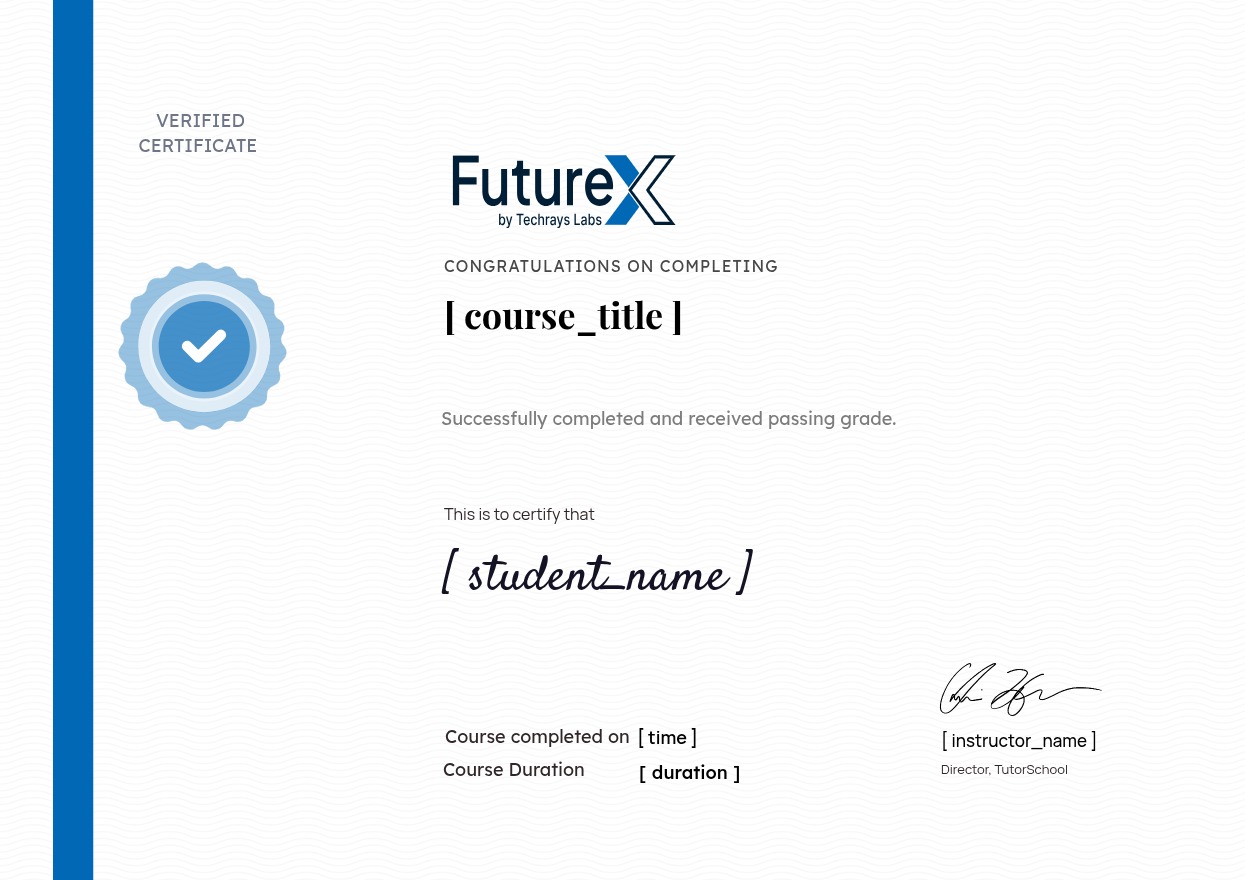
selected template

Student Ratings & Reviews

No Review Yet
No Review Yet