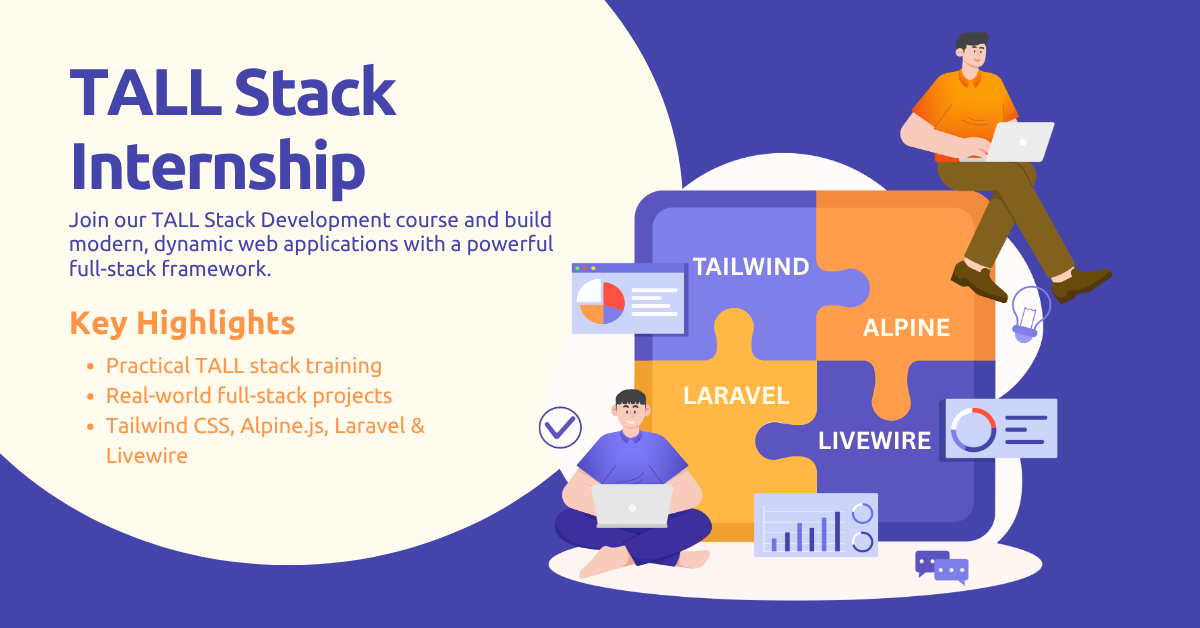
6 Months TALL Stack Training & Internship

Categories: Training & Internship
Wishlist Share

About Course

This 6-month TALL Stack Internship is a comprehensive, structured training program designed to transform beginners into job-ready full-stack developers with strong problem-solving, application architecture, and modern web development skills using the TALL Stack ecosystem — Tailwind CSS, Alpine.js, Laravel, and Livewire.

The program follows a progressive learning approach, starting from frontend and backend development fundamentals and gradually advancing toward building scalable, production-ready full-stack applications using modern Laravel-based technologies. It is carefully designed to provide both conceptual understanding and extensive hands-on coding experience through real-world examples, assignments, quizzes, mini-projects, and project-based learning.

The internship emphasizes practical implementation, industry workflows, clean coding practices, and modern application architecture to prepare learners for real-world development environments.

🚀 What This Internship Covers

The internship begins with the fundamentals of web development and programming concepts, where learners understand how websites and web applications work. Students build a strong foundation in HTML, CSS, responsive design, JavaScript basics, and frontend development principles before moving into advanced frameworks and backend technologies.

Once the foundation is established, learners are introduced to Tailwind CSS, a modern utility-first CSS framework used for building clean, responsive, and scalable user interfaces. Students learn layout systems, responsive utilities, reusable UI patterns, dark mode, component-based styling, and professional frontend design practices.

The internship then transitions into Laravel, one of the most widely used PHP frameworks for modern web development. Learners gain deep understanding of MVC architecture, routing, controllers, middleware, Blade templating, database migrations, Eloquent ORM, validation, authentication, file handling, queues, and application structuring.

As the program progresses, students move into Livewire, which enables reactive full-stack development directly within Laravel. Learners understand how to create dynamic components, real-time interfaces, CRUD systems, modal systems, search/filter functionality, pagination, form handling, and reactive UI behavior without relying heavily on complex frontend frameworks.

The internship also covers Alpine.js, a lightweight JavaScript framework that works seamlessly with Tailwind CSS and Livewire. Students learn frontend interactivity concepts such as dropdowns, tabs, modals, accordions, toggles, dynamic states, transitions, and lightweight reactive behavior for modern user experiences.

In addition to frontend and backend development, learners gain practical experience with database management, authentication systems, role-based access control, API integration, debugging, optimization, deployment workflows, and production best practices. They also learn how real-world applications are structured and maintained in professional environments.

In the final phase, learners apply everything they have learned by building a complete production-level TALL Stack application such as:

  • CRM System
  • Project Management Tool
  • Inventory Management System
  • SaaS Dashboard
  • HRMS Platform
  • Invoice/Billing System

This project includes authentication, CRUD operations, responsive UI, database integration, role-based permissions, real-time components, validations, optimized workflows, and production-ready application structure, closely simulating real-world software development environments.

🧠 Learning Approach

This internship is not just theory-based; it is heavily focused on practical implementation, real-world development workflows, and continuous evaluation.

Each module includes:

  • Structured video/text lessons
  • Real-world coding examples
  • Hands-on exercises and assignments
  • Module-wise quizzes to test understanding
  • Mini-projects for practical exposure
  • Debugging and implementation tasks
  • A final production-level capstone project

The progression is strictly sequential, meaning learners must successfully complete quizzes, assignments, and assessments before unlocking the next module. This ensures strong conceptual understanding before moving toward advanced development concepts.

The internship also encourages learners to follow industry best practices such as:

  • Clean code architecture
  • Reusable component design
  • Git/GitHub workflow
  • Database optimization
  • Secure application development
  • Deployment and production checks

🏆 Skills You Will Gain

By the end of this internship, participants will be able to:

  • Build responsive user interfaces using Tailwind CSS
  • Develop interactive frontend behavior using Alpine.js
  • Understand Laravel MVC architecture deeply
  • Create scalable backend systems using Laravel
  • Work with Blade templating and Livewire components
  • Build reactive full-stack applications without heavy frontend frameworks
  • Implement authentication and role-based access systems
  • Perform CRUD operations and database management
  • Build and integrate APIs
  • Optimize and debug Laravel applications
  • Understand deployment workflows and production best practices
  • Work on real-world full-stack software projects
  • Build portfolio-ready production-level applications

🎯 Who This Internship is For

This program is ideal for:

  • Beginners who want to start a career in full-stack web development
  • Students pursuing computer science or IT-related fields
  • PHP developers wanting to master Laravel and Livewire
  • Developers interested in modern TALL Stack architecture
  • Freelancers building SaaS platforms, dashboards, and admin systems
  • Anyone aiming for Laravel or full-stack developer roles in IT companies

Basic knowledge of HTML, CSS, and programming concepts can be helpful, but no prior Laravel or Livewire experience is required. Consistency, practice, and project implementation are essential for successful completion.

💼 Internship Outcome

Upon completion of this internship, learners will have strong practical experience in full-stack TALL Stack development and will be capable of building scalable, responsive, database-driven, and production-ready web applications using Laravel, Livewire, Alpine.js, and Tailwind CSS.

Participants will also complete a real-world capstone project that can be showcased in portfolios, resumes, and GitHub profiles, significantly improving their chances of securing internships, freelance projects, or full-time roles as Laravel developers, full-stack developers, or TALL Stack developers in modern software development environments.

Show More

Course Content

Module 1: Introduction to TALL Stack & Development Environment Setup
This module serves as the foundation of your TALL Stack journey, where you will understand what the TALL Stack actually is and why it is gaining popularity in modern web development. You will learn about each component—Tailwind CSS, Alpine.js, Laravel, and Livewire—and how they work together to build powerful, reactive applications without heavy JavaScript frameworks. The focus of this module is not just theory but also practical setup. You will configure your local development environment, install required tools, and run your first Laravel application. Understanding the development environment is critical because real-world development depends heavily on proper configuration, debugging, and tool familiarity. By the end of this module, you will have a fully working development setup and a clear conceptual understanding of the stack you will be using throughout the internship. This ensures that all future modules can focus purely on building and scaling applications instead of dealing with setup issues. This module is especially important for beginners because many developers struggle due to poor environment setup or unclear fundamentals. Here, we eliminate that barrier completely.

  • What is TALL Stack?
  • Installing Required Tools (PHP, Composer, Node.js)
  • Installing Laravel & Creating First Project
  • Project Structure & Understanding Laravel Files
  • Personal Developer Setup Dashboard
  • Check what have you learnt about TALL Stack Basics

Module 2: Laravel Fundamentals – Routing, Controllers & Views
In this module, you will dive deep into the core building blocks of any Laravel application: Routing, Controllers, and Views. These are the essential components that define how your application responds to user requests and displays data. Understanding these concepts thoroughly is critical because every real-world application—from simple websites to complex SaaS platforms—relies on them. You will learn how URLs are mapped to specific logic using routes, how controllers handle business logic, and how views render the final output to users. This module introduces you to the MVC (Model-View-Controller) architecture in a practical and applied way. By the end of this module, you will be able to create structured and scalable applications where responsibilities are clearly separated. This will significantly improve your ability to write clean, maintainable, and professional-grade code. This module also prepares you for future topics like Livewire and APIs by establishing a strong backend foundation. Without mastering these basics, building advanced features becomes difficult and error-prone.

Module 3: Laravel Database Handling – Migrations, Models & Eloquent ORM
In this module, you will learn how Laravel interacts with databases, which is one of the most critical aspects of backend development. Almost every real-world application—whether it's an e-commerce platform, SaaS product, or booking system—relies heavily on storing, retrieving, and managing data efficiently. You will explore Laravel’s database system, including migrations (for database structure), models (for representing data), and Eloquent ORM (for interacting with the database using object-oriented syntax). This module ensures that you do not just write queries but understand how Laravel simplifies complex database operations. By mastering these concepts, you will be able to design scalable database structures, perform CRUD operations, and build applications that can handle real-world data efficiently. This module is extremely important because poor database design and handling can lead to performance issues, bugs, and security risks. You will learn best practices used by professional developers to ensure clean, optimized, and maintainable database interactions.

Module 4: Laravel Forms, Validation & Request Handling
In this module, you will learn how to handle user input in Laravel applications, which is one of the most critical aspects of building real-world web systems. Almost every application—from login forms to booking systems—relies heavily on collecting and processing user input. You will explore how forms work in Laravel, how data is sent from the frontend to the backend, and how Laravel processes that data using requests. More importantly, you will learn how to validate user input to ensure data integrity, prevent errors, and improve security. Validation is a crucial part of professional development because accepting invalid or malicious input can break your application or expose vulnerabilities. Laravel provides a powerful validation system that simplifies this process. By the end of this module, you will be able to create forms, handle submissions, validate data, display errors, and process user input effectively. This module prepares you for building real-world features like authentication systems, booking forms, and admin dashboards.

Module 5: Authentication & Authorization in Laravel
In this module, you will learn how to implement authentication and authorization systems in Laravel—two of the most essential features in any real-world application. Authentication ensures that users can securely log in and access their accounts, while authorization controls what actions they are allowed to perform within the system. From simple login forms to complex role-based access control systems, authentication is the backbone of applications like e-commerce platforms, admin dashboards, and SaaS tools. Laravel provides powerful built-in features to simplify this process, allowing developers to implement secure systems without reinventing the wheel. You will explore Laravel authentication scaffolding, session handling, password hashing, and user roles. You will also understand middleware and guards, which play a crucial role in protecting routes and controlling access. By the end of this module, you will be able to build a secure authentication system, restrict access based on roles, and understand how professional applications manage user permissions. This module lays the foundation for building production-grade applications where security is critical.

Module 6: Livewire Fundamentals – Building Dynamic Interfaces Without JavaScript
In this module, you will explore one of the most powerful components of the TALL Stack—Livewire. Livewire allows you to build dynamic, reactive user interfaces directly in Laravel without writing complex JavaScript frameworks like React or Vue. This makes development faster, cleaner, and more maintainable, especially for backend-focused developers. You will learn how Livewire works behind the scenes, how it communicates with the server, and how it updates the UI without full page reloads. This is crucial for building modern web applications where users expect seamless interactions such as real-time validation, dynamic forms, and instant updates. This module focuses on practical implementation—creating Livewire components, binding data, handling events, and updating UI dynamically. You will also understand how Livewire differs from traditional frontend frameworks and when to use it effectively. By the end of this module, you will be able to build interactive features like counters, forms, and dynamic components without writing heavy JavaScript. This module is a turning point where your applications start becoming truly dynamic and professional.

Module 7: Tailwind CSS – Utility-First Styling for Modern UI
In this module, you will learn how to design modern, responsive, and professional user interfaces using Tailwind CSS, one of the core technologies in the TALL Stack. Unlike traditional CSS frameworks, Tailwind follows a utility-first approach, allowing you to build designs directly in your HTML without writing custom CSS for every element. You will understand how Tailwind speeds up development, improves consistency, and enables rapid UI prototyping. This is especially important in real-world projects where UI development must be fast, scalable, and maintainable. You will also explore responsive design, spacing systems, colors, typography, and layout utilities. By mastering Tailwind, you will be able to create visually appealing dashboards, forms, and application interfaces that match modern design standards. This module ensures that your applications are not just functional but also visually polished, which is critical for user experience and professional-quality products.

Module 8: Alpine.js – Lightweight JavaScript for Interactivity
In this module, you will learn Alpine.js, a lightweight JavaScript framework that brings interactivity to your frontend without the complexity of large frameworks like React or Vue. Alpine.js is a key part of the TALL Stack and works perfectly with Laravel and Livewire to handle small UI interactions directly in HTML. You will understand how Alpine.js enables reactive behavior such as dropdowns, modals, toggles, counters, and dynamic UI states. Instead of writing separate JavaScript files, you will write behavior directly inside your HTML using simple directives. This module is important because modern web applications require interactive user experiences. Alpine.js allows you to achieve this with minimal code, making your development faster and cleaner. By the end of this module, you will be able to build interactive UI components without writing complex JavaScript logic, improving both your productivity and code maintainability.

Module 9: Advanced Laravel Features – Middleware, Service Container & Service Providers
In this module, you will move deeper into Laravel’s internal architecture and learn how professional-grade applications are structured behind the scenes. While earlier modules focused on building features, this module focuses on how Laravel itself manages execution flow, dependency management, and request handling at a system level. You will explore Middleware in more depth, understand how Laravel’s Service Container works as a dependency injection system, and learn how Service Providers boot and configure your application. These concepts are essential for writing scalable, modular, and maintainable applications used in production environments. This module is especially important because it introduces you to the “engine room” of Laravel. Most beginners use Laravel without understanding how it works internally, but professionals leverage these systems to build clean architectures and reusable codebases. By the end of this module, you will understand how Laravel binds classes, resolves dependencies automatically, and controls application flow in a structured way.

Module 10: APIs in Laravel – RESTful API Development
In this module, you will learn how to build RESTful APIs using Laravel, which is one of the most important skills in modern backend development. APIs are the backbone of mobile apps, web apps, and third-party integrations. Whether you are building a Flutter app, React frontend, or mobile backend, APIs are essential for communication between systems. You will learn how Laravel handles API routing, JSON responses, authentication using tokens, and how to structure clean and scalable API endpoints. You will also understand how APIs differ from traditional web routes and why they are critical in modern full-stack development. This module will also introduce you to API resource controllers, API authentication using Sanctum, and best practices for building secure and efficient APIs. By the end of this module, you will be able to build fully functional APIs that can power mobile apps and frontend frameworks independently of Laravel views.

Module 11: Testing, Debugging & Performance Optimization in Laravel
In this module, you will learn how to test, debug, and optimize Laravel applications—skills that separate beginner developers from professional engineers. Writing code is only half of development; ensuring it works correctly, performs efficiently, and is free of bugs is what makes applications production-ready. You will explore Laravel’s built-in testing tools, debugging techniques, logging systems, and performance optimization strategies. These concepts are essential for building scalable applications that can handle real-world traffic and complex business logic. You will also learn how to identify bottlenecks, fix errors efficiently, and improve database and application performance. This module focuses heavily on practical developer workflows used in real companies. By the end of this module, you will be able to confidently test your applications, debug issues faster, and optimize Laravel projects for speed and scalability.

Module 12 (FINAL MODULE): Capstone Project – Full-Stack TALL Stack Production Application
This final module brings everything together into a real-world, production-style project using the full TALL Stack (Tailwind CSS, Alpine.js, Laravel, Livewire). Instead of learning isolated concepts, you will now build a complete system just like professional developers working in startups and companies. You will apply authentication, authorization, APIs, Livewire components, Tailwind UI, Alpine interactivity, database design, and performance practices into one unified application. This is where your internship transforms from learning individual skills into building a complete product. The project will simulate a real SaaS-style platform with users, roles, dashboards, and dynamic features. You will also understand how to structure a scalable Laravel codebase, organize modules, and design clean architecture. By completing this module, you will have a fully working portfolio-grade project that demonstrates real industry-level ability in full-stack development.

Earn a certificate

Add this certificate to your resume to demonstrate your skills & increase your chances of getting noticed.
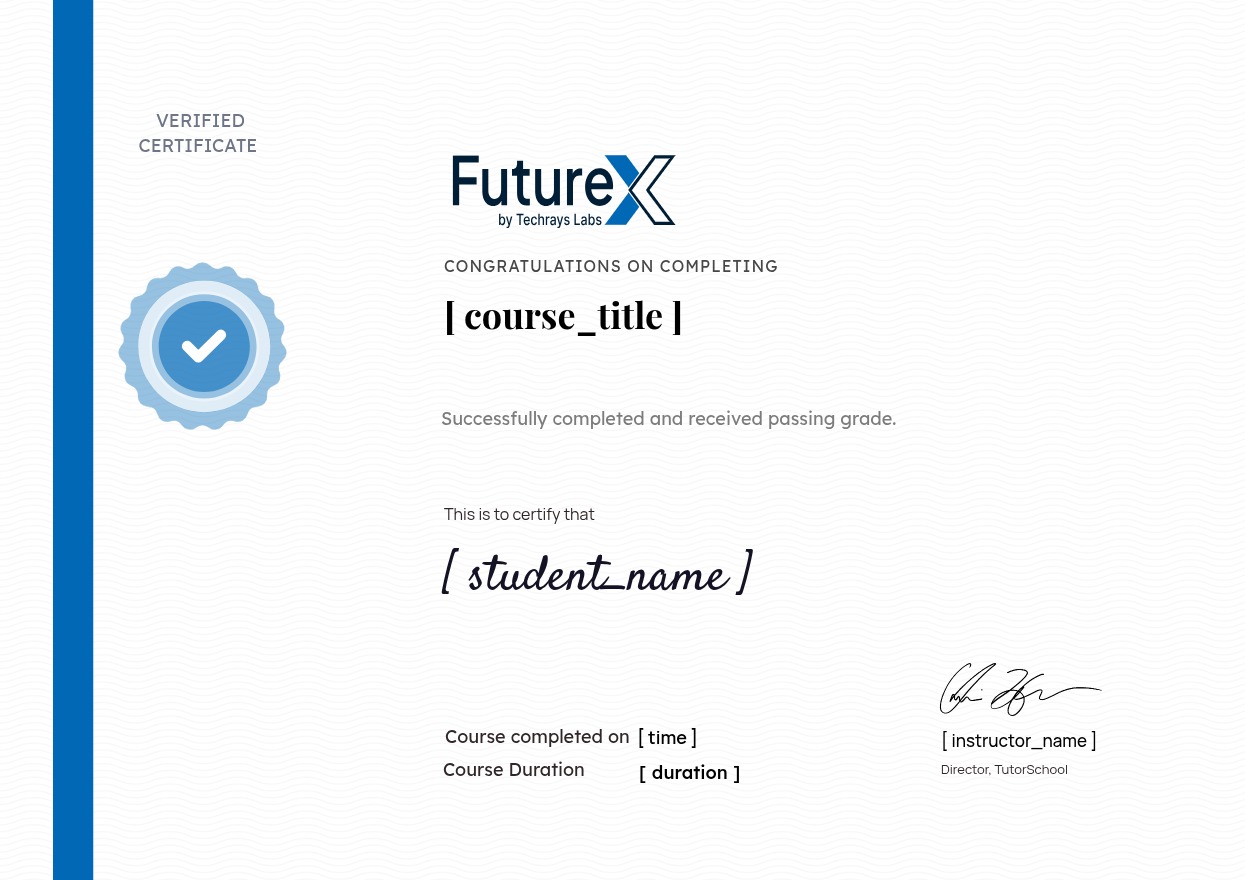
selected template

Student Ratings & Reviews

No Review Yet
No Review Yet