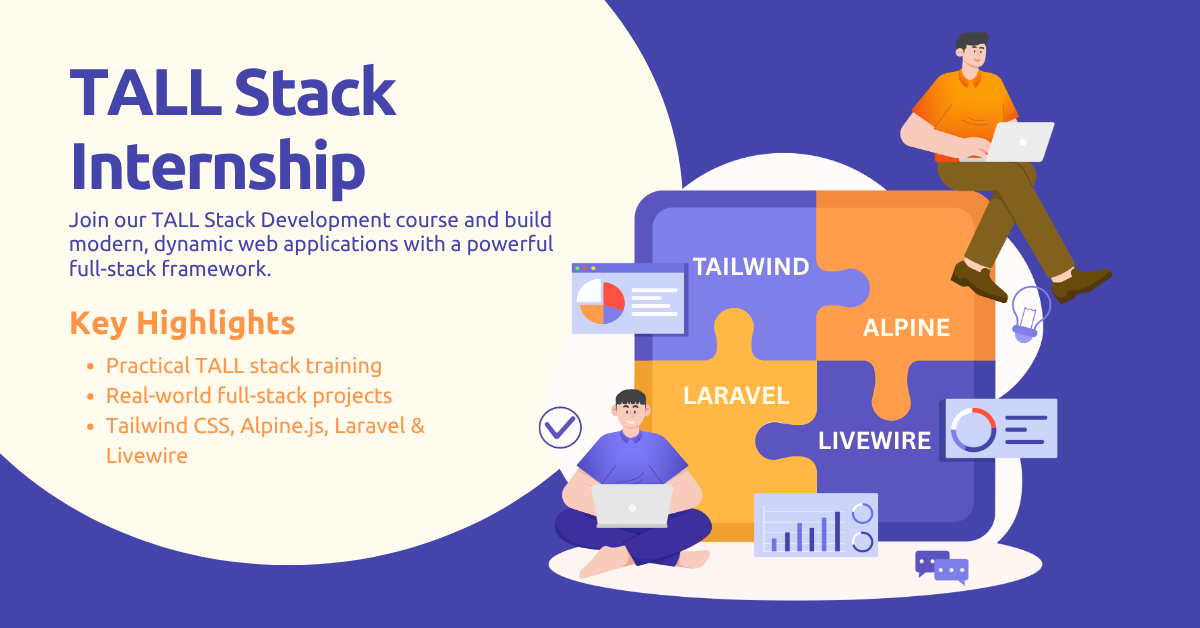
3 Months TALL Stack Training & Internship

Categories: Training & Internship
Wishlist Share

About Course

This 3-month TALL Stack Internship is a practical, industry-oriented training program designed to transform beginners into job-ready full-stack developers using the TALL Stack ecosystem — Tailwind CSS, Alpine.js, Laravel, and Livewire.

The program follows a structured and progressive learning approach, beginning with frontend and backend fundamentals and gradually advancing toward building modern, dynamic, and production-ready web applications using Laravel and reactive full-stack development techniques.

The internship is carefully designed to provide both conceptual understanding and hands-on implementation through real-world coding exercises, assignments, quizzes, mini-projects, and a final capstone project.

🚀 What This Internship Covers

The internship begins with the fundamentals of web development, where learners understand how modern websites and web applications work. Students start with HTML, CSS, responsive design, and JavaScript basics to build a strong frontend foundation before moving into advanced frameworks and backend development.

Once the basics are established, learners are introduced to Tailwind CSS, a utility-first CSS framework widely used for building modern and responsive user interfaces efficiently. Students learn how to create clean, responsive, and professional layouts using reusable utility classes and responsive design principles.

The internship then transitions into Laravel, one of the most popular PHP frameworks used for backend and full-stack web development. Learners understand routing, controllers, models, migrations, authentication, database relationships, validation, and MVC architecture while building scalable backend applications.

As the program progresses, students explore Livewire, which enables reactive and dynamic interfaces directly within Laravel without requiring complex frontend frameworks. They learn how to build interactive components, handle real-time updates, form submissions, modals, CRUD systems, and dynamic UI behavior using server-driven components.

The internship also introduces Alpine.js, a lightweight JavaScript framework used for frontend interactivity. Learners understand state management, dropdowns, modals, tabs, toggles, and frontend behavior enhancements that work seamlessly with Tailwind CSS and Livewire.

In the final phase, learners apply all concepts together by building a complete real-world TALL Stack application such as an admin dashboard, CRM system, project management tool, or inventory management system. This project includes authentication, CRUD operations, database integration, responsive UI, dynamic components, validations, and production-level application structure.

🧠 Learning Approach

This internship is designed around practical implementation and real-world development workflows rather than theory alone. Every module focuses on hands-on coding and application development.

Each module includes:

  • Structured video/text lessons
  • Real-world coding examples
  • Practical exercises and assignments
  • Module-wise quizzes for concept evaluation
  • Mini-projects for implementation practice
  • A final capstone project

The learning progression is strictly sequential, meaning learners must complete quizzes and assessments successfully before unlocking the next module. This ensures strong conceptual clarity before moving toward advanced application development.

🏆 Skills You Will Gain

By the end of this internship, participants will be able to:

  • Build responsive user interfaces using Tailwind CSS
  • Develop dynamic frontend interactions using Alpine.js
  • Understand Laravel MVC architecture and backend workflows
  • Create database-driven applications using Laravel
  • Build reactive full-stack applications using Livewire
  • Implement CRUD operations and form validations
  • Work with authentication and database relationships
  • Develop modern TALL Stack web applications
  • Understand real-world full-stack development practices
  • Build portfolio-ready production-level projects

🎯 Who This Internship is For

This program is ideal for:

  • Beginners who want to start a career in full-stack web development
  • Students pursuing computer science or IT-related fields
  • PHP developers wanting to learn Laravel and Livewire
  • Developers interested in modern TALL Stack development
  • Freelancers building dynamic web applications and admin panels

No prior Laravel experience is required, but basic understanding of HTML, CSS, and programming concepts can be helpful. Consistent practice and implementation are essential for successful completion.

💼 Internship Outcome

Upon completion of this internship, learners will have practical experience in full-stack TALL Stack development and will be capable of building responsive, database-driven, and production-ready web applications using Laravel, Livewire, Alpine.js, and Tailwind CSS.

Participants will also complete a real-world capstone project that can be showcased in portfolios, resumes, or GitHub profiles, significantly improving their chances of securing internships, freelance projects, or junior full-stack developer roles in modern web development environments.

Show More

Course Content

Module 1: Introduction to TALL Stack & Development Environment Setup
This module serves as the foundation of the entire TALL Stack internship. You will begin by understanding what the TALL Stack actually is—Tailwind CSS, Alpine.js, Laravel, and Livewire—and how these technologies work together to build modern, reactive web applications without relying heavily on JavaScript frameworks like React or Angular. You will learn why the TALL Stack is becoming increasingly popular among startups and developers due to its simplicity, performance, and developer experience. The module also focuses heavily on setting up your local development environment properly, which is a critical real-world skill that many beginners overlook. By the end of this module, you will not only understand the core philosophy behind the TALL Stack but also have a fully working development environment with Laravel installed, Tailwind configured, and your first application running. This module is crucial because a weak foundation leads to confusion later. A strong understanding here will make advanced concepts like Livewire and Alpine.js much easier to grasp.

  • What is the TALL Stack?
  • Installing PHP, Composer & Laravel
  • Understanding Laravel Project Structure
  • Installing and Configuring Tailwind CSS
  • Check what have you learnt about TALL Stack Fundamentals
  • Basic TALL App Setup

Module 2: Blade Templating Engine & Dynamic UI Rendering
In this module, you will dive deep into Blade, Laravel’s powerful templating engine that allows you to create dynamic, reusable, and maintainable user interfaces. Blade plays a critical role in the TALL Stack because it acts as the bridge between backend logic and frontend display. You will learn how to render dynamic data, create reusable layouts, manage conditional rendering, and structure UI components in a clean and scalable way. This module is extremely important because poor UI structuring leads to messy and unmaintainable code in real-world applications. Blade is widely used in production systems such as admin dashboards, SaaS platforms, and enterprise applications where clean separation of logic and UI is necessary. Understanding Blade deeply will prepare you for working with Livewire later, as Livewire heavily relies on Blade templates. By the end of this module, you will be able to build structured layouts, create reusable components, and dynamically render data in a professional way—skills that are essential for real-world Laravel development.

Module 3: Database Management, Migrations & Eloquent ORM
In this module, you will learn how Laravel handles databases using Migrations, Seeders, and Eloquent ORM, which are essential for building any real-world application. A strong understanding of database management is critical because almost every application relies on storing, retrieving, and manipulating data efficiently. You will start by understanding how migrations work as a version control system for your database, allowing you to create and modify tables in a structured and safe manner. Then, you will explore Eloquent ORM, Laravel’s elegant way of interacting with the database using models instead of raw SQL queries. This module is highly important in real-world scenarios such as building SaaS platforms, e-commerce systems, and admin dashboards, where data relationships and efficient querying play a major role. You will also learn how to structure relationships between tables (One-to-One, One-to-Many, Many-to-Many), which is a critical concept for scalable applications. By the end of this module, you will be able to design databases, create migrations, work with models, and perform CRUD operations using Eloquent in a clean, professional way.

Module 4: Laravel Routing, Controllers & Request Lifecycle
In this module, you will learn how Laravel handles HTTP requests, routing, and controllers, which are the backbone of any web application. Every time a user visits a page, submits a form, or interacts with your app, Laravel processes that request through a structured lifecycle. You will understand how URLs are mapped to specific logic using routes, how controllers help organize business logic, and how data flows from the browser to the server and back. This module is extremely important because poorly structured routing and controller logic can make applications messy, hard to maintain, and difficult to scale. In real-world applications such as SaaS dashboards, booking systems, and admin panels, routing defines how users navigate through the application, while controllers handle logic like fetching data, validating input, and returning responses. By the end of this module, you will be able to create clean, scalable routes, organize logic using controllers, and understand the complete request lifecycle in Laravel—skills that are essential for building production-ready applications.

Module 5: Livewire – Building Dynamic Interfaces Without JavaScript
In this module, you will learn Livewire, one of the most powerful parts of the TALL Stack. Livewire allows you to build dynamic, reactive user interfaces using PHP instead of writing complex JavaScript. This is a game-changer for backend developers who want to create modern interactive applications without switching to frontend-heavy frameworks. You will understand how Livewire works behind the scenes using AJAX requests, how it keeps the frontend and backend in sync, and how it simplifies UI interactivity like form submissions, real-time updates, and dynamic content rendering. Livewire is heavily used in real-world applications such as admin dashboards, booking systems, SaaS tools, and internal business platforms where rapid development and maintainability are crucial. It allows you to write clean, readable code while still delivering a modern user experience. By the end of this module, you will be able to create interactive components, handle events, manage state, and build real-time features using Livewire—without writing heavy JavaScript.

Module 6: Alpine.js – Frontend Interactivity in TALL Stack
In this module, you will learn Alpine.js, a lightweight JavaScript framework used in the TALL Stack to add simple and efficient interactivity to web pages. Unlike heavy frontend frameworks, Alpine.js is designed to work directly inside Blade templates with minimal setup. You will understand how Alpine.js helps you manage UI states like dropdowns, modals, toggles, tabs, and dynamic components without writing complex JavaScript logic. It is often described as “Tailwind for JavaScript” because it provides utility-like simplicity for frontend behavior. In real-world applications, Alpine.js is widely used in SaaS dashboards, admin panels, and Livewire-based projects to handle small interactive features without introducing large frontend frameworks. It perfectly complements Livewire by handling client-side behavior while Livewire handles server-side logic. By the end of this module, you will be able to build interactive UI components, manage frontend state, and enhance user experience using Alpine.js in a clean and scalable way.

Module 7: Authentication, Authorization & Security in Laravel (TALL Stack)
In this module, you will learn how to build secure authentication and authorization systems in Laravel, which are essential for any real-world application. Every production system—whether it is an e-commerce platform, SaaS product, or admin dashboard—requires user login, role management, and security mechanisms. You will understand how Laravel handles authentication using built-in systems like Laravel Breeze / Jetstream, how sessions work, and how users are securely logged in and managed. You will also learn authorization concepts such as roles and permissions, which control what a user is allowed to do inside the application. Security is one of the most critical parts of web development. You will also explore protection techniques like CSRF protection, password hashing, middleware-based access control, and route protection. By the end of this module, you will be able to build a complete authentication system with role-based access control, secure routes, and protected application layers—just like real production-grade systems.

Final Module: Full-Stack TALL Stack SaaS Project (Production-Level Application)
This final module is a complete real-world, production-style project where you will apply everything learned across the internship. You will build a fully functional SaaS-style Task Management System using the TALL Stack. This project is designed to simulate how real companies build applications: structured architecture, authentication, database design, dynamic UI, and secure role-based access. You will combine: Laravel (Backend + API + logic) Livewire (dynamic frontend without JS complexity) Alpine.js (UI interactivity) Tailwind CSS (modern UI styling) Database (migrations + relationships) Authentication & Authorization This module is extremely important because it transforms theoretical knowledge into a real deployable application. By completing it, you will have a portfolio-ready project that demonstrates industry-level skills.

Earn a certificate

Add this certificate to your resume to demonstrate your skills & increase your chances of getting noticed.
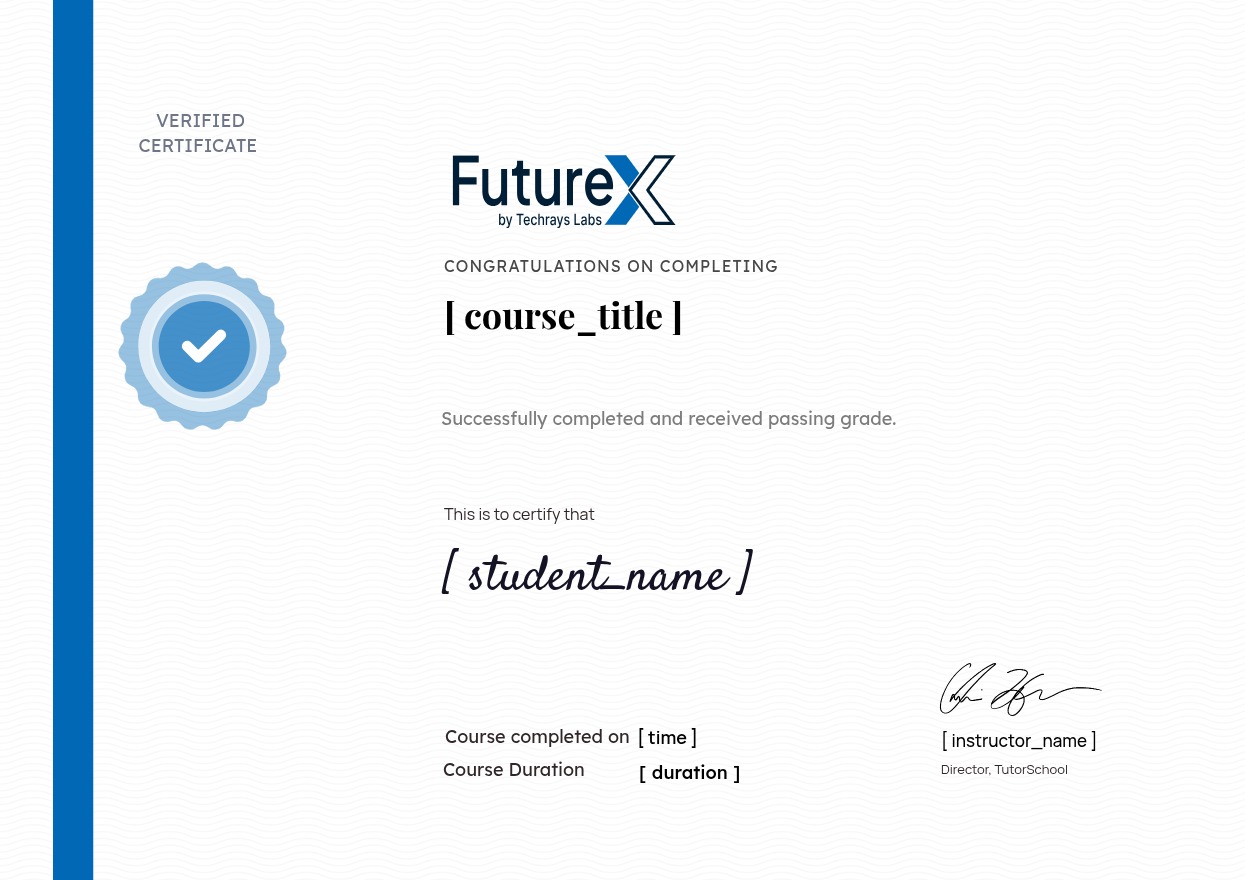
selected template

Student Ratings & Reviews

No Review Yet
No Review Yet