5.00
(1 Rating)

2 Months AI / ML Training & Internship

Categories: Training & Internship
Wishlist Share

About Course

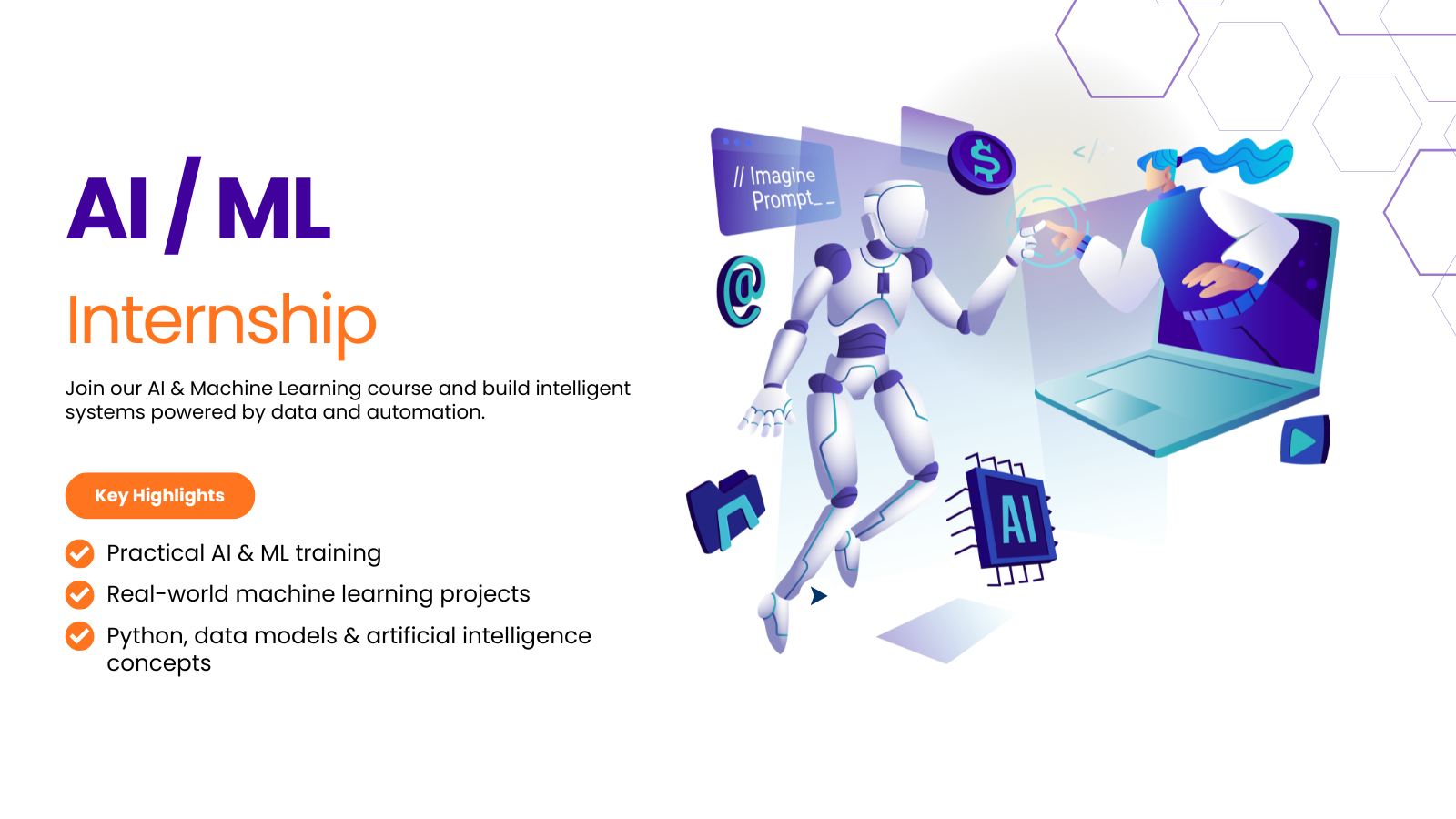
The 2-Month AI/ML Internship is an intermediate-level practical training program designed to help learners build strong machine learning and predictive analytics skills through real-world AI projects and implementation-focused learning.

This internship emphasizes hands-on development of AI systems, data analysis, feature engineering, and machine learning model deployment using Flask APIs.

The program bridges the gap between theoretical AI concepts and practical industry implementation by providing guided projects, assignments, and analytics-based workflows.

🚀 What This Internship Covers

The internship starts with strengthening Python Programming and Data Science fundamentals, ensuring participants can efficiently work with machine learning libraries and datasets.

Learners then move into Exploratory Data Analysis (EDA), where they analyze trends, correlations, and insights from datasets using visualizations and statistical techniques.

The program introduces Feature Engineering and Data Preprocessing, where students learn scaling, encoding, normalization, and handling real-world structured datasets.

Next, participants work on Machine Learning Algorithms, including:

  • Logistic Regression
  • Decision Trees
  • Random Forest
  • K-Nearest Neighbors

Students also learn Model Evaluation Techniques such as:

  • Accuracy
  • Precision
  • Recall
  • Confusion Matrix

The internship then covers Flask API Development, where learners build prediction APIs and connect machine learning models with frontend applications.

In the final phase, learners complete a Real-World AI Project involving prediction systems, analytics dashboards, or recommendation engines.

🧠 Learning Approach

The internship follows a project-oriented learning model with:

  • Real-world datasets
  • Guided coding exercises
  • Practical AI implementation
  • Analytics-based assignments
  • Weekly assessments
  • Capstone AI project

Participants continuously apply concepts through coding and model development tasks.

🏆 Skills You Will Gain

By the end of this internship, learners will be able to:

  • Perform advanced data preprocessing
  • Build predictive machine learning systems
  • Analyze and visualize real-world datasets
  • Develop AI-powered Flask APIs
  • Evaluate and optimize ML models
  • Create complete AI projects

🎯 Who This Internship is For

This internship is suitable for:

  • Students with basic Python knowledge
  • AI/ML beginners wanting practical experience
  • Data Science enthusiasts
  • Engineering students
  • Aspiring AI developers

Basic Python understanding is recommended before joining.

💼 Internship Outcome

After completing the internship, participants will have experience building machine learning applications and AI APIs. They will also complete an industry-style AI project suitable for portfolios, freelance work, and internship applications.

Show More

Course Content

Module 1: Introduction to AI, Machine Learning & Python Foundations
This module establishes the fundamental understanding required to enter the field of Artificial Intelligence and Machine Learning. Students will begin by learning what AI actually means beyond buzzwords and how Machine Learning fits into the broader ecosystem. The module breaks down complex concepts into simple, understandable components so beginners can build a strong conceptual base. Alongside theory, students will start working with Python, the primary programming language used in AI/ML development. This includes understanding syntax, variables, and basic logic building. The purpose is to ensure students are not just memorizing definitions but actually writing code from the beginning. This module is critical because weak fundamentals lead to failure in later modules like model building and data science. Every concept here directly connects to real-world systems such as recommendation engines, fraud detection, and automation tools. By the end of this module, students will: Understand AI, ML, and their differences Write basic Python programs Understand how ML systems generally work Build logical thinking required for coding

  • Introduction to Artificial Intelligence & Machine Learning
  • Applications of AI & ML in Real World
  • Python Basics for AI/ML
  • Variables, Data Types & Basic Input/Output
  • Check what have you learnt about AI & Python Fundamentals
  • Build a Student Information System:

Module 2: Python Programming for Machine Learning & Mathematical Foundations
This module strengthens the programming backbone required for machine learning by diving deeper into Python concepts and introducing essential mathematical foundations used in ML systems. While Module 1 focused on basic syntax, this module moves toward writing structured, reusable, and logical programs that directly align with machine learning workflows. Students will learn how to use Python data structures such as lists, dictionaries, and tuples to represent datasets. They will also understand how functions are used to modularize ML pipelines and reduce repetitive code. These concepts are critical because real-world ML systems are built using layered logic, not isolated scripts. Additionally, this module introduces the mathematical intuition behind machine learning, including averages, basic probability, and numeric reasoning. Students will not be overloaded with theory but will instead learn practical math concepts used in preprocessing and model understanding. This module is important because poor Python skills or weak math understanding leads to failure in model building and data analysis stages. Everything in ML—data cleaning, feature engineering, and model training—depends on these fundamentals. By the end of this module, students will: Write structured Python programs using functions and data structures Understand how datasets are represented in code Apply basic mathematical operations used in ML Build logic required for data processing

Module 3: Data Handling, Analysis & Visualization for Machine Learning
This module introduces the most critical layer in any machine learning system: data handling and preprocessing. No ML model works without clean and structured data, and in real-world scenarios, raw data is always messy, incomplete, and inconsistent. Students will learn how to load datasets, inspect them, clean missing values, and prepare them for machine learning algorithms. The module focuses heavily on practical skills using libraries like Pandas and Matplotlib, which are industry standards for data analysis and visualization. Understanding data is more important than building models. Most real-world ML failures happen not because of bad algorithms but because of poor data handling. This module ensures students develop the ability to explore, clean, and visualize datasets effectively. Students will also learn how to identify patterns, trends, and anomalies using visual tools, which is a key skill in data science and analytics roles. By the end of this module, students will: Load and explore datasets using Pandas Clean and preprocess raw data Handle missing and inconsistent data Visualize data using graphs Understand features and target variables

Module 4: Supervised Machine Learning (Regression & Classification)
This module introduces the core engine of machine learning: supervised learning, where models learn from labeled data to make predictions. This is the most widely used approach in industry because most real-world problems involve predicting known outcomes based on historical data. Students will learn how machine learning models actually learn patterns from input-output relationships. The module focuses on two major supervised learning tasks: regression (predicting numerical values) and classification (predicting categories). Unlike earlier modules that focused on preparation and foundations, this module transitions into actual model building. Students will train models, make predictions, and evaluate performance using real metrics. Understanding this module is non-negotiable because it forms the base of all advanced ML techniques. The module also introduces important concepts like train-test split, overfitting, and evaluation metrics, which are critical for building reliable models in real-world systems. By the end of this module, students will: Understand supervised learning workflow Train regression and classification models Evaluate model performance using metrics Identify overfitting and underfitting issues Build basic predictive systems

Module 5: Unsupervised Learning, Feature Engineering & Model Optimization
This module focuses on what most beginners completely ignore but what actually determines real-world ML performance: data quality, feature engineering, and model tuning. At this stage, students already know how to train models — now they learn how to make those models actually useful. Unsupervised learning is introduced to handle scenarios where labeled data is not available. Students will learn how systems automatically discover hidden patterns, group similar data, and extract insights without predefined outputs. This is heavily used in customer segmentation, anomaly detection, and recommendation systems. The module then shifts to feature engineering, which is the most critical skill in machine learning. In real-world projects, improving features often gives better results than changing algorithms. Students will learn how to transform raw data into meaningful inputs that improve model performance. Finally, model optimization and scaling are introduced. Students will understand how small parameter changes can significantly impact model accuracy. Concepts like feature scaling and hyperparameter tuning will be covered in a practical way. By the end of this module, students will: Understand unsupervised learning and clustering Apply K-Means algorithm Perform feature engineering on datasets Apply feature scaling techniques Improve models using basic tuning

Module 6: End-to-End AI/ML Capstone Project (Final Module)
This final module is where everything becomes real. Up to this point, students have learned concepts in isolation—data handling, model training, evaluation, and optimization. Now they will combine all of it into a complete, production-style machine learning system. This module is not about learning new theory. It is about execution. Students will build a full pipeline starting from raw data to a deployed prediction system. This mirrors exactly how real ML systems are built in companies. The project forces students to deal with real problems such as dirty data, incorrect predictions, and system design decisions. It ensures they are not just learners but capable of building usable ML solutions. By the end of this module, students will: Build a complete ML pipeline Handle real datasets Train and evaluate models properly Deploy a model using an API Create a portfolio-ready project

Earn a certificate

Add this certificate to your resume to demonstrate your skills & increase your chances of getting noticed.
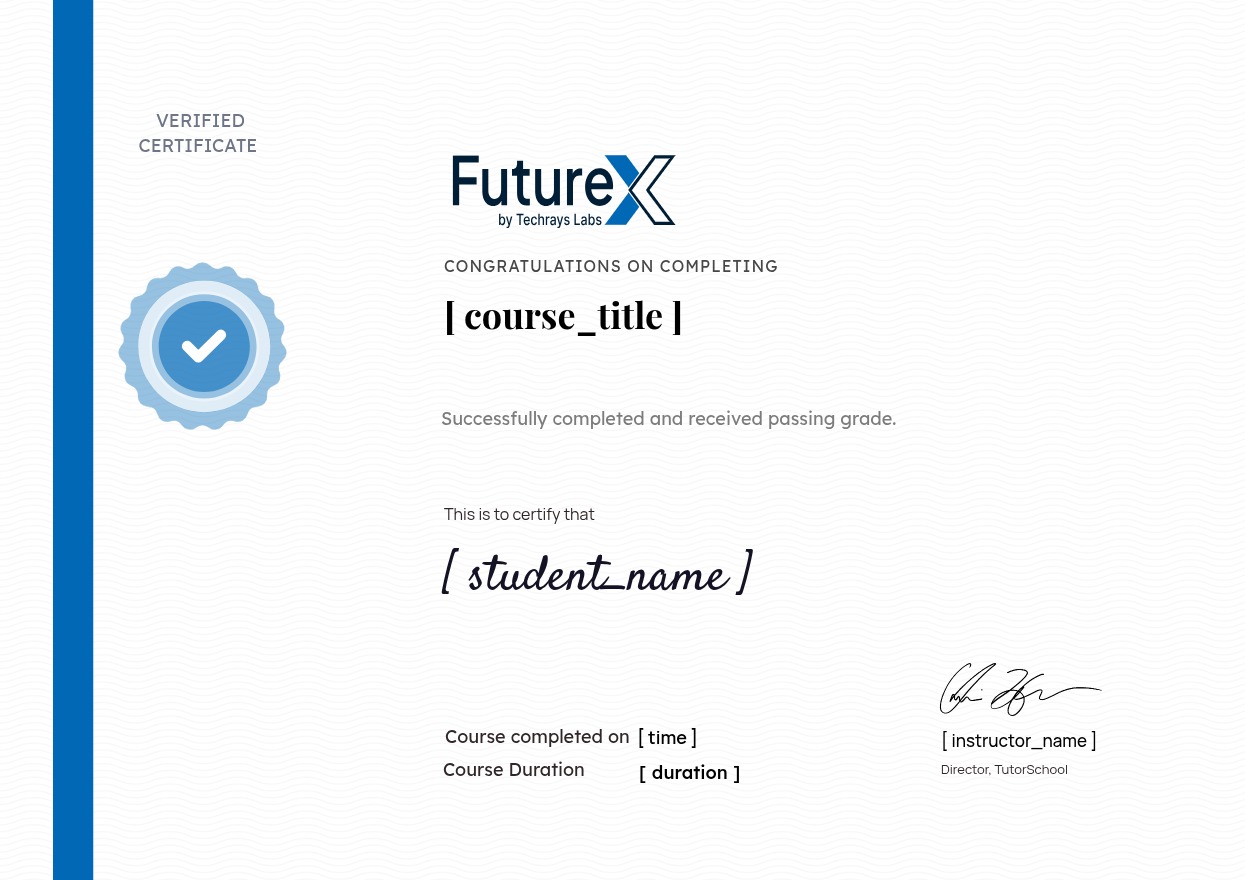

selected template

Student Ratings & Reviews

5.0
Total 1 Rating
5
1 Rating
4
0 Rating
3
0 Rating
2
0 Rating
1
0 Rating
Nishant Rana
2 days ago
Yes I am able to learn more quickly and effectively