
Technology education is going through one of its biggest transformations in decades.
For years, the traditional learning model focused heavily on theory, classroom lectures, exams, and certifications. Students were trained to memorize concepts, complete assignments, and score well in examinations. While this approach helped build foundational knowledge, it often left a major gap between education and real industry expectations.
But the technology industry has evolved rapidly.
Today, companies are not simply hiring candidates who “know” technology in theory. They are hiring people who can build products, solve real-world problems, collaborate with teams, think independently, and adapt quickly in dynamic work environments.
This shift is one of the biggest reasons why project-based learning is becoming the future of tech education and modern internship programs.
The Shift From Passive Learning to Active Building
One of the biggest limitations of traditional learning is that students often spend months consuming tutorials, watching videos, reading documentation, or preparing for exams without actually creating anything meaningful.
As a result, many learners understand concepts theoretically but struggle when asked to apply them in practical scenarios.
Project-based learning changes this completely.
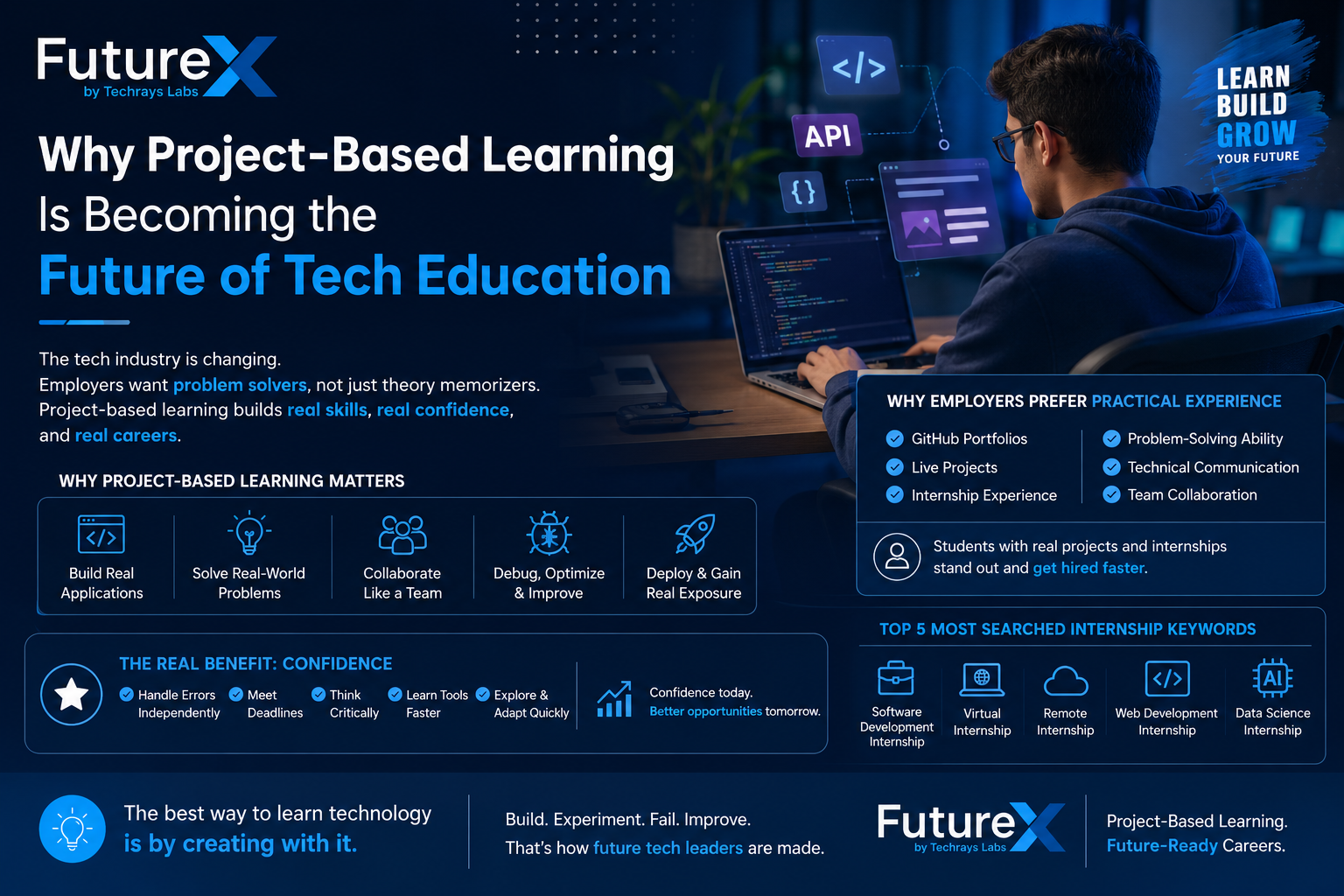
Instead of only learning concepts passively, students begin learning through execution. They actively participate in the development process by:
- Building real applications
- Solving practical business problems
- Working on assignments that simulate industry workflows
- Understanding product architecture
- Debugging errors independently
- Optimizing performance
- Collaborating with other developers and designers
- Deploying projects in real environments
This creates a much deeper level of understanding.
Because technology is not a field where theoretical knowledge alone creates expertise. Real learning happens when students start building, experimenting, failing, fixing, and improving continuously.
Why Practical Learning Creates Better Developers
In the real world, software development is rarely about solving textbook problems.
Developers are expected to:
- Understand changing requirements
- Work with incomplete information
- Debug unexpected issues
- Read documentation constantly
- Learn new frameworks quickly
- Communicate with teams
- Manage deadlines and priorities
These skills cannot be mastered through exams alone.
Project-based learning exposes students to these realities early in their journey, especially during a software development internship or virtual internship experience.
When learners work on practical projects, they begin understanding how technology is actually used to solve business and user problems. They start thinking beyond syntax and coding tutorials.
They learn:
- Why scalability matters
- How users interact with products
- Why clean architecture is important
- How APIs, databases, and frontend systems work together
- How to handle production-level challenges
- Why collaboration and communication are critical in development
This creates industry-ready professionals instead of just certificate holders.
Why Employers Prefer Real-World Experience
Hiring trends in the technology industry have changed significantly.
Modern hiring managers often look beyond degrees and certifications. A resume filled with theoretical courses no longer guarantees employability.
Employers now want proof of practical capability.
They actively look for:
- GitHub portfolios
- Live applications
- Internship experience
- Real-world project exposure
- Open-source contributions
- Problem-solving ability
- Technical communication skills
- Team collaboration experience
A student who has built multiple practical projects or completed an online internship often stands out far more than someone who only possesses theoretical knowledge.
Because projects demonstrate something extremely important: the ability to execute.
A live project shows that the learner understands implementation, problem-solving, debugging, deployment, and ownership — all of which are highly valuable in real organizations.
This is why project-based learning is becoming the foundation of career-focused education, remote internship opportunities, and job-ready training programs globally.
The Confidence Advantage
One of the most underrated benefits of project-based learning is confidence.
Many students fear technology because they have only interacted with it academically. They hesitate during interviews because they have never worked on something independently.
But when students build real applications, everything changes.
They become more comfortable with uncertainty.
They learn how to:
- Handle errors without panic
- Research solutions independently
- Work under deadlines
- Communicate technical ideas clearly
- Learn new tools faster
- Experiment without fear of failure
- Think critically under pressure
Over time, this creates self-confidence that cannot be developed through passive learning alone.
And confidence plays a huge role during internships, freelance projects, client meetings, and technical interviews.
The Future of Tech Education
The future of education is shifting from information consumption to skill application.
Companies increasingly value:
- Practical exposure
- Real execution
- Problem-solving ability
- Product thinking
- Adaptability
- Collaboration skills
This is why bootcamps, startup internships, industrial training programs, and project-based learning models are growing rapidly across the world.
The focus is no longer just on “learning technology.”
The focus is on building with technology.
Final Thoughts
Technology is a practical industry.
The learners who grow the fastest are usually not the ones who consume the most tutorials. They are the ones who build consistently, experiment fearlessly, solve problems actively, and gain real-world exposure early in their careers.
Because the best way to truly learn technology is not just by studying it.
It is by creating with it.