15 Days Blockchain Development Training & Internship

Categories: Training & Internship
Wishlist Share

About Course

tep into the world of decentralized technologies with our 15-Day Blockchain Development Internship, designed to provide a strong foundation in blockchain concepts and hands-on experience in building decentralized applications (DApps). This internship combines structured learning with practical implementation, enabling you to understand how blockchain works, write smart contracts using Solidity, and integrate them with modern web applications.

Throughout the internship, you’ll progress from learning blockchain fundamentals to developing and deploying your own blockchain-based project. Using industry-standard tools such as Solidity, Hardhat, MetaMask, Ethers.js, Node.js, and Visual Studio Code, you’ll gain practical experience that mirrors real-world blockchain development workflows.

Whether you’re a student, aspiring blockchain developer, or software enthusiast looking to explore Web3 technologies, this internship provides the knowledge and practical skills needed to begin your blockchain development journey.


🚀 What This Internship Covers

During this internship, you’ll gain both theoretical knowledge and practical experience in blockchain development, including:

  • Fundamentals of blockchain technology and decentralized systems
  • Understanding blocks, transactions, cryptographic hashing, and consensus mechanisms
  • Ethereum blockchain architecture and smart contract concepts
  • Solidity programming language for smart contract development
  • Writing, testing, debugging, and deploying smart contracts using Hardhat
  • Wallet integration using MetaMask
  • Blockchain interaction using Ethers.js
  • Reading and writing blockchain data from web applications
  • Understanding gas fees, transactions, and blockchain events
  • Building decentralized applications (DApps)
  • Smart contract security fundamentals and best practices
  • Developing and deploying a complete blockchain-based project

🧠 Learning Approach

This internship follows a practical, project-oriented learning methodology that focuses on applying concepts through real development tasks.

You’ll learn through:

  • Easy-to-understand theory sessions
  • Step-by-step coding demonstrations
  • Guided hands-on practical exercises
  • Real-world assignments after each module
  • Mini projects to reinforce concepts
  • Industry-standard development tools and workflows
  • Continuous practice with blockchain transactions and smart contracts
  • A final capstone project that integrates everything you’ve learned

By learning through implementation rather than memorization, you’ll build confidence in developing blockchain applications from scratch.


🏆 Skills You Will Gain

By completing this internship, you will develop valuable blockchain development skills, including:

  • Strong understanding of blockchain technology and decentralized architecture
  • Smart contract development using Solidity
  • Ethereum development fundamentals
  • Hardhat project setup and deployment
  • Web3 application development
  • MetaMask wallet integration
  • Ethers.js for blockchain communication
  • Blockchain transaction management
  • Smart contract testing and debugging
  • Event handling in blockchain applications
  • Secure smart contract development practices
  • Git-based project management
  • Problem-solving and debugging skills
  • End-to-end decentralized application (DApp) development

🎯 Who This Internship is For

This internship is ideal for:

  • Computer Science and IT students
  • Engineering students interested in Web3 technologies
  • Beginners who want to start learning blockchain development
  • Web developers looking to transition into blockchain development
  • JavaScript developers interested in Ethereum development
  • Software developers exploring decentralized applications
  • Technology enthusiasts interested in cryptocurrencies and blockchain
  • Anyone looking to build practical blockchain development skills for future career opportunities

No prior blockchain experience is required. Basic programming knowledge (preferably JavaScript) will help learners understand concepts more effectively.


💼 Internship Outcome

Upon successful completion of the internship, participants will be able to:

  • Understand the complete blockchain development lifecycle
  • Design and develop smart contracts using Solidity
  • Deploy and test smart contracts using Hardhat
  • Build decentralized applications that interact with blockchain networks
  • Integrate MetaMask wallet authentication into web applications
  • Read and write blockchain data using Ethers.js
  • Apply blockchain security best practices during development
  • Build and deploy a complete blockchain-based application independently
  • Showcase a portfolio-ready Decentralized Student Certificate Verification System project
  • Earn practical experience that strengthens resumes, internship applications, and entry-level blockchain developer opportunities
Show More

Course Content

Module 1: Blockchain Fundamentals & Development Environment
Blockchain is one of the most transformative technologies of the modern digital era, enabling decentralized, transparent, and tamper-proof systems for storing and exchanging data. In this module, students will build a strong foundation by understanding what blockchain is, how it works, and why it is revolutionizing industries such as finance, healthcare, supply chain, and digital identity. Students will learn the evolution of blockchain technology, understand distributed ledger concepts, explore blocks, transactions, cryptographic hashing, consensus mechanisms, wallets, and blockchain networks. They will also set up a professional blockchain development environment using industry-standard tools such as Node.js, MetaMask, Hardhat, and Visual Studio Code. By the end of this module, learners will be comfortable with blockchain terminology, understand how decentralized systems differ from traditional applications, and prepare their systems for smart contract development in upcoming modules. This foundational knowledge is essential because every blockchain developer must first understand how blockchain networks function before writing smart contracts or decentralized applications. Students completing this module will confidently explain blockchain concepts, identify real-world blockchain use cases, and successfully configure a blockchain development environment for future practical work.

  • Lesson 1: Introduction to Blockchain Technology
  • Lesson 2: Blocks, Transactions, Hashing & Consensus Mechanisms
  • Lesson 3: Blockchain Networks, Wallets & Development Environment Setup
  • Blockchain Fundamentals Assessment
  • Explore Blockchain Concepts and Prepare Your Development Environment

Module 2: Smart Contracts with Solidity
Smart contracts are self-executing programs that run on blockchain networks and automatically enforce predefined rules without requiring intermediaries. They form the foundation of decentralized applications (DApps), enabling secure, transparent, and automated digital agreements. In this module, students will learn how to write, compile, test, deploy, and interact with smart contracts using the Solidity programming language. The module begins with Solidity fundamentals, including contract structure, data types, variables, functions, and visibility modifiers. Students will then explore constructors, control statements, mappings, arrays, events, and error handling before learning how to deploy contracts using Hardhat and interact with them through scripts. By combining theory with practical coding exercises, students will understand how blockchain executes smart contracts, how contract state is stored, and how transactions modify blockchain data. They will also gain experience in writing secure and maintainable Solidity code by following industry best practices. Throughout the module, learners will use Hardhat to compile contracts, deploy them to a local blockchain, and test their functionality. By the end of this module, students will have the confidence to build basic decentralized logic and prepare for integrating smart contracts into full-stack blockchain applications in the next module.

Module 3: Decentralized Application (DApp) Development & Web3 Integration
After learning blockchain fundamentals and smart contract development, the next step is building complete decentralized applications (DApps) that users can interact with through a web interface. A DApp combines a frontend application with blockchain smart contracts, allowing users to securely perform transactions using their cryptocurrency wallets without relying on centralized servers. In this module, students will learn how blockchain applications communicate with deployed smart contracts using Web3 libraries such as Ethers.js. They will understand wallet integration through MetaMask, learn how to read and write blockchain data, manage transactions, listen to smart contract events, and build responsive blockchain user interfaces. Students will also explore blockchain networks, gas fees, transaction lifecycle, account management, and security best practices. They will develop practical skills by creating frontend applications that interact with previously developed Solidity contracts. By the end of this module, learners will be capable of developing a complete frontend that communicates with blockchain smart contracts, handling user authentication through wallets, displaying blockchain data, and securely executing transactions. This module bridges the gap between blockchain backend development and full-stack decentralized application development, preparing students for the capstone project.

Module 4: Capstone Project – Decentralized Student Certificate Verification System
ongratulations! You have successfully learned blockchain fundamentals, Solidity smart contract development, and decentralized application (DApp) development. The final module brings together all the concepts covered throughout this internship into a comprehensive, real-world capstone project. In this project, students will build a Decentralized Student Certificate Verification System, a blockchain-based application that enables educational institutions to issue digital certificates while allowing employers, universities, and organizations to verify certificate authenticity without relying on a centralized database. The project combines smart contracts, wallet authentication, blockchain transactions, and a user-friendly frontend. Students will deploy their smart contracts to a local blockchain or Ethereum Sepolia Testnet, connect them to a frontend using Ethers.js, and interact with the application through MetaMask. By completing this project, students will gain practical experience in blockchain application architecture, smart contract design, frontend integration, testing, deployment, and debugging. The finished project can also serve as a valuable portfolio piece demonstrating full-stack blockchain development skills.

Earn a certificate

Add this certificate to your resume to demonstrate your skills & increase your chances of getting noticed.
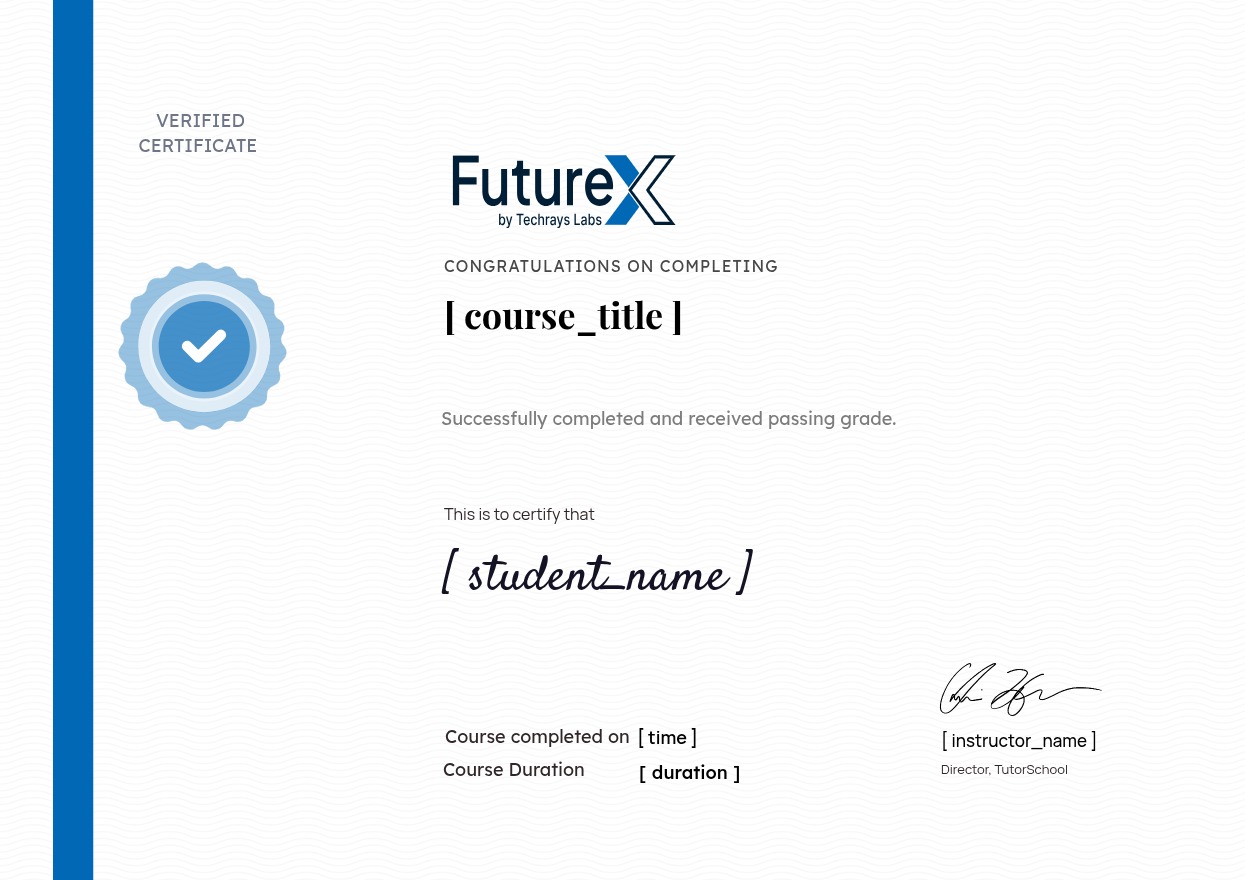
selected template

Student Ratings & Reviews

No Review Yet
No Review Yet