About Course
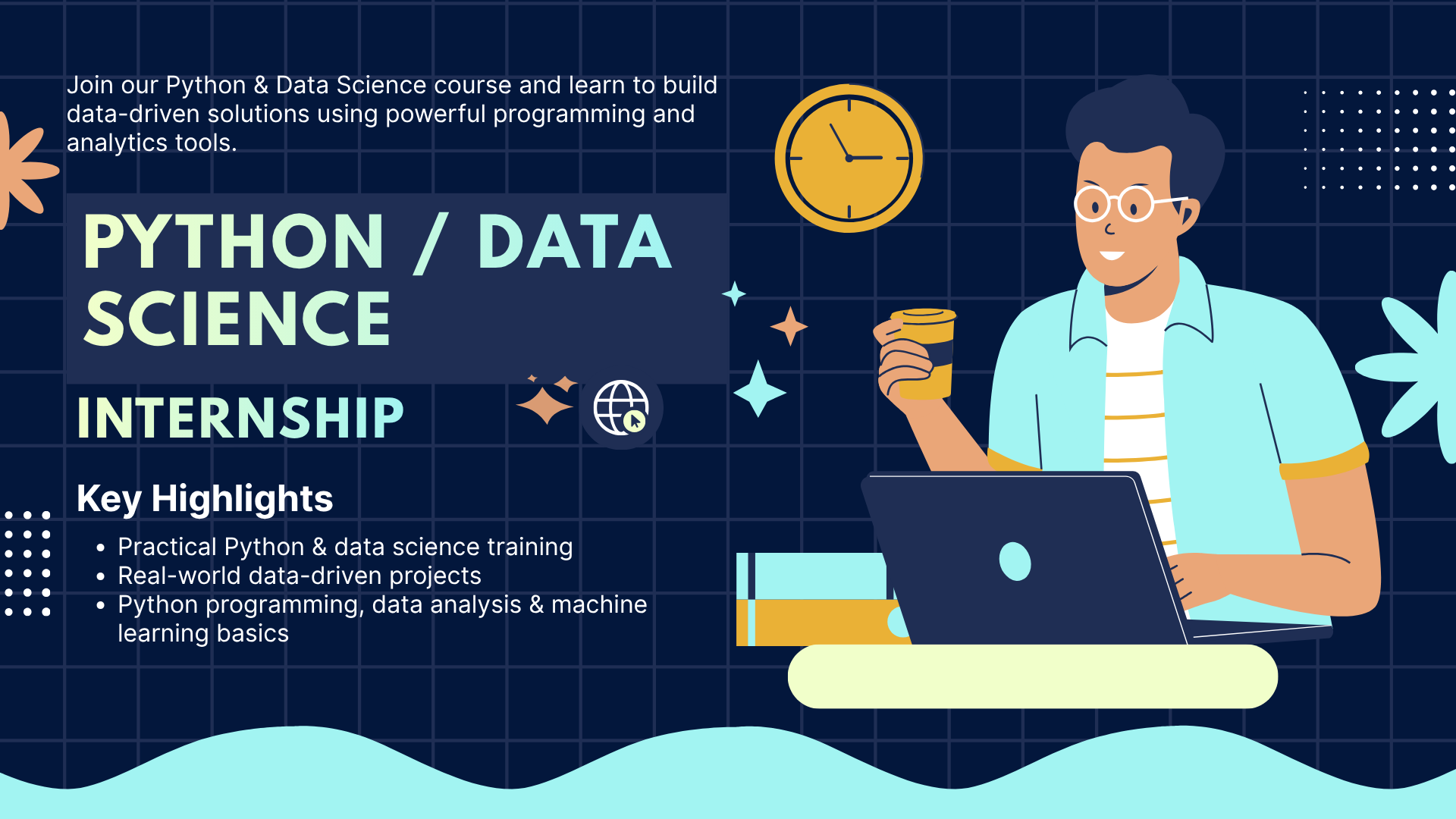
The 15 Days Python / Data Science Training & Internship is an intensive, hands-on, and beginner-friendly program designed to introduce learners to the world of Python programming, data analysis, visualization, and machine learning. The internship focuses on building strong programming fundamentals while providing practical experience in solving real-world data problems using industry-standard Python libraries.
The program follows a structured learning approach, beginning with the fundamentals of Python programming and gradually progressing toward data manipulation, visualization, exploratory data analysis, and introductory machine learning. Every concept is reinforced through practical coding exercises, assignments, quizzes, mini-projects, and a final capstone project, ensuring learners gain both theoretical understanding and practical implementation skills.
Although the internship spans only 15 days, it is carefully designed to maximize learning through project-based training and real-world datasets. By the end of the program, learners will be able to write Python programs, analyze datasets, visualize insights, build basic machine learning models, and understand the complete data science workflow used by professionals.
🚀 What This Internship Covers
The internship begins with the fundamentals of Python programming, where learners understand variables, data types, operators, conditional statements, loops, functions, modules, file handling, and object-oriented programming. This foundation ensures that even participants with little or no programming experience can comfortably begin their data science journey.
Once the programming fundamentals are established, learners are introduced to the Data Science ecosystem and its workflow. Students gain hands-on experience with powerful Python libraries such as NumPy for numerical computing, Pandas for data manipulation, and Matplotlib and Seaborn for data visualization. They learn how to import datasets, clean missing values, transform data, and perform exploratory data analysis (EDA) to discover meaningful insights.
The program then focuses on data visualization and statistical analysis, enabling students to represent data effectively using charts, graphs, and dashboards. Learners understand how visualization supports business decision-making and how statistical summaries help identify patterns, trends, and anomalies in real-world datasets.
As the internship progresses, students are introduced to the fundamentals of Machine Learning using Scikit-learn. They learn about supervised learning concepts, data preprocessing, model training, testing, evaluation metrics, and prediction techniques through beginner-friendly examples. The internship also introduces best practices in feature selection, train-test splitting, and model performance evaluation.
In the final phase, learners apply everything they have learned by developing a complete Data Analysis and Prediction Project using a real-world dataset. The capstone project includes data cleaning, visualization, exploratory analysis, feature engineering, machine learning model development, evaluation, and result interpretation, providing practical experience similar to professional data science workflows.
🧠 Learning Approach
This internship follows a practical, project-based learning methodology where every concept is immediately reinforced through hands-on implementation rather than theory alone.
Each module includes:
- Structured video/text lessons
- Step-by-step coding demonstrations
- Real-world datasets for practice
- Hands-on programming exercises
- Module-wise quizzes
- Practical assignments
- Mini-projects
- A final capstone project
The curriculum follows a progressive learning path, ensuring learners build confidence with Python before advancing to data science concepts and machine learning. Continuous assessments and practical tasks help reinforce conceptual understanding while preparing students for real-world problem-solving.
Students are also introduced to modern data science practices, including:
- Python Programming Best Practices
- Data Cleaning & Preprocessing
- Exploratory Data Analysis (EDA)
- Data Visualization
- Statistical Analysis
- Machine Learning Workflow
- Model Evaluation
- Data-Driven Decision Making
- Professional Coding Standards
🏆 Skills You Will Gain
By the end of this internship, participants will be able to:
- Write clean and efficient Python programs
- Understand core programming concepts and object-oriented programming
- Work with NumPy for numerical computations
- Analyze and manipulate datasets using Pandas
- Clean, transform, and preprocess real-world data
- Perform exploratory data analysis (EDA)
- Create meaningful visualizations using Matplotlib and Seaborn
- Understand basic statistical concepts for data analysis
- Build and evaluate introductory machine learning models using Scikit-learn
- Interpret model performance and prediction results
- Work with real-world datasets to solve business problems
- Develop portfolio-ready data science projects
🎯 Who This Internship is For
This internship is ideal for:
- Beginners who want to start a career in Data Science
- Students pursuing Computer Science, IT, Mathematics, Statistics, or Engineering
- Python developers interested in data analysis and machine learning
- Aspiring Data Analysts and Data Scientists
- Professionals looking to enhance their analytical and programming skills
- Researchers working with data-driven projects
- Anyone interested in Artificial Intelligence, Machine Learning, and Data Analytics
No prior experience in Data Science or Machine Learning is required. A basic understanding of mathematics is helpful but not mandatory. The internship is designed to guide learners from Python fundamentals to building practical data science solutions through continuous hands-on practice.
💼 Internship Outcome
Upon successful completion of the 15 Days Python / Data Science Training & Internship, participants will have practical experience in Python programming, data preprocessing, visualization, exploratory analysis, and introductory machine learning.
Learners will complete a portfolio-ready Data Science Capstone Project using real-world datasets, demonstrating their ability to collect, clean, analyze, visualize, and build predictive models using Python. This project can be showcased on GitHub, portfolios, and resumes to highlight practical data science skills.
By the end of the internship, participants will be well-prepared for Python Developer Internships, Data Analyst roles, Junior Data Scientist positions, Machine Learning Internships, freelance analytics projects, and further learning in advanced Machine Learning, Artificial Intelligence, Deep Learning, and Big Data technologies.
Course Content
Module 1: Python Programming Fundamentals
-
Introduction to Python & Setting Up the Development Environment
-
Variables, Data Types & Operators
-
Conditional Statements, Loops & Functions
-
Lists, Tuples, Dictionaries, Sets & File Handling
-
Python Programming Fundamentals
-
Student Record Management System
Module 2: Data Science Fundamentals with Python
Module 3: Machine Learning Fundamentals with Scikit-learn
Final Module: End-to-End Machine Learning Capstone Project
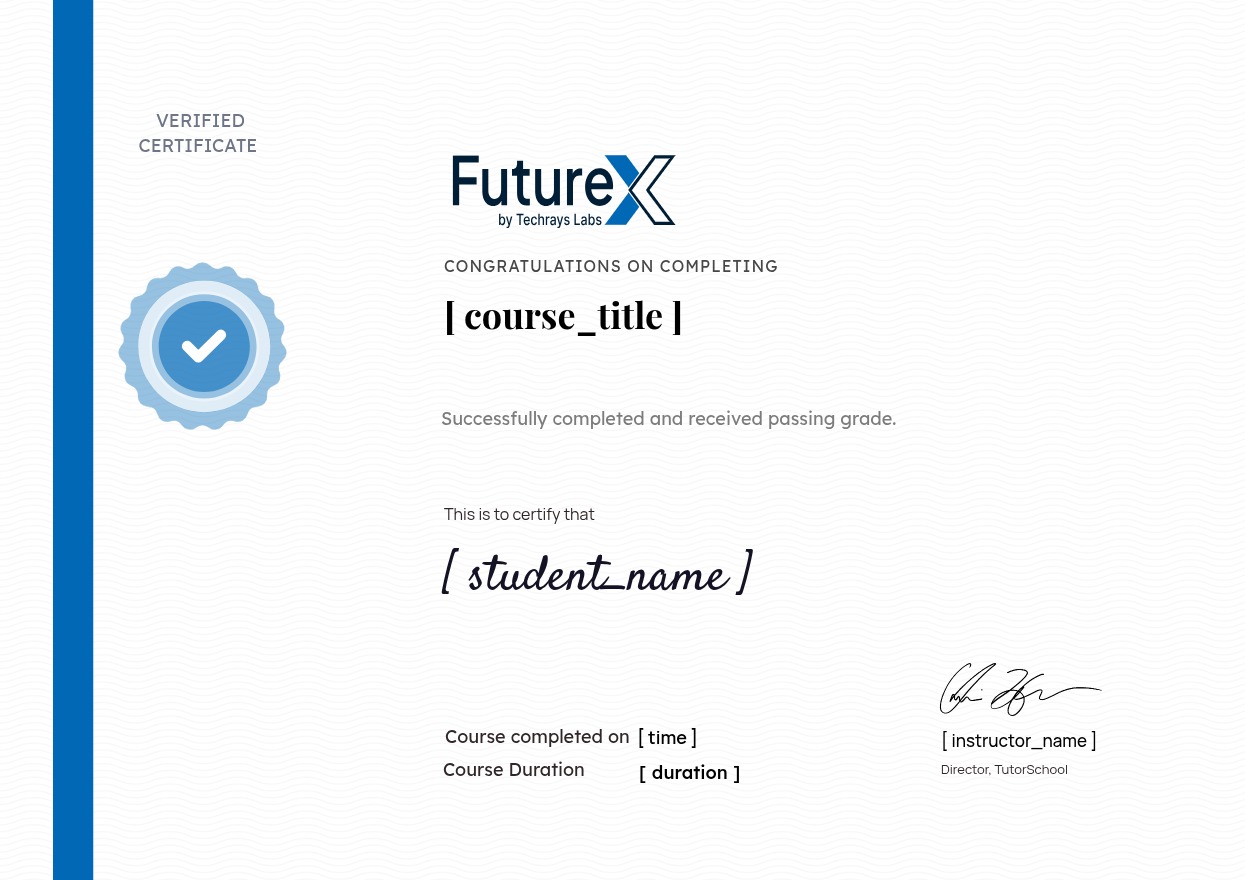
Earn a certificate
Add this certificate to your resume to demonstrate your skills & increase your chances of getting noticed.
Student Ratings & Reviews