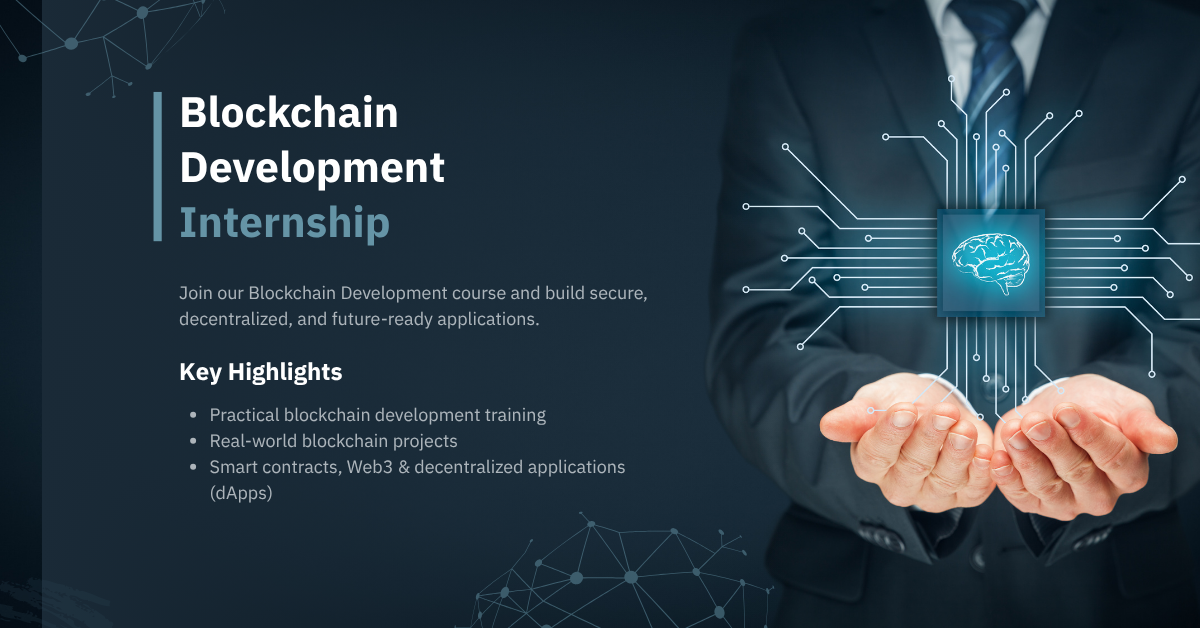
2 Months Blockchain Development Training & Internship

Categories: Training & Internship
Wishlist Share

About Course

The 2-Month Blockchain Development Internship is a professional training program focused on blockchain engineering fundamentals, Solidity development, decentralized applications (DApps), and smart contract deployment workflows.

This internship simulates real-world Web3 development environments where participants work on decentralized systems, blockchain interactions, and smart contract implementation.

The program combines blockchain architecture, Ethereum development, DApp integration, and deployment practices into a structured hands-on learning experience.

🚀 What This Internship Covers

The internship starts with strengthening Blockchain and Ethereum fundamentals including:

  • Blockchain architecture
  • Consensus mechanisms
  • Ethereum ecosystem
  • Public and private blockchains
  • Smart contract lifecycle

Participants then work on Smart Contract Development using Solidity including:

  • Functions and modifiers
  • Structs and mappings
  • Events and inheritance
  • Access control mechanisms
  • Error handling

The program introduces Decentralized Application (DApp) Development including:

  • Web3.js/Ethers.js basics
  • Wallet connectivity
  • MetaMask integration
  • Smart contract interaction
  • Frontend integration concepts

Learners also explore:

  • Test networks and deployment workflows
  • Smart contract testing basics
  • Blockchain security fundamentals
  • NFT and token basics

The internship includes mini-projects and blockchain implementation assignments.

🧠 Learning Approach

This internship follows an industry-oriented practical learning model including:

  • Smart contract implementation
  • DApp building exercises
  • Real blockchain testing workflows
  • Team-based project practice
  • Continuous code reviews and evaluations

The focus is on developing professional blockchain development skills through execution-heavy learning.

🏆 Skills You Will Gain

By the end of this internship, learners will be able to:

  • Build Solidity smart contracts
  • Create simple decentralized applications
  • Integrate blockchain wallets
  • Deploy contracts on Ethereum testnets
  • Understand Web3 workflows
  • Test and debug blockchain applications

🎯 Who This Internship is For

This internship is ideal for:

  • Students and freshers
  • Aspiring Blockchain Developers
  • Frontend/backend developers exploring Web3
  • Developers transitioning into blockchain engineering

Basic JavaScript and programming knowledge is helpful.

💼 Internship Outcome

After completing this internship, participants will gain practical blockchain development experience and the ability to build, deploy, and interact with decentralized applications professionally.

Show More

Course Content

Module 1: Blockchain Fundamentals
This module introduces the core foundation of blockchain technology from absolute basics. Students will understand what blockchain is, why it exists, and how it solves trust problems in digital systems. It builds the mental model required for everything that comes later in development. You will learn how data is structured in blocks, how cryptographic hashing works, and why decentralization is the backbone of blockchain systems. These concepts are not optional—they are mandatory before writing any smart contract or building any DApp. By the end of this module, you will clearly understand how Bitcoin and Ethereum fundamentally work at the data level. You will also be able to explain blockchain to anyone in simple technical terms and implement basic hashing logic.

  • What is Blockchain?
  • Cryptographic Hashing Basics
  • Decentralization & Consensus
  • Structure of a Blockchain (Blocks, Chain, Genesis Block)
  • Check what have you learnt about Blockchain Fundamentals Check
  • Simple Blockchain Simulator

Module 2: Blockchain Architecture & Working Principles
This module breaks down how blockchain actually functions under the hood. You are moving from theory to system-level understanding. You will learn how nodes communicate, how transactions are validated, and how blocks propagate across the network. It explains internal architecture used in Bitcoin and Ethereum-like systems. You will understand peer-to-peer networks, block propagation delays, and consensus enforcement logic. This is the point where most beginners get confused—because blockchain is not just code, it is a distributed system problem. By the end, you will understand how a blockchain network actually stays synchronized across thousands of machines.

Module 3: Cryptography in Blockchain Systems
This module moves into the security core of blockchain. Everything in blockchain depends on cryptography, not trust. Without cryptography, blockchain collapses into a normal shared database. You will learn how public-private key pairs work, how digital signatures are generated, and how identity is proven without passwords or central authority. This is critical because blockchain does not “trust users”—it mathematically verifies them. You will also understand how wallets actually work internally and how transactions are securely authorized. By the end, you will be able to explain and implement basic wallet-like signing mechanisms.

Module 4: Smart Contracts & Ethereum Ecosystem
This module shifts from blockchain theory into programmable blockchain systems. You are now dealing with logic that runs directly on the blockchain without intermediaries. Smart contracts are self-executing programs stored on the blockchain. Once deployed, they cannot be altered, which makes them powerful and dangerous if written poorly. You will learn Solidity basics, contract structure, execution flow, gas concept, and how Ethereum executes code deterministically across all nodes. This is the foundation for DeFi, NFTs, DAOs, and most Web3 applications. By the end, you will be able to write, deploy, and understand simple smart contracts.

Module 5: Decentralized Applications (DApps) & Web3 Integration
This module connects blockchain backend systems with real user-facing applications. Smart contracts alone are useless without a frontend layer that interacts with users, and that is where DApps come in. You will learn how decentralized applications are structured, how Web3 libraries communicate with blockchain networks, and how frontend-backend interaction works without traditional servers. You will also understand wallet integration (MetaMask conceptually), contract interaction flow, and how transactions are triggered from UI. By the end of this module, you will understand how real-world Web3 apps like NFT marketplaces and DeFi dashboards actually function.

Module 6: Advanced Blockchain Systems, Scaling & Final Capstone Project
This is the final module and it shifts from building components to understanding how real blockchain networks survive at global scale. Most beginners ignore this part and end up building systems that look correct but fail in real usage. You will learn blockchain scaling problems, Layer 1 vs Layer 2 architecture, sharding concepts, and real-world limitations like throughput, latency, and congestion. Most importantly, you will build a full end-to-end capstone project combining everything: cryptography, smart contracts, and DApp flow. By the end, you will not just “know blockchain”—you will understand how production systems like Ethereum actually handle millions of users.

Earn a certificate

Add this certificate to your resume to demonstrate your skills & increase your chances of getting noticed.
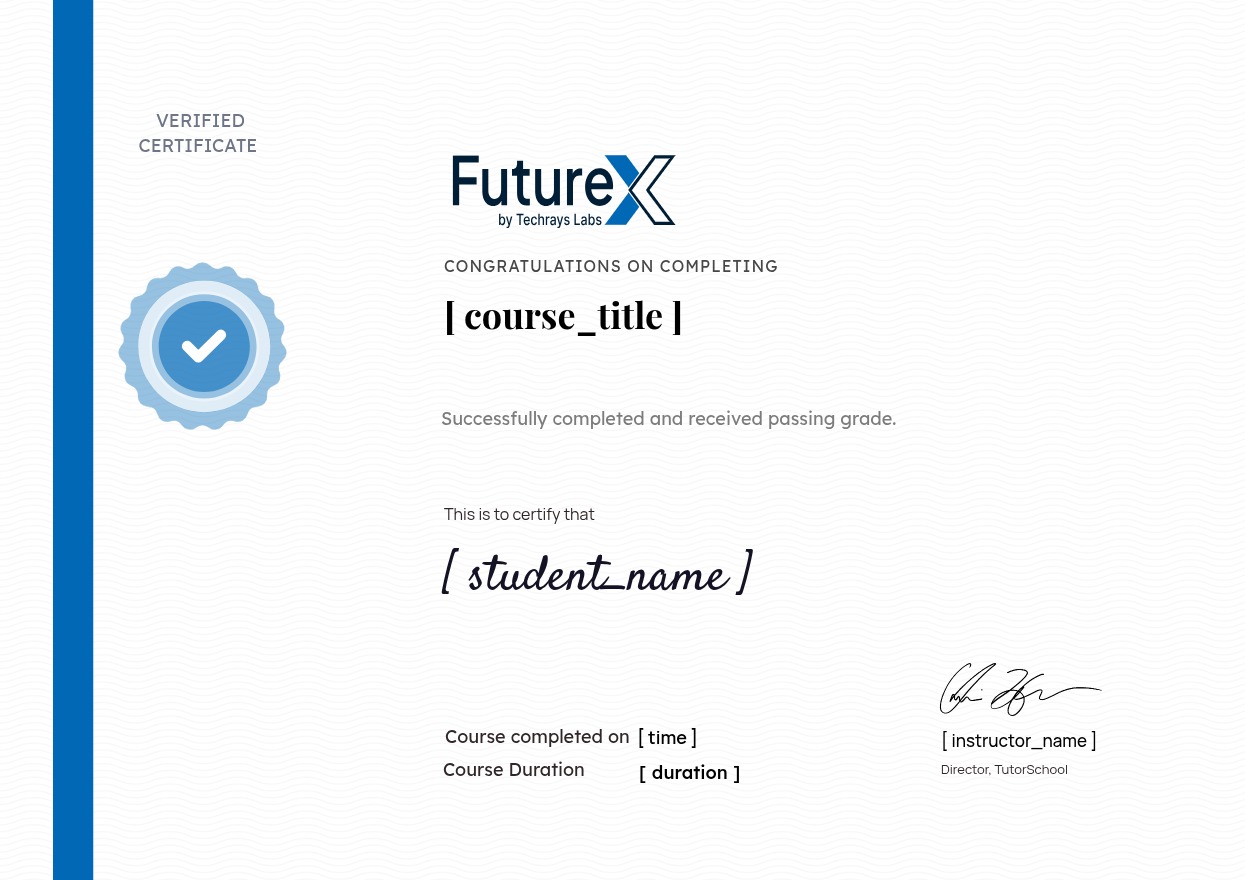
selected template

Student Ratings & Reviews

No Review Yet
No Review Yet