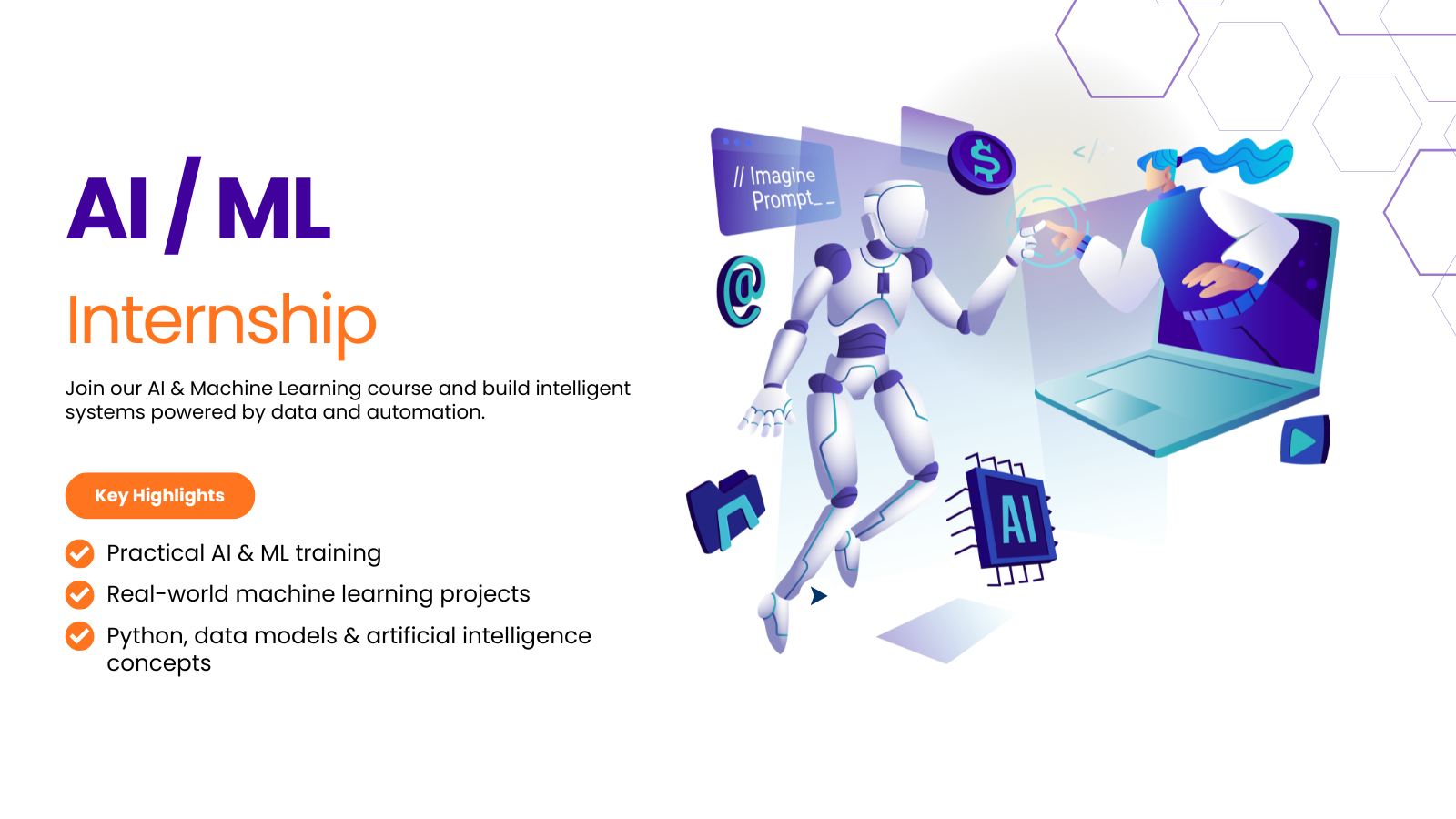
3 Months AI / ML Training & Internship

Categories: Training & Internship
Wishlist Share

About Course

The 3-Month AI/ML Internship is an advanced industry-oriented training program designed to help learners develop professional AI engineering and machine learning development skills through intensive hands-on implementation and real-world projects.

The internship focuses on predictive analytics, recommendation systems, intelligent automation, API integration, and deployment workflows used in modern AI applications.

This program is structured to simulate real AI industry environments where participants build complete end-to-end AI solutions.

🚀 What This Internship Covers

The internship begins with advanced Machine Learning and Data Analytics concepts, where learners understand model optimization, overfitting, feature selection, and scalable workflows.

Participants then explore Predictive Analytics and AI Systems, building intelligent models for forecasting, recommendation systems, and classification tasks.

The program introduces Natural Language Processing (NLP) Basics, including:

  • Text preprocessing
  • Sentiment analysis
  • Resume screening
  • Text classification

Learners also work on AI Web Application Development, integrating machine learning models into Flask-based web systems and analytics dashboards.

The internship covers Model Serialization and Deployment, where participants deploy machine learning applications and APIs using real hosting platforms.

In the final stage, students complete a Major AI Project involving analytics dashboards, AI automation systems, or recommendation engines.

🧠 Learning Approach

The internship follows a professional project-based approach that includes:

  • Real-world AI case studies
  • Practical coding sessions
  • Guided ML projects
  • Dashboard development
  • API integration tasks
  • Deployment exercises
  • Industry-style assessments

The learning structure focuses heavily on implementation and portfolio development.

🏆 Skills You Will Gain

By the end of this internship, participants will be able to:

  • Build advanced machine learning systems
  • Develop AI-powered web applications
  • Create recommendation systems
  • Work with NLP basics
  • Build REST APIs for AI models
  • Deploy machine learning applications
  • Develop portfolio-ready AI projects

🎯 Who This Internship is For

This internship is ideal for:

  • Intermediate AI/ML learners
  • Students preparing for AI careers
  • Developers interested in machine learning
  • Aspiring Data Scientists
  • Freelancers building AI skills

Participants should have basic Python and ML knowledge.

💼 Internship Outcome

After completing this internship, learners will have strong practical AI development skills and experience building real-world machine learning systems suitable for professional portfolios and internship/job opportunities.

Show More

Course Content

Module 1: Introduction to Artificial Intelligence, Machine Learning & Python Foundations
This module builds the foundation for the entire AI/ML internship by introducing students to the core concepts of Artificial Intelligence, Machine Learning, and the role of Python in building intelligent systems. Students begin by understanding what AI actually means, how Machine Learning fits inside AI, and why these technologies are transforming nearly every modern industry. This module is essential because students cannot build intelligent systems without first understanding the ecosystem, terminology, and problem-solving mindset behind AI/ML. Students will learn the differences between AI, ML, and Deep Learning, understand where these technologies are used in the real world, and explore the complete machine learning lifecycle from data collection to prediction. Alongside theory, students will also build their Python foundation, since Python is the primary programming language used in AI/ML due to its simplicity and powerful ecosystem. By the end of this module, students will understand how AI systems work at a high level, why Python is dominant in ML, how to set up a proper Python environment, and how to write basic Python code required for future machine learning modules. This module ensures students move into technical AI/ML topics with conceptual clarity and coding readiness.

  • Introduction to Artificial Intelligence, Machine Learning & Deep Learning
  • Real-World Applications of AI & Machine Learning
  • Introduction to Python for AI/ML
  • Setting Up Python Environment for Machine Learning
  • Check what have you learnt about AI, ML & Python Foundations Quiz
  • AI/ML Workspace Setup & Python Readiness Checker

Module 2: Python Programming for Machine Learning
This module builds the practical Python programming foundation required for machine learning development. In AI/ML, Python is not used just for basic scripting—it is used to manipulate data, automate logic, build reusable functions, process datasets, and prepare machine learning workflows. Students who do not understand Python fundamentals properly struggle later with data preprocessing, model training, and debugging. In this module, students will learn the Python concepts most relevant to machine learning, including variables, data types, conditional statements, loops, functions, lists, dictionaries, and file handling. The focus is not on generic academic programming, but on applied Python skills directly used in machine learning pipelines. Students will understand how Python code flows, how data is stored and manipulated, how logic is built, and how reusable code structures are created. Every concept is taught with direct AI/ML relevance so students understand not just syntax, but practical application. By the end of this module, students will be able to write structured Python programs, manipulate collections of data, build reusable logic with functions, and read/write files—skills that are essential before working with NumPy, Pandas, and machine learning libraries.

Module 3: Mathematics for Artificial Intelligence and Machine Learning
Mathematics is the operational backbone of Artificial Intelligence and Machine Learning. Every machine learning algorithm, from linear regression to deep neural networks, is built on mathematical principles. Students often attempt to learn machine learning only through libraries and code, but without mathematical understanding they fail to understand why models behave the way they do, how optimization works, or how predictions are mathematically generated. This module introduces the mathematical foundations required for machine learning in a practical and implementation-focused manner. The objective is not academic theorem memorization, but mathematical intuition for AI/ML engineering. Students will learn the exact mathematical concepts used in model training, optimization, probability estimation, and data representation. This module covers linear algebra, statistics, probability, and calculus from the perspective of machine learning applications. Each concept is taught with direct relevance to ML systems so students understand where it is used, why it matters, and how it affects model performance. By the end of this module, students will understand the mathematical reasoning behind machine learning algorithms, enabling them to interpret models better, debug intelligently, and optimize systems with technical confidence.

Module 4: Data Handling, Preprocessing & Exploratory Data Analysis (EDA)
Raw data is useless for machine learning until it is cleaned, structured, analyzed, and transformed into a usable format. In real-world AI/ML systems, most of the work is not model building—it is data preparation. Poor quality data leads to poor quality models regardless of how advanced the algorithm is. This is why data handling, preprocessing, and exploratory data analysis are core practical skills in machine learning. This module teaches students how to load, inspect, clean, preprocess, and analyze data before model training. Students will learn how to use Pandas for structured data manipulation, handle missing values, remove duplicates, encode categories, and prepare data for machine learning pipelines. They will also perform exploratory data analysis (EDA) to understand patterns, relationships, and anomalies in datasets. The focus is practical and industry-oriented. Students will learn the exact preprocessing steps used in real machine learning workflows and understand why data cleaning directly impacts model performance. By the end of this module, students will be able to load raw datasets, inspect data quality, clean inconsistencies, transform features, and perform exploratory analysis to make datasets ready for machine learning.

Module 5: Supervised Machine Learning – Regression and Classification
Supervised Machine Learning is the most widely used branch of machine learning in real-world systems. It is called “supervised” because models learn from labeled data, meaning the input data already contains the correct answers. The model studies patterns between input features and known outputs, then learns to predict outcomes for unseen data. This module introduces students to the two major categories of supervised learning: Regression and Classification. Regression is used when the output is a continuous numeric value, such as predicting salary, sales, or temperature. Classification is used when the output belongs to a category, such as spam detection, disease prediction, or customer churn classification. Students will learn how supervised learning works, how models are trained, how regression and classification differ, and how to evaluate both types of models. This module is one of the most important parts of the internship because it introduces students to actual predictive modeling. By the end of this module, students will be able to train supervised learning models, understand the difference between regression and classification, evaluate predictions, and apply these models to practical datasets.

Module 6: Unsupervised Learning, Feature Engineering & Model Optimization
Not all real-world data comes with labels. In many practical machine learning problems, datasets contain only raw input data with no predefined target output. In such cases, supervised learning cannot be used directly. This is where Unsupervised Learning becomes essential. Unsupervised learning helps discover hidden structures, patterns, and relationships in unlabeled data. This module introduces students to unsupervised learning techniques, especially clustering, and then extends into feature engineering and model optimization—two critical skills that directly improve machine learning performance. Students will learn how to group similar data points, create stronger input features, and improve model performance through better parameter tuning. In industry, the difference between a weak model and a strong model is often not the algorithm—it is the quality of features and optimization. This module teaches students how to improve models beyond basic training. By the end of this module, students will understand how to work with unlabeled data, apply clustering algorithms, engineer stronger features, and optimize machine learning models for better real-world performance.

Module 7: Model Deployment, ML in Production & Deep Learning Fundamentals
Building a machine learning model is only part of the real workflow. A model becomes useful only when it is deployed into a production environment where real users, systems, or applications can interact with it. In industry, machine learning is not considered complete when a model is trained—it is complete when the model is usable, accessible, and reliable in production. This module teaches students how machine learning models move from development to deployment and how ML systems function in production environments. Students will learn how trained models are saved, loaded, exposed through APIs, and integrated into real applications. They will also learn the basic production concerns such as inference, scalability, monitoring, and reliability. This module also introduces Deep Learning fundamentals, giving students a practical understanding of neural networks, how deep learning differs from traditional machine learning, and where it is used in real-world AI systems. By the end of this module, students will understand how machine learning models are deployed in real applications, how production ML works, and how deep learning systems learn from data using neural networks.

Final Module: End-to-End AI/ML Capstone Project
This final module is the complete practical consolidation of the internship. Students will build a full end-to-end AI/ML project that simulates a real industry workflow—from problem understanding and data collection to preprocessing, model training, evaluation, and deployment. This is not a toy exercise. It is a production-style capstone designed to test whether the student can apply the complete machine learning lifecycle independently. The objective of this final project is to move students from “learning ML concepts” to “building usable ML systems.” Students will combine Python, data preprocessing, exploratory analysis, supervised learning, feature engineering, evaluation, deployment, and API exposure into one complete real-world project. This project is intentionally structured like a real AI/ML workflow used in companies. Students will work through problem definition, dataset handling, model development, optimization, and deployment while documenting each step like a practical ML engineer. By the end of this final module, students will have one complete portfolio-ready AI/ML project demonstrating end-to-end machine learning engineering skills.

Earn a certificate

Add this certificate to your resume to demonstrate your skills & increase your chances of getting noticed.
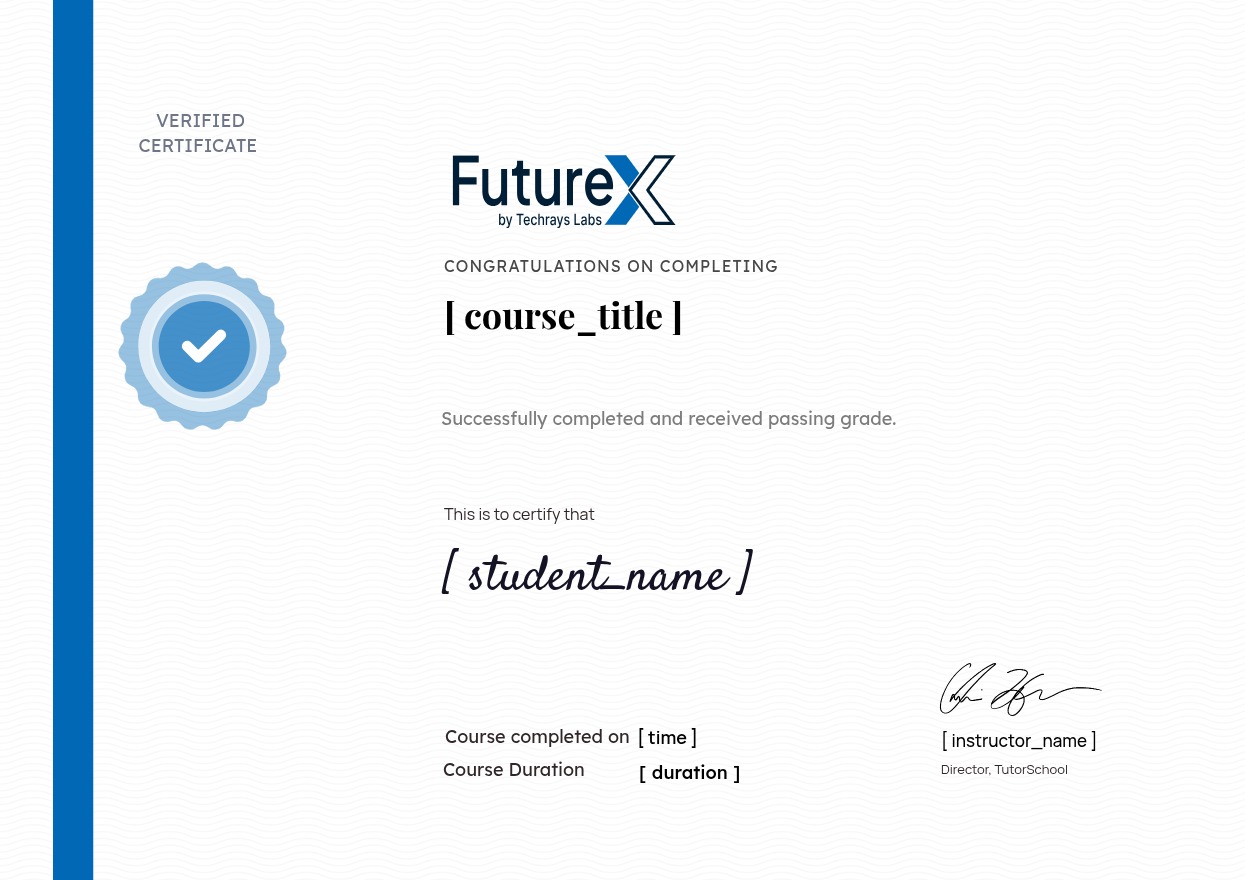
selected template

Student Ratings & Reviews

No Review Yet
No Review Yet