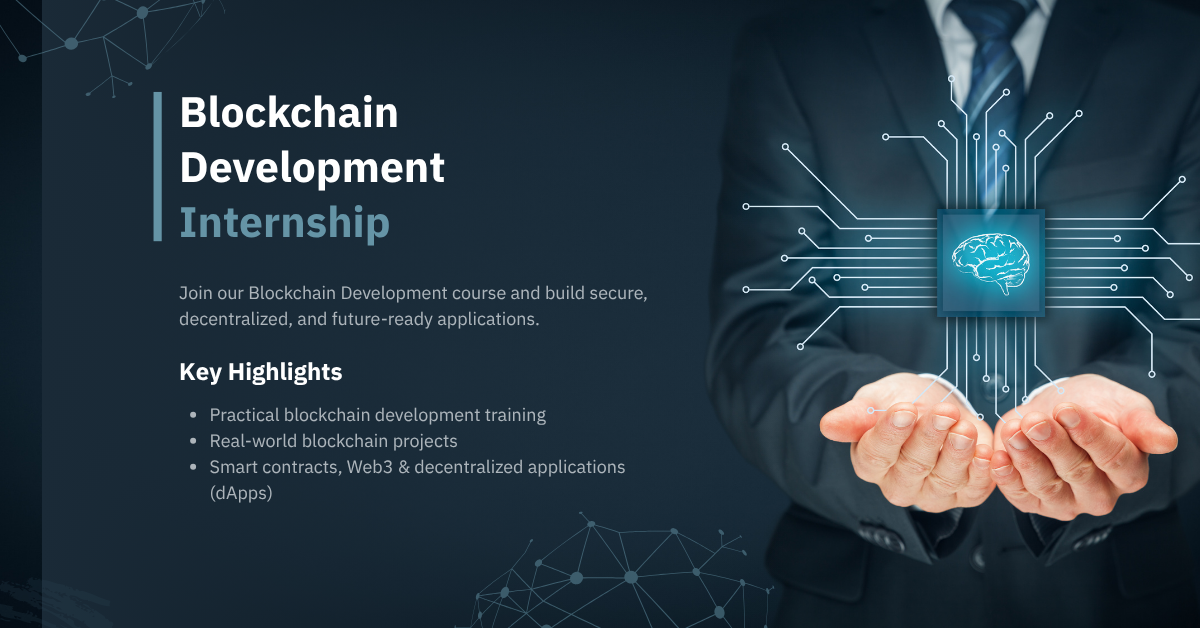
3 Months Blockchain Development Training & Internship

Categories: Training & Internship
Wishlist Share

About Course

The 3-Month Blockchain Development Internship is an advanced practical training program focused on smart contract engineering, decentralized application development, blockchain integration systems, and Web3 development workflows.

This internship is designed to simulate professional blockchain engineering environments where participants work on scalable decentralized applications, secure smart contracts, and collaborative blockchain development systems.

The program combines blockchain engineering, DApp architecture, smart contract security fundamentals, and deployment workflows into a structured professional learning experience.

🚀 What This Internship Covers

The internship begins with strengthening advanced Blockchain Development concepts including:

  • Ethereum ecosystem architecture
  • Blockchain nodes and networks
  • Token standards
  • Smart contract lifecycle management
  • Gas optimization basics

Participants then work on Advanced Smart Contract Development including:

  • ERC-20 and ERC-721 token standards
  • NFT development basics
  • Contract inheritance
  • Smart contract optimization
  • Role-based access systems

The program introduces Advanced DApp Development including:

  • React + Web3 integration
  • Wallet authentication
  • Ethers.js/Web3.js workflows
  • Smart contract interaction systems
  • Blockchain event handling

Participants also learn:

  • Smart contract testing
  • Hardhat/Truffle basics
  • Blockchain security practices
  • Decentralized storage concepts
  • Blockchain deployment workflows

The internship includes multiple real-world blockchain projects and collaborative Web3 implementation exercises.

🧠 Learning Approach

This internship follows a highly practical implementation-driven learning model including:

  • Industry-oriented blockchain projects
  • Smart contract coding sessions
  • Real DApp development workflows
  • Team collaboration
  • Code reviews and optimization
  • Deployment practice
  • Continuous performance evaluations

The focus is on developing professional blockchain engineers through project-based learning.

🏆 Skills You Will Gain

By the end of this internship, learners will be able to:

  • Build advanced smart contracts
  • Create decentralized applications
  • Integrate blockchain wallets and networks
  • Deploy and test blockchain systems
  • Understand NFT and token standards
  • Follow secure blockchain development practices
  • Work with modern Web3 frameworks

🎯 Who This Internship is For

This internship is ideal for:

  • Serious blockchain learners
  • Engineering students
  • Aspiring Web3 Developers
  • Developers transitioning into blockchain engineering
  • Freelancers building decentralized application expertise

Basic JavaScript and blockchain knowledge is recommended.

💼 Internship Outcome

After completing this internship, participants will gain industry-level blockchain development experience with practical knowledge of smart contract engineering, DApp development, blockchain integration, and professional Web3 workflows.

Show More

Course Content

Module 1: Introduction to Blockchain & Decentralized Systems
This module builds the foundation of blockchain development by introducing students to the core concepts behind blockchain technology and decentralized systems. Students will learn what blockchain is, why it was created, and how it solves major limitations of traditional centralized systems. This module is critical because every advanced blockchain topic—such as smart contracts, decentralized applications (dApps), and Web3—depends on a clear understanding of these fundamentals. Students will explore how blockchain stores data, how transactions are validated, and why decentralization matters in modern digital systems. The module also explains the difference between blockchain, cryptocurrency, and distributed systems, which is one of the most misunderstood areas for beginners. These concepts are essential for anyone planning to build secure and scalable blockchain applications. By the end of this module, students will understand the internal structure of blockchain, how blocks are connected, how nodes communicate, and how trust is established without a central authority. They will also gain practical exposure to blockchain data flow using simple code examples and simulations. This module sets the base for all technical implementation in later modules.

  • What is Blockchain?
  • Centralized vs Decentralized Systems
  • Blocks, Transactions, and Hashing
  • Check what have you learnt about Blockchain Fundamentals Quiz
  • Build a Simple Blockchain Simulation

Module 2: Blockchain Architecture & Core Components
This module focuses on the internal architecture of blockchain systems and explains the core components that make a blockchain network function correctly. After learning the basic idea of blockchain in Module 1, students now move deeper into the actual structure of blockchain networks, including nodes, blocks, ledgers, consensus systems, and peer-to-peer communication. This module is important because blockchain development is not just about writing smart contracts. A developer must understand how the network works underneath before building applications on top of it. Without understanding blockchain architecture, students usually learn tools mechanically and fail when debugging real systems. Students will learn how blockchain networks are structured, how data flows between participants, how blocks are validated, and how network participants stay synchronized without a central server. This module also introduces the role of miners and validators, and explains how blockchain maintains trust in distributed environments. By the end of this module, students will understand the complete lifecycle of a blockchain transaction—from creation to validation to permanent storage in the ledger. They will also be able to identify the key architectural layers in blockchain systems and understand how those layers interact in real-world blockchain networks such as Bitcoin and Ethereum.

Module 3: Cryptography Fundamentals for Blockchain
This module introduces the cryptographic principles that make blockchain secure, verifiable, and tamper-resistant. Blockchain is not secure because it is distributed alone. It is secure because cryptography protects identities, validates ownership, secures transactions, and ensures data integrity across untrusted environments. Students will learn the core cryptographic building blocks used in blockchain systems, including hashing, public-key cryptography, private keys, digital signatures, and wallets. These concepts are critical because blockchain transactions, account ownership, and smart contract interactions all depend on cryptographic verification. This module is important because most blockchain failures at the beginner level happen due to poor understanding of keys, signatures, and cryptographic trust. A developer who does not understand cryptography cannot safely build blockchain systems. Students will understand how blockchain proves identity without usernames, verifies ownership without centralized control, and secures transactions without exposing private data. By the end of this module, students will be able to explain and implement basic cryptographic operations used in blockchain applications and understand how trust is mathematically enforced in decentralized systems.

Module 4: Consensus Mechanisms in Blockchain
This module explains how blockchain networks reach agreement without relying on a central authority. In traditional systems, one central server decides what is valid. In blockchain, thousands of independent participants must agree on the same state of data. That agreement process is called consensus. Consensus mechanisms are one of the most important parts of blockchain because they determine how transactions are verified, how blocks are added, how trust is maintained, and how attacks are prevented. Without consensus, blockchain becomes an untrusted distributed database with no reliable way to validate records. Students will learn why consensus is necessary, how different consensus mechanisms work, and where each one is used in real blockchain systems. This module covers Proof of Work (PoW), Proof of Stake (PoS), and Delegated Proof of Stake (DPoS), along with their tradeoffs in speed, energy use, decentralization, and security. By the end of this module, students will understand how blockchain participants agree on valid transactions, how consensus protects against fraud such as double-spending, and why different blockchain systems choose different consensus models depending on their goals.

Module 5: Smart Contracts Development Fundamentals
This module introduces smart contracts, which are the core execution layer of modern blockchain platforms like Ethereum. Smart contracts are self-executing programs stored on the blockchain that automatically run when predefined conditions are met. They remove the need for intermediaries in agreements, transactions, and digital processes. This module is critical because smart contracts are the foundation of decentralized applications (dApps), DeFi platforms, NFT systems, and blockchain-based automation. Without understanding smart contracts, blockchain development is incomplete. Students will learn how smart contracts work internally, how they are written, deployed, and executed, and why they are considered immutable once deployed. The module also explains gas fees, contract storage, and execution flow on blockchain networks. By the end of this module, students will be able to write basic smart contracts using Solidity, understand contract deployment lifecycle, and identify common security risks in smart contract development.

Module 6: Decentralized Applications (dApps) Development
This module focuses on decentralized applications (dApps), which are user-facing applications built on top of blockchain smart contracts. dApps represent the practical layer of blockchain technology where users interact with blockchain systems through web or mobile interfaces. This module is important because smart contracts alone are not enough to build real-world systems. dApps combine frontend, backend logic, and blockchain smart contracts into a complete product. This is where blockchain becomes usable for end users. Students will learn how dApps are structured, how frontend applications connect to smart contracts, how blockchain wallets interact with applications, and how data flows between UI and blockchain. The module also introduces Web3 libraries like Web3.js and Ethers.js. By the end of this module, students will be able to design and build basic decentralized applications, connect wallets to blockchain networks, and interact with smart contracts from a frontend application.

Module 7: Blockchain Security, Attacks & Best Practices
This module covers security risks in blockchain systems and how real-world attacks happen on smart contracts, networks, and wallets. Blockchain is often considered “secure by design,” but that is misleading. The base protocol is strong, but applications built on top of it are frequently vulnerable due to poor coding, bad architecture, or weak key management. Students will learn how attackers exploit blockchain systems, what common vulnerabilities exist in smart contracts, and how to prevent them using proper development practices. This includes reentrancy attacks, 51% attacks, phishing risks, private key leakage, and oracle manipulation. This module is critical because most real blockchain hacks do not break cryptography—they exploit developer mistakes. Understanding security is mandatory for building production-grade smart contracts and dApps. By the end of this module, students will understand major blockchain attack vectors, how they work internally, and how to secure applications using industry-standard best practices.

Module 8: Final Project – Full Blockchain System (End-to-End Implementation)
This final module is the complete consolidation of everything learned in the internship. Students will design and simulate a full blockchain system that includes blocks, transactions, hashing, consensus logic, and a simple dApp-style interaction flow. This module is not theoretical. It forces you to build a working system that behaves like a simplified real blockchain. It combines cryptography, consensus, architecture, and smart contract-like logic into one integrated project. This is important because real blockchain development is not isolated topics—it is system integration. Most beginners fail because they understand concepts separately but cannot connect them into a working system. By the end of this module, students will have built a fully functional blockchain simulation with transaction flow, block creation, validation logic, and a simple frontend-style interaction model. This acts as a capstone project for portfolio and interview readiness.

Earn a certificate

Add this certificate to your resume to demonstrate your skills & increase your chances of getting noticed.
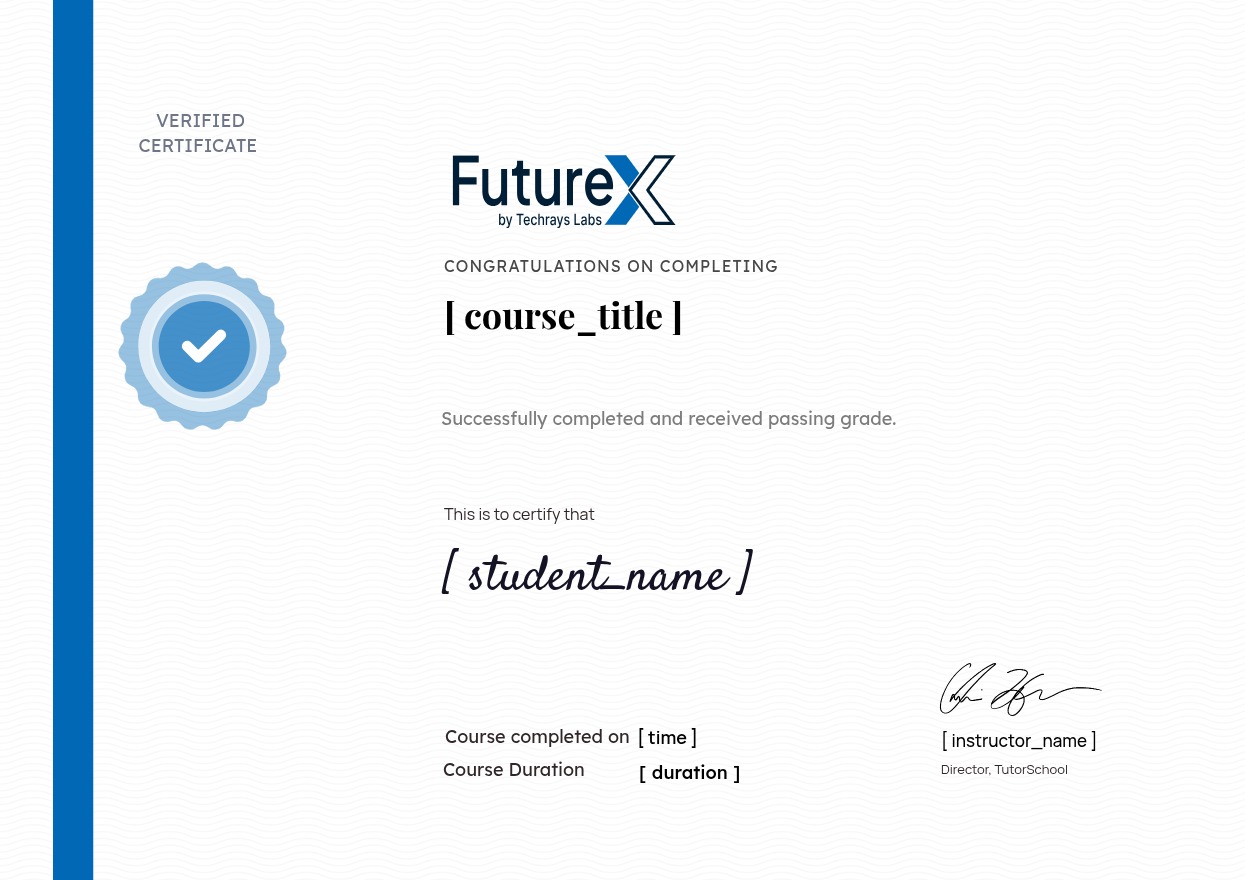
selected template

Student Ratings & Reviews

No Review Yet
No Review Yet