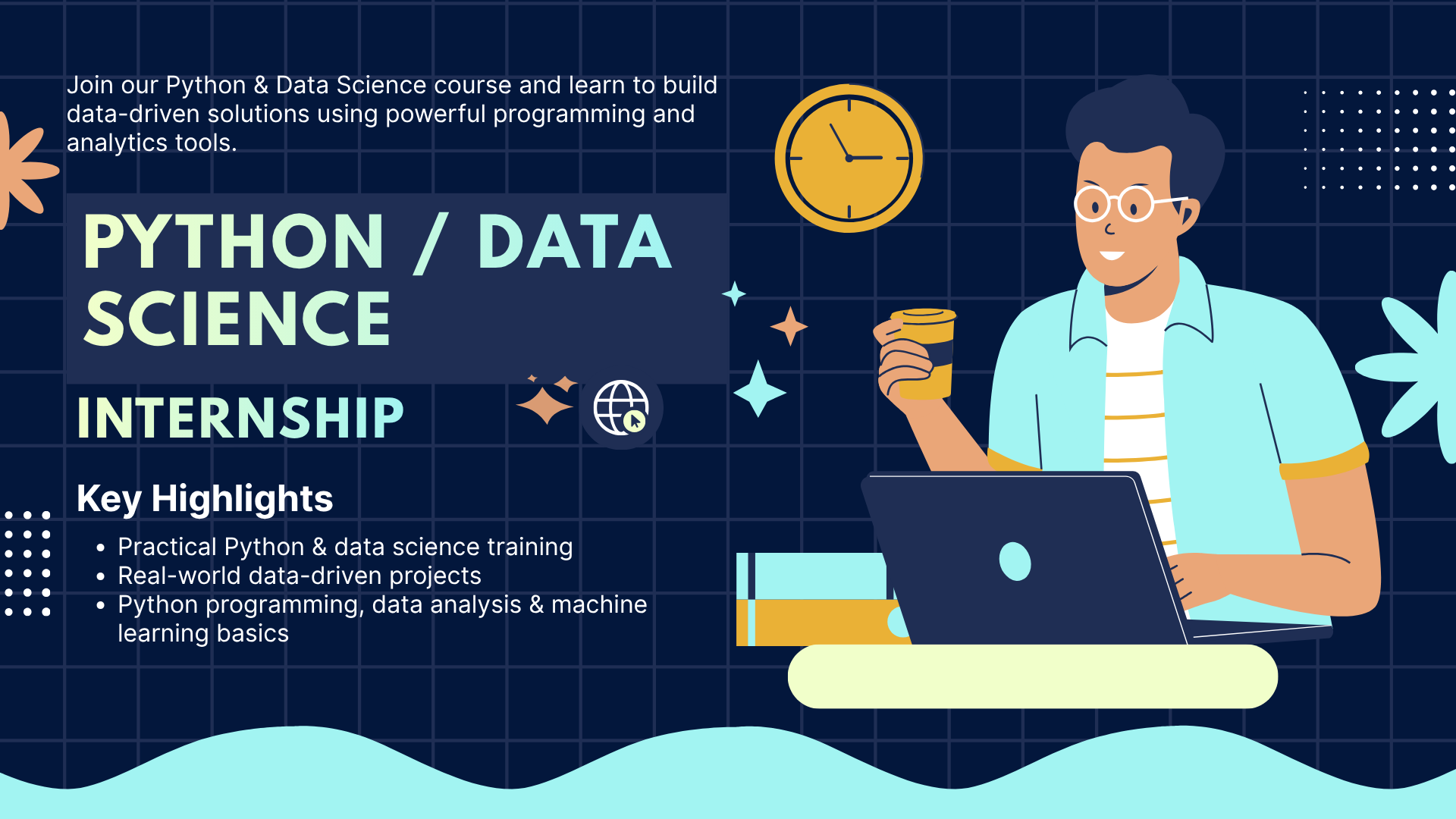
3 Months Python / Data Science Training & Internship

Categories: Training & Internship
Wishlist Share

About Course

This 3-Month Python / Data Science Internship is a comprehensive and practical training program designed to help beginners build strong programming, analytical, and data science skills using Python and modern data science technologies. The internship focuses on developing problem-solving abilities, data analysis expertise, and machine learning fundamentals through structured learning and real-world project implementation.

The program follows a progressive learning approach, starting from Python programming fundamentals and gradually advancing toward data analysis, visualization, machine learning, and real-world data science workflows. Learners gain both conceptual understanding and practical hands-on experience through coding exercises, assignments, quizzes, datasets, mini-projects, and industry-style capstone projects.

🚀 What This Internship Covers

The internship begins with the fundamentals of Python programming, where learners build strong logical thinking and coding skills. Students understand concepts such as variables, data types, loops, conditional statements, functions, lists, tuples, dictionaries, file handling, exception handling, and Object-Oriented Programming basics.

This phase helps beginners become comfortable with programming and problem-solving before moving toward advanced data science concepts.

Once the programming foundation is established, the program introduces learners to Data Analysis using Python. Students work with real-world datasets and learn how to process, clean, organize, and analyze data efficiently.

Key topics include:

  • Data cleaning and preprocessing
  • Handling missing data
  • Data transformation
  • Exploratory Data Analysis (EDA)
  • Statistical analysis basics
  • Working with structured datasets
  • Business data interpretation

Learners gain practical experience using powerful Python libraries such as:

  • NumPy for numerical computing
  • Pandas for data manipulation and analysis
  • Matplotlib for data visualization
  • Seaborn for advanced visualization basics

The internship then moves into Data Visualization and Reporting, where learners understand how to represent data visually and communicate insights effectively through charts, graphs, and dashboards.

Visualization topics include:

  • Line charts
  • Bar graphs
  • Pie charts
  • Histograms
  • Scatter plots
  • Heatmaps
  • Trend and pattern analysis
  • Data storytelling basics

After building strong data analysis fundamentals, students are introduced to Machine Learning Fundamentals, where they understand how predictive models are created using data.

Machine learning topics include:

  • Introduction to Machine Learning
  • Supervised and Unsupervised Learning basics
  • Training and testing datasets
  • Regression algorithms
  • Classification algorithms
  • Model evaluation basics
  • Feature selection concepts
  • Prediction workflows

Learners work with beginner-friendly machine learning implementations using Scikit-learn and understand how machine learning is applied in real-world industries.

The internship also introduces important professional workflows and tools used in data science environments, including:

  • Jupyter Notebook
  • Google Colab
  • Dataset handling
  • Project structuring
  • Data-driven problem-solving
  • Reporting and presentation techniques
  • Real-world analytics workflows

As students progress through the internship, they complete coding exercises, analytics tasks, and mini-projects that strengthen their understanding of Python and data science concepts.

In the final phase of the internship, learners build a real-world Data Science Project such as:

  • Sales Prediction System
  • Customer Segmentation Analysis
  • Student Performance Prediction
  • Stock Market Analysis
  • Movie Recommendation Basics
  • Data Analytics Dashboard

The capstone project helps learners apply programming, analysis, visualization, and machine learning concepts together while simulating real industry data science workflows.

🧠 Learning Approach

This internship is designed around practical implementation and hands-on learning rather than theory-only education. Every module includes:

  • Structured lessons and guided learning
  • Practical coding exercises
  • Real-world datasets and examples
  • Assignments and mini-projects
  • Module-wise quizzes and assessments
  • Data analysis practice sessions
  • Visualization and reporting exercises
  • A final industry-style capstone project

The learning progression is sequential, ensuring learners develop strong programming and analytical foundations before advancing toward machine learning concepts.

🏆 Skills You Will Gain

By the end of this internship, participants will be able to:

  • Write clean and efficient Python programs
  • Analyze and process real-world datasets
  • Perform data cleaning and preprocessing
  • Use Pandas and NumPy for data analysis
  • Create visual reports and dashboards
  • Understand exploratory data analysis techniques
  • Build basic machine learning models
  • Work with Scikit-learn for predictive analysis
  • Interpret data and generate actionable insights
  • Develop real-world data science projects independently

🎯 Who This Internship is For

This internship is ideal for:

  • Beginners interested in Python and Data Science
  • Students pursuing computer science, IT, mathematics, statistics, or related fields
  • Learners wanting practical data analytics and machine learning skills
  • Professionals looking to enter the data science field
  • Anyone preparing for internships or entry-level data science roles

No prior programming experience is required. However, consistency, analytical thinking, and regular practice are important for successful completion.

💼 Internship Outcome

Upon successful completion of this internship, learners will have strong practical experience in Python programming, data analysis, visualization, and machine learning fundamentals. They will also complete a portfolio-ready data science project that demonstrates their analytical and technical skills, significantly improving their readiness for internships, freelance opportunities, and entry-level Data Analyst or Data Science roles in the industry.

Show More

Course Content

Module 1: Python Foundations for Programming & Data Science
This module builds the foundation of the entire internship by introducing students to Python programming from the ground up. Students will begin by understanding what Python is, why it is one of the most in-demand programming languages, and how it is used in software development, automation, analytics, and data science. This module is designed for complete beginners, so no prior coding experience is required. Students will learn how to set up Python, write their first programs, understand syntax, work with variables, and perform basic operations. These are the building blocks required before moving into advanced programming and data science libraries such as NumPy, Pandas, and Machine Learning. The module focuses heavily on practical understanding so learners not only read syntax but actually understand how Python executes code internally. This is important because data science is not just about tools—it is about solving problems through logic and computation. By the end of this module, students will be able to write simple Python programs, understand how Python interprets instructions, manipulate variables, take user input, and perform logical operations confidently. This module establishes the programming mindset required for the rest of the internship. Students will also begin thinking like developers by understanding how programs are structured, how errors happen, and how to write readable code. These habits are essential in real-world data and software projects. This module serves as the launchpad for everything that follows in the internship.

  • Introduction to Python & Environment Setup
  • Variables, Data Types & Input/Output
  • Operators in Python
  • Check what have you learnt about Python Basics & Programming Foundations
  • Personal Expense Calculator

Module 2: Control Flow & Functions in Python
This module introduces students to the logic-building core of programming: decision-making, repetition, and reusable code. After learning Python basics in Module 1, students now move from writing simple statements to building actual program logic. This is where students begin learning how programs “think” and respond dynamically based on conditions and user input. Students will learn how to control the flow of execution using conditional statements such as if, elif, and else, and how to automate repetitive tasks using loops. These concepts are the backbone of software development because real-world programs constantly make decisions and repeat tasks. The module also introduces functions, which allow developers to organize code into reusable blocks. This is a critical programming skill because functions improve readability, reduce repetition, and make code scalable. In real-world data science and software engineering, functions are used everywhere—from cleaning datasets to building machine learning pipelines. Students will understand how conditions are evaluated, how loops execute internally, how function calls work, and how arguments and return values help modularize logic. These concepts are essential because all advanced programming depends on control flow and structured logic. By the end of this module, students will be able to write dynamic Python programs that make decisions, repeat tasks intelligently, and organize code into reusable functions. This module transforms students from writing isolated statements into writing actual logic-driven programs. This is the module where students stop “writing lines” and start “building logic.”

Module 3: Data Structures in Python
This module introduces students to Python’s core data structures, which are essential for storing, organizing, and manipulating collections of data efficiently. In real-world programming and data science, working with single values is rare. Most systems process lists of records, collections of values, structured mappings, and grouped datasets. Data structures are what make that possible. Students will learn the four most important built-in Python data structures: lists, tuples, sets, and dictionaries. These structures are used constantly in software engineering, automation, analytics, and machine learning because they allow developers to organize data based on use case and access pattern. This module is critical because data science is fundamentally about handling data, and raw data almost always comes in grouped or structured forms. Whether storing rows from a CSV file, mapping user information, removing duplicates, or organizing feature values, data structures are used everywhere. Students will learn not just syntax, but when and why each structure is used, how Python stores them internally, what operations are efficient, and how to choose the correct structure in real-world applications. By the end of this module, students will be able to store and manipulate grouped data, iterate through structured collections, choose appropriate data structures based on problem requirements, and write cleaner, more efficient Python programs. This module is where students stop thinking in single values and start thinking in collections, which is mandatory for real-world programming and data science.

Module 4: File Handling & Exception Handling in Python
This module focuses on two critical real-world programming skills: working with external data files and handling runtime errors safely. Up to this point, programs have been working only with in-memory data. In real applications, data is stored in files, databases, and external systems. File handling teaches how to read and write persistent data such as text files, logs, and datasets. Exception handling teaches how to build stable programs that do not crash when unexpected errors occur. In production systems, failures are common—missing files, wrong inputs, broken connections. Without proper error handling, applications fail completely. With it, they recover gracefully. Students will learn how to open files, read content, write data, append records, and manage file modes. They will also learn how to detect, catch, and handle errors using try, except, finally, and custom exception handling logic. This module is extremely important for data science because datasets are almost always loaded from files like CSV, TXT, or JSON. Similarly, real systems require robust error handling to ensure reliability. By the end of this module, students will be able to build programs that interact with external files and handle errors safely without crashing. This is where Python becomes production-ready.

Module 5: Object-Oriented Programming (OOP) in Python
This module introduces Object-Oriented Programming, which is a major shift from procedural coding to structured software design. Until now, students have written functions and logic, but real-world software is not built as isolated functions—it is built as interacting objects that represent real entities. OOP allows you to model real-world systems using classes and objects. For example, a student, a bank account, or a machine learning model can all be represented as objects with properties (data) and behaviors (methods). This module is critical for building scalable applications because it introduces core software engineering principles like encapsulation, inheritance, abstraction, and polymorphism. These concepts are used in frameworks like Django, Flask, and in data science pipelines where models and datasets are structured as objects. Students will learn how to design classes, create objects, use constructors, and implement OOP principles in real programs. This is where Python starts feeling like professional software development. By the end of this module, students will be able to design structured applications using classes, model real-world systems in code, and write reusable, scalable object-based programs. This is the foundation of real software engineering.

Module 6: NumPy for Numerical Computing
This module introduces NumPy, the fundamental library for numerical computing in Python. At this stage, students move from basic Python programming into data science tools that are actually used in real industry workflows. NumPy is the foundation for almost every data science and machine learning library, including Pandas, TensorFlow, and Scikit-learn. Students will learn how to work with arrays instead of Python lists, perform fast mathematical operations, and handle multi-dimensional data efficiently. Unlike lists, NumPy arrays are optimized for performance and memory, making them essential for large-scale data processing. This module is critical because real-world datasets are large, and Python lists are too slow for mathematical computation at scale. NumPy solves this problem using vectorized operations and optimized C-based backend execution. Students will learn how arrays work, how broadcasting operates, how to perform statistical and mathematical operations, and how to manipulate matrices. These concepts form the backbone of machine learning and data analysis pipelines. By the end of this module, students will be able to perform high-speed numerical computations, manipulate arrays efficiently, and prepare data for machine learning models. This is where Python transforms into a data science engine.

Module 7: Pandas for Data Analysis
This module introduces Pandas, the most widely used Python library for data analysis and manipulation. After learning NumPy for numerical computation, students now move to structured data handling, which is the core of real-world data science workflows. Pandas is designed to work with tabular data such as spreadsheets, CSV files, and SQL tables. It allows users to clean, transform, filter, and analyze large datasets efficiently. In real industry scenarios, data is never clean or ready for machine learning. Pandas is the primary tool used to prepare raw data into usable formats. Students will learn how to use Series and DataFrames, which are the core data structures in Pandas. They will also learn how to load datasets, handle missing values, filter data, and perform grouping and aggregation operations. This module is extremely important because 70–80% of data science work involves data cleaning and preprocessing, not model building. Without Pandas, handling real datasets becomes inefficient and error-prone. By the end of this module, students will be able to load datasets, clean messy data, transform columns, and perform meaningful analysis on structured data. This is where raw data becomes usable intelligence.

Module 8: Data Visualization with Matplotlib & Seaborn
This module focuses on transforming raw data into visual insights using Python’s most important visualization libraries: Matplotlib and Seaborn. After working with NumPy and Pandas, students now move to interpreting data visually, which is a critical skill in data science and analytics. Data visualization is the process of representing data in graphical form such as charts, graphs, and plots so that patterns, trends, and anomalies can be easily understood. Humans process visuals far faster than raw numbers, which is why visualization is essential in every data-driven decision-making process. Students will learn how to create line charts, bar charts, histograms, scatter plots, and advanced statistical plots. They will also learn how Seaborn simplifies complex visualizations and enhances aesthetics for better interpretation. This module is essential because data scientists do not just analyze data—they communicate insights. Visualization is the bridge between analysis and decision-making. By the end of this module, students will be able to create professional-level charts, identify patterns in datasets visually, and present data insights effectively. This is where data becomes understandable storytelling.

Final Module: End-to-End Data Science Project
This final module brings together everything learned across the internship into a complete real-world data science workflow. Students will no longer work on isolated concepts like Python basics, NumPy, Pandas, or visualization individually. Instead, they will apply all of them in a structured pipeline similar to how real data scientists work in industry. The goal of this module is to simulate a full data science project lifecycle: from raw data ingestion to cleaning, analysis, visualization, and deriving insights. This is exactly how data science projects are executed in companies. Students will work with a real dataset, clean it, analyze patterns, visualize trends, and generate insights. This module is designed to test problem-solving ability, not just coding knowledge. By the end of this module, students will be able to independently build end-to-end data analysis projects and present insights in a structured, professional format. This is the transition from learner to job-ready data practitioner.

Earn a certificate

Add this certificate to your resume to demonstrate your skills & increase your chances of getting noticed.
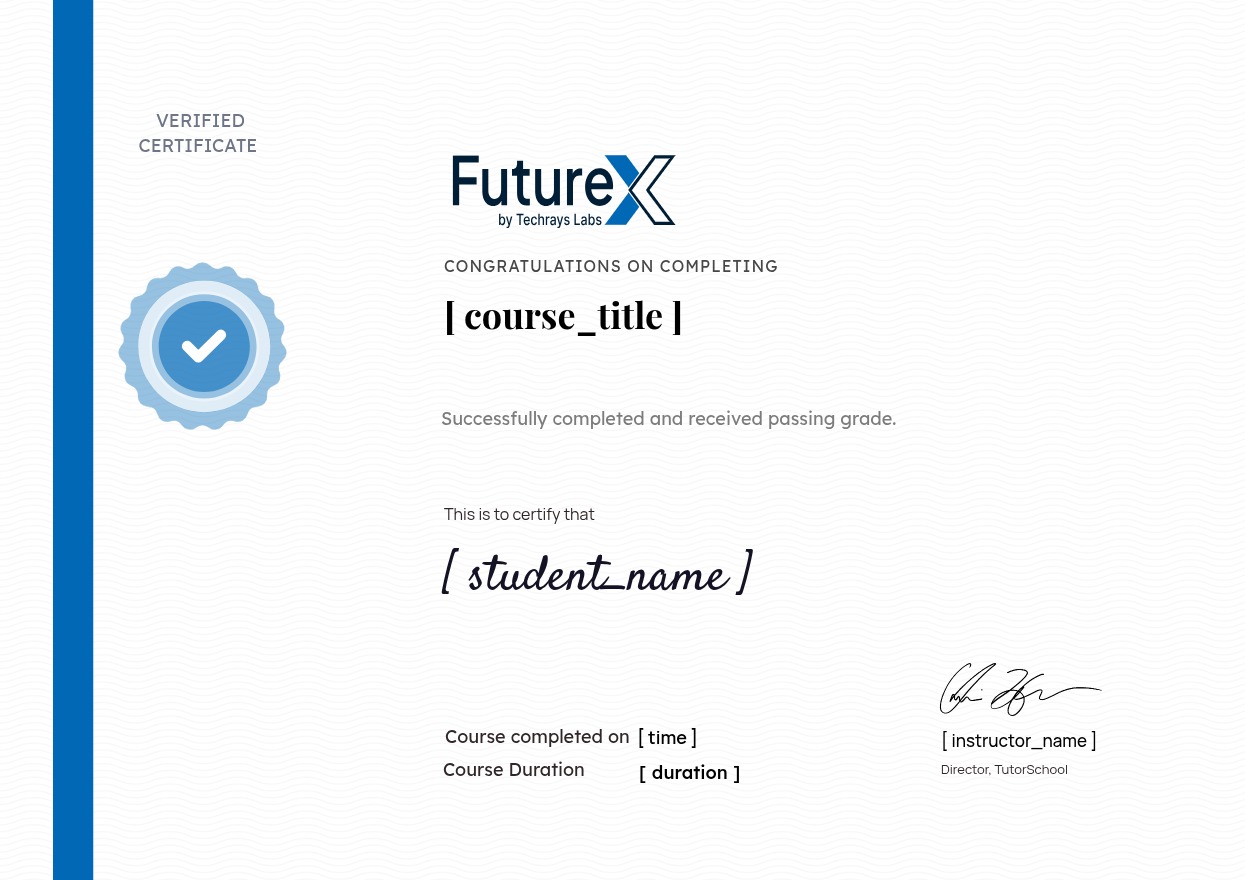
selected template

Student Ratings & Reviews

No Review Yet
No Review Yet