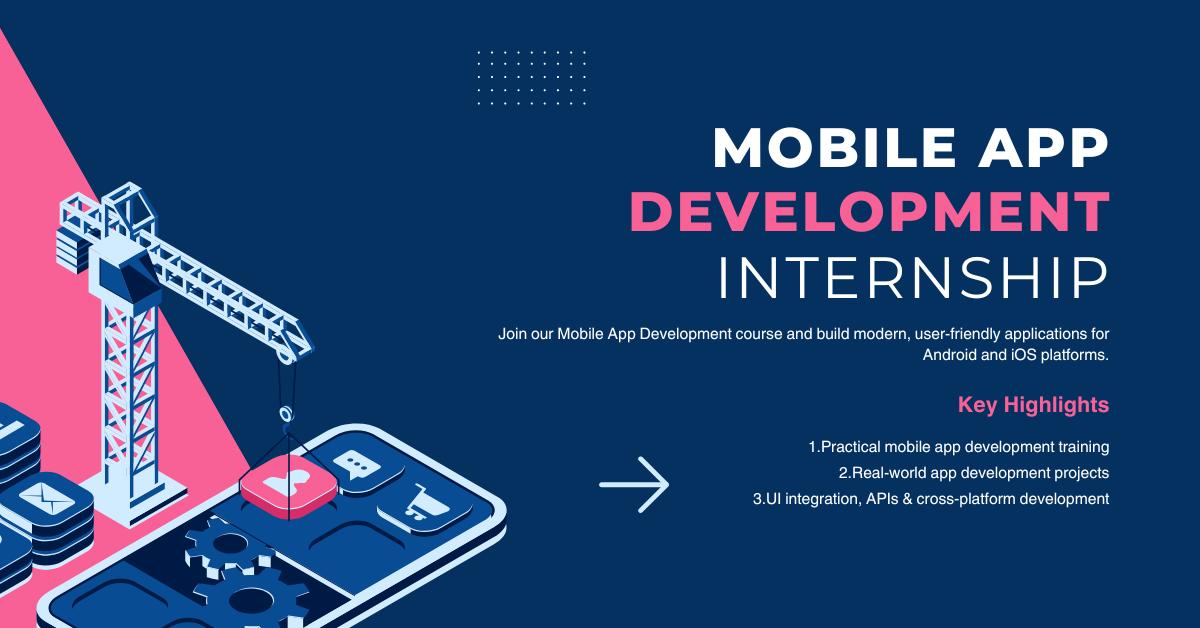
6 Months Mobile App Development Training & Internship

Categories: Training & Internship
Wishlist Share

About Course

This 6-month Mobile App Development Internship is a comprehensive, structured training program designed to transform beginners into job-ready mobile application developers with strong problem-solving, UI development, and cross-platform app-building skills using modern mobile technologies.

The program follows a progressive learning approach, starting from fundamental programming concepts and gradually advancing toward production-level mobile application development. It is designed to provide both conceptual clarity and hands-on practical experience through real-world examples, assignments, quizzes, and project-based learning.

🚀 What This Internship Covers

The internship begins with the fundamentals of programming and mobile application development, where learners understand core concepts such as variables, data types, conditions, loops, functions, and programming logic. This foundation ensures that even beginners with no prior development experience can comfortably begin their mobile app development journey.

Once the basics are established, the program moves into Dart programming and Object-Oriented Programming (OOP) concepts, which are essential for modern mobile development using Flutter. Learners gain deep understanding of classes, objects, inheritance, encapsulation, abstraction, and reusable code structures through practical coding exercises and examples.

Next, students are introduced to Flutter fundamentals and UI development, where they learn how to build responsive and interactive mobile user interfaces. Topics include widgets, layouts, navigation, forms, state management basics, reusable components, animations, and responsive design techniques for Android and iOS applications.

The internship then transitions into backend integration and database management for mobile applications. Students learn how to work with REST APIs, JSON data handling, authentication basics, local storage, Firebase integration, and cloud-based backend services. They also gain understanding of app architecture, API communication, and data persistence.

The program further covers advanced mobile development concepts such as state management, app optimization, performance handling, push notifications, app deployment basics, debugging, and version control workflows used in real-world development environments.

In the final phase, learners apply everything they have learned by building a complete real-world Mobile Application Project, such as a Food Delivery App, Driver Booking App, E-commerce App, Task Management System, or Social Media Application. This project includes UI development, backend integration, authentication, database handling, and structured application architecture, simulating real industry mobile app development workflows.

🧠 Learning Approach

This internship is designed around practical implementation, hands-on development, and continuous evaluation. Each module includes:

  • Structured video/text lessons

  • Practical coding exercises

  • Real-world mobile app examples

  • Module-wise quizzes and assessments

  • UI design and app-building assignments

  • Mini-projects for hands-on learning

  • A final capstone mobile application project

Progression is strictly sequential, meaning learners must complete quizzes, assignments, and practical exercises before advancing to the next module. This ensures strong conceptual understanding before moving toward advanced app development concepts.

🏆 Skills You Will Gain

By the end of this internship, participants will be able to:

  • Understand mobile app development fundamentals

  • Write clean and structured Dart code

  • Apply Object-Oriented Programming concepts

  • Build responsive mobile UIs using Flutter

  • Develop Android and iOS applications

  • Integrate REST APIs and backend services

  • Manage application state effectively

  • Work with Firebase and local databases

  • Debug and optimize mobile applications

  • Build real-world production-style mobile apps

  • Understand modern app architecture and workflows

🎯 Who This Internship is For

This program is ideal for:

  • Beginners who want to start a career in mobile app development

  • Students pursuing computer science, IT, or related fields

  • Developers interested in Flutter and cross-platform app development

  • Individuals looking to build Android and iOS applications

  • Anyone aiming for Mobile App Developer roles in software companies

No prior mobile development experience is required, but consistency, practice, and problem-solving interest are essential for successful completion.

💼 Internship Outcome

Upon completion of this internship, learners will have practical experience in mobile application development and will be capable of building production-level cross-platform mobile applications using Flutter and modern backend integration techniques.

Participants will also complete a portfolio-ready real-world mobile app project that can be showcased to potential employers or clients, significantly improving their opportunities for Mobile App Developer, Flutter Developer, or Cross-Platform App Developer roles in the software industry.

Show More

Course Content

Module 1: Introduction to Mobile App Development
This module serves as the foundation of your Mobile App Development journey. It introduces you to the entire ecosystem of mobile applications, including how apps are built, deployed, and used across platforms like Android and iOS. You will gain clarity on the differences between native, hybrid, and cross-platform development approaches and understand how developers choose the right technology stack. The module also walks you through setting up your development environment, which is a critical step before writing any code. You’ll explore essential tools like Android Studio, VS Code, and emulators that simulate real devices. Additionally, you will learn how mobile apps interact with operating systems and hardware components such as sensors, GPS, and storage. Understanding these basics is crucial because every advanced concept—UI design, API integration, performance optimization—depends on this foundation. By the end of this module, you will be fully equipped to start building your first mobile app and understand the workflow of professional developers. This module emphasizes practical learning, ensuring that you not only understand concepts theoretically but also implement them step-by-step.

  • What is Mobile App Development?
  • Types of Mobile Applications (Native vs Hybrid vs Cross-Platform)
  • Setting Up Development Environment
  • Understanding Mobile App Architecture
  • Check what have you learnt about Mobile App Development Basics
  • Mobile Development Setup & First App

Module 2: Programming Fundamentals for Mobile Development
Before diving deep into mobile frameworks like Flutter or React Native, it is essential to build a strong foundation in programming fundamentals. This module introduces you to the core building blocks of coding using JavaScript, one of the most widely used languages in mobile app development, especially for cross-platform frameworks. You will learn about variables, data types, operators, control structures, functions, and basic data structures such as arrays and objects. These concepts form the backbone of any application logic and are required regardless of the platform or framework you choose later. Understanding programming fundamentals helps you write clean, efficient, and maintainable code. It also prepares you to debug issues, optimize performance, and understand complex frameworks easily. This module ensures that even beginners with no prior coding experience can confidently move forward. By the end of this module, you will be able to write simple programs, understand logic building, and apply these concepts to mobile app development scenarios such as user input handling, decision-making, and data processing.

Module 3: Introduction to Flutter & Dart Programming
This module marks your transition from basic programming to actual mobile app development using Flutter, one of the most powerful cross-platform frameworks developed by Google. You will also learn Dart, the programming language used in Flutter, which is optimized for building fast and expressive mobile applications. In this module, you will understand how Flutter works, why it is widely used in industry, and how it differs from other frameworks like React Native. You will explore Flutter’s widget-based architecture, which is the core concept behind building user interfaces in Flutter apps. You will also gain hands-on experience with Dart fundamentals such as variables, functions, classes, and object-oriented programming concepts tailored specifically for Flutter development. By the end of this module, you will be able to set up a Flutter project, understand its folder structure, write Dart code, and build basic UI components using widgets. This module is crucial because it lays the foundation for all upcoming modules where you will build real-world mobile applications.

Module 4: Flutter UI Development & Layout System
In this module, you will dive deep into building user interfaces (UI) using Flutter. Since Flutter is entirely widget-based, understanding how to design layouts and structure UI components is one of the most critical skills for a mobile developer. You will learn how to use essential layout widgets such as Row, Column, Container, Stack, and Expanded to create responsive and visually appealing designs. This module also introduces alignment, spacing, padding, margins, and how to structure UI elements efficiently. You will explore how Flutter handles screen sizes and responsiveness, which is crucial for building apps that work across different devices. Additionally, you will understand how to apply styling such as colors, fonts, and themes to enhance the user experience. By the end of this module, you will be able to design complete screens, structure UI layouts professionally, and build interfaces similar to real-world mobile applications.

Module 5: Navigation & Routing in Flutter
In this module, you will learn how users move between different screens in a mobile application—one of the most essential aspects of app development. Navigation is the backbone of user experience, enabling seamless transitions between pages such as login, home, profile, and settings. You will explore Flutter’s navigation system, including routes, Navigator class, and different navigation techniques like push, pop, and named routes. Understanding navigation is crucial for building multi-screen applications that feel intuitive and user-friendly. This module also introduces passing data between screens, handling back navigation, and managing navigation stacks efficiently. These concepts are widely used in real-world applications such as e-commerce apps, booking apps, and social media platforms. By the end of this module, you will be able to create multi-screen apps, implement smooth navigation, and manage user flow effectively.

Module 6: State Management in Flutter
In this module, you will learn one of the most critical and often challenging concepts in mobile app development—State Management. State refers to the data or information that determines how your app behaves and what it displays at any given moment. As your app grows in complexity, managing state efficiently becomes essential. Without proper state management, your app can become difficult to maintain, buggy, and inefficient. This module introduces you to both basic and advanced state management techniques in Flutter. You will begin with understanding the difference between Stateless and Stateful widgets, then move on to managing state using setState(). After that, you will explore more scalable approaches like Provider, which is widely used in production-level apps. Real-world applications like e-commerce apps, chat apps, and booking platforms rely heavily on proper state management—for example, updating cart items, refreshing UI after API calls, or managing user authentication state. By the end of this module, you will be able to manage app data efficiently, update UI dynamically, and choose the right state management approach for different scenarios.

Module 7: Working with APIs & Backend Integration
In this module, you will learn how to connect your mobile application to real-world data using APIs (Application Programming Interfaces). Modern mobile apps rarely work in isolation—they rely heavily on backend services to fetch, store, and update data dynamically. You will understand how APIs work, how mobile apps communicate with servers, and how to fetch data from external sources like REST APIs. This module also introduces JSON (JavaScript Object Notation), which is the standard format used for data exchange between client and server. You will learn how to perform HTTP requests (GET, POST), handle API responses, and display dynamic data in your Flutter app. Additionally, you will explore error handling, loading states, and best practices for managing API calls. Real-world applications like social media apps, e-commerce platforms, and booking systems depend heavily on API integration—for example, fetching product lists, user profiles, or booking data. By the end of this module, you will be able to build apps that interact with real servers, handle live data, and create dynamic user experiences.

Module 8: Local Storage & Data Persistence in Flutter
In this module, you will learn how to store and manage data locally on a user’s device. While APIs allow you to fetch and send data to servers, local storage ensures that your app can save important information such as user preferences, login sessions, cached data, and offline content. You will explore different types of local storage options in Flutter, including SharedPreferences, SQLite databases, and lightweight storage solutions. Understanding when and where to use each type is crucial for building efficient and scalable mobile applications. This module also covers how to persist data even after the app is closed, which is essential for real-world apps like authentication systems, note-taking apps, and offline-first applications. By the end of this module, you will be able to store simple data (like user settings) as well as structured data (like lists and records), retrieve it efficiently, and integrate it into your app workflows.

Module 9: Authentication & User Management in Mobile Apps
In this module, you will learn how to implement user authentication systems, one of the most critical components of modern mobile applications. Authentication ensures that users can securely log in, sign up, and access personalized features within an app. You will explore different authentication methods such as email/password login, token-based authentication (JWT), and third-party authentication (Google, Facebook). This module also introduces session management, secure data storage, and user state handling. You will understand how authentication works in real-world apps like e-commerce platforms, ride-booking apps, and social media platforms, where user identity and security are essential. Additionally, you will learn how to integrate authentication with APIs, manage login/logout flows, and protect routes/screens based on user state. By the end of this module, you will be able to build a complete authentication system, handle user sessions securely, and implement login flows used in production apps.

Module 10: Performance Optimization & Debugging in Flutter
In this module, you will learn how to optimize your mobile applications for speed, efficiency, and smooth user experience. As apps grow in complexity, performance issues such as lag, slow loading, and memory leaks can arise. Understanding how to identify and fix these issues is a critical skill for professional developers. You will explore Flutter’s performance tools, learn how rendering works, and understand how to minimize unnecessary UI rebuilds. This module also covers debugging techniques to identify and fix errors effectively during development. You will learn how to use Flutter DevTools, optimize widget usage, reduce app size, and improve responsiveness. These skills are essential for building production-ready apps that perform well on all devices. Real-world applications like ride-booking apps, social media apps, and streaming platforms require highly optimized performance to ensure smooth user interaction. By the end of this module, you will be able to analyze performance bottlenecks, debug issues efficiently, and build high-performance mobile applications.

Module 11: App Deployment, Publishing & CI/CD
In this module, you will learn how to take your Flutter application from development to production and make it available to real users. Building an app is only half the journey—deploying, testing, and publishing it on app stores is what makes it accessible to the world. You will understand the complete process of preparing your app for release, including generating APKs and App Bundles, configuring app metadata, and signing your application securely. You will also learn the guidelines and requirements for publishing apps on the Google Play Store and Apple App Store. This module introduces CI/CD (Continuous Integration and Continuous Deployment), which automates building, testing, and deploying apps. These practices are widely used in professional environments to maintain code quality and speed up releases. You will also explore versioning, release management, and how to handle updates efficiently. By the end of this module, you will be able to deploy your app, publish it on app stores, and implement automated workflows used in real-world development teams.

Final Module: Capstone Real-World Project – Driver Booking Mobile Application
This final module is a complete industry-level capstone project where students will apply everything learned throughout the internship to build a real-world Driver Booking Mobile Application. The project simulates how modern ride-booking and driver management platforms work in real companies. Students will work on both frontend and backend workflows while understanding mobile app architecture, APIs, authentication systems, booking workflows, real-time tracking concepts, database management, and admin operations. This capstone is designed to help students experience a production-style development workflow similar to companies such as Uber and Ola . Students will build: Customer mobile application Driver mobile application Admin management panel Backend API system Booking and ride management workflows The module focuses on: Real-world architecture Scalable folder structure API-based communication Authentication & authorization Database relationships State management Clean coding practices Deployment-ready workflows By the end of this project, students will understand how real transportation and service-booking platforms are designed and managed.

Earn a certificate

Add this certificate to your resume to demonstrate your skills & increase your chances of getting noticed.
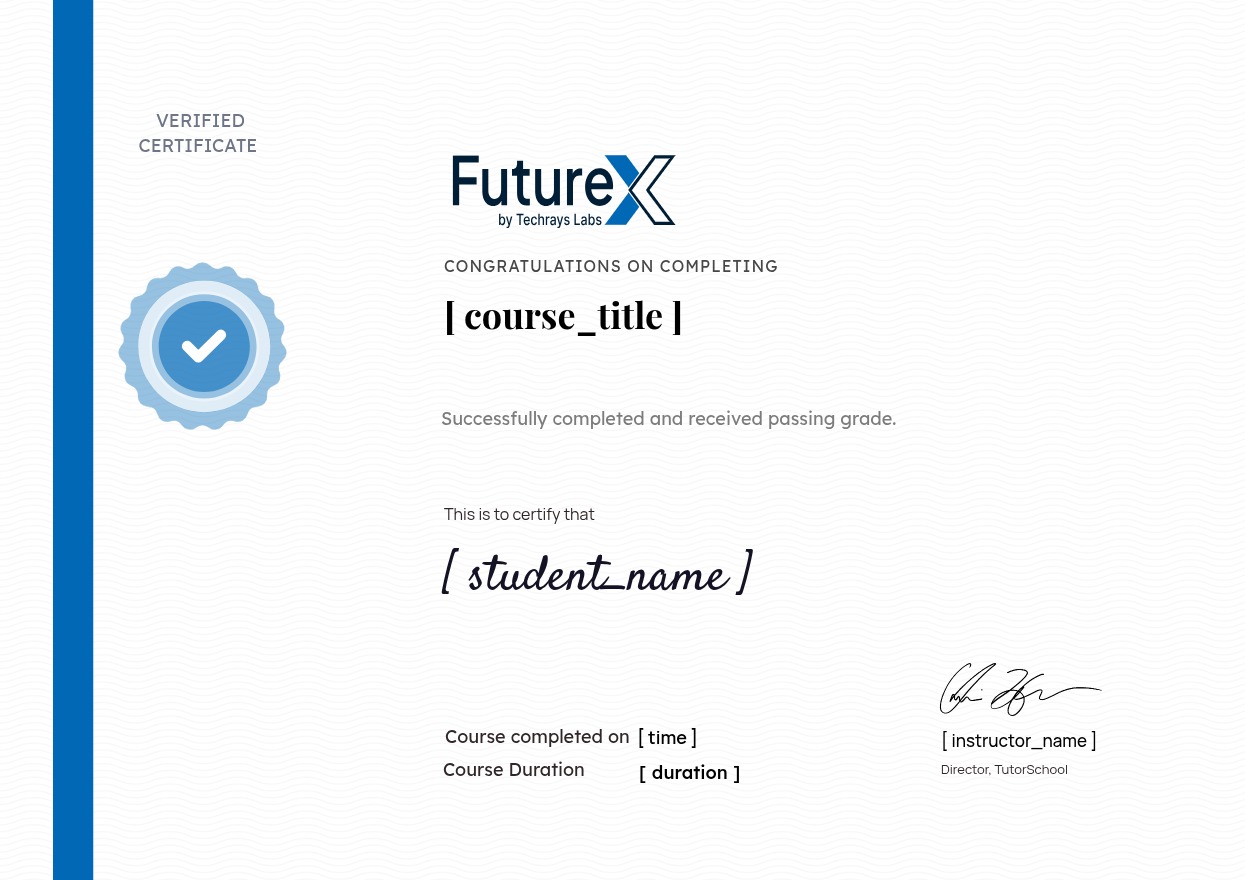
selected template

Student Ratings & Reviews

No Review Yet
No Review Yet