
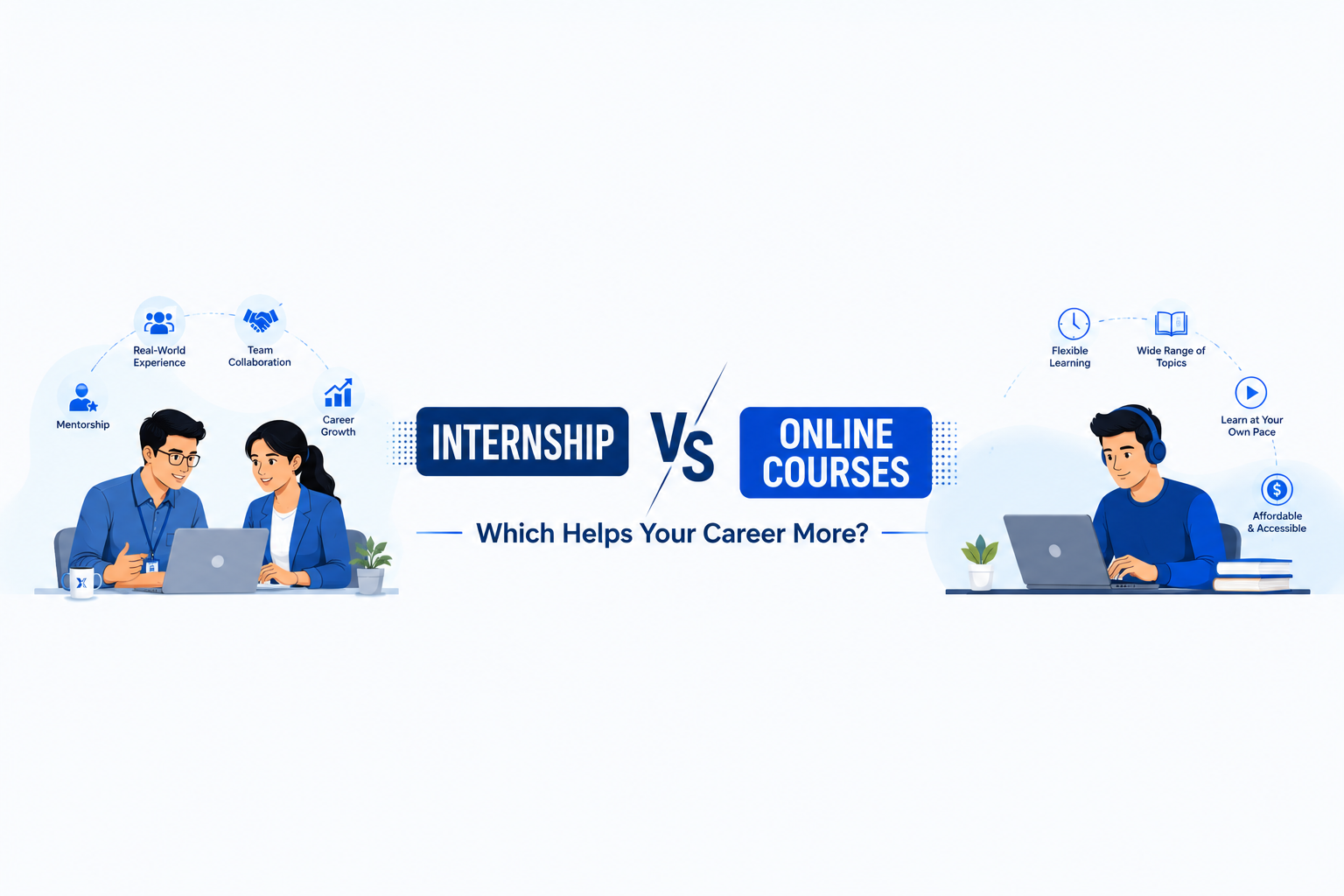
One of the most common questions students ask while planning their careers is:
“Should I enroll in another online course, or should I focus on gaining practical experience through an internship?”
With thousands of online courses available today, learning has become more accessible than ever. Students can learn programming, web development, artificial intelligence, data science, cloud computing, digital marketing, and almost any other skill from the comfort of their homes.
At the same time, employers continue to emphasize the importance of practical experience and real-world problem-solving abilities.
So which path is better?
The answer is not as simple as choosing one over the other.
To understand why, let’s first look at what each approach offers.
The Rise of Online Learning
Over the last decade, online learning has transformed education.
Students now have access to:
- Expert instructors
- Flexible schedules
- Affordable learning resources
- Industry-relevant topics
- Global learning communities
Online courses help students build foundational knowledge and understand concepts that may not always be covered in academic curricula.
For example, a student interested in software development can learn:
- Java Programming
- Python
- React.js
- Node.js
- Database Management
- Cloud Computing
- Artificial Intelligence
without waiting for these topics to be included in their college syllabus.
This accessibility has made online learning an important part of modern education.
What Online Courses Do Best
Online courses are excellent for building theoretical understanding.
They help students:
- Learn concepts
- Understand frameworks
- Explore tools and technologies
- Follow structured learning paths
- Gain exposure to industry trends
For beginners, online courses provide an excellent starting point.
They help answer questions such as:
- What is Java?
- How does React work?
- What is machine learning?
- How do databases function?
This theoretical foundation is essential.
Without it, students often struggle to understand real-world projects.
The Limitation of Learning Alone
However, learning concepts is only one part of career development.
Many students complete multiple courses and collect certificates but still feel unprepared when they face practical challenges.
Why does this happen?
Because understanding a concept is different from applying it.
Watching someone build an application is not the same as building one yourself.
Reading about teamwork is not the same as collaborating with a development team.
Learning GitHub commands is not the same as managing code changes in a real project environment.
This is where practical exposure becomes important.
What Internships Teach That Courses Cannot
Internships expose students to situations that are difficult to replicate through traditional learning.
They help students understand how work actually happens in professional environments.
During an internship, students learn:
Real-World Problem Solving
In courses, problems are often predefined.
In real projects, problems are often unclear and require investigation, analysis, and collaboration.
Students learn how to approach challenges systematically and find solutions independently.
Professional Communication
Communication is one of the most overlooked career skills.
Internships teach students how to:
- Discuss ideas professionally
- Report progress
- Ask questions effectively
- Participate in meetings
- Collaborate with teammates
These skills are valuable in every profession.
Team Collaboration
Most modern projects are built by teams, not individuals.
Internships help students understand:
- Team workflows
- Code reviews
- Project management tools
- Task assignments
- Collaborative development
This experience is difficult to gain through self-paced learning alone.
Accountability and Responsibility
In an internship environment, students become responsible for delivering tasks and meeting expectations.
This develops:
- Discipline
- Time management
- Ownership
- Professionalism
These qualities often separate successful professionals from average performers.
Why Employers Value Practical Experience
When companies hire fresh graduates, they are not only evaluating technical knowledge.
They also assess:
- Problem-solving ability
- Adaptability
- Communication skills
- Teamwork
- Learning mindset
- Practical exposure
A candidate who has worked on projects, completed assignments, and gained hands-on experience often stands out during interviews.
This is because practical experience demonstrates that the candidate can apply knowledge, not just recall it.
The Strongest Candidates Combine Both
The most successful students do not choose between learning and practical experience.
They combine both.
Their journey usually looks like this:
Step 1: Learn
Build strong foundations through courses, workshops, books, and self-learning.
Step 2: Build
Apply learning through projects and assignments.
Create websites, applications, portfolios, and problem-solving exercises.
Step 3: Gain Experience
Participate in internships, collaborative projects, and real-world learning opportunities.
This combination creates a powerful profile that demonstrates both knowledge and execution.
Why Practical Learning Creates Better Outcomes
Learning becomes significantly more effective when students apply concepts immediately.
For example:
A student learning GitHub understands the commands.
A student using GitHub in a project understands:
- Branching strategies
- Pull requests
- Code reviews
- Team collaboration
- Version control workflows
The second student gains deeper understanding because learning is reinforced through practical application.
The same principle applies to programming, design, data analysis, digital marketing, and nearly every professional skill.
Preparing for the Future Job Market
The modern workforce rewards individuals who can learn and execute.
Employers increasingly look for candidates who demonstrate:
- Technical skills
- Practical project experience
- Communication abilities
- Continuous learning
- Professional mindset
Students who focus only on theory often struggle with implementation.
Students who focus only on execution may lack foundational knowledge.
The ideal approach combines both.
Final Thoughts
Online courses are valuable.
Internships are valuable.
But they serve different purposes.
Courses help students understand concepts.
Projects help students apply concepts.
Internships help students experience how those concepts are used in the real world.
Career growth happens when learning, building, and practical exposure come together.
The students who continuously learn, apply their knowledge, and seek real-world experience are often the ones who develop stronger skills, greater confidence, and better career opportunities.
In today’s competitive environment, success is rarely built through knowledge alone.
It is built through knowledge combined with experience.