
Introduction
Every engineering student wants to get their first internship.
But there is one challenge.
Most students apply with only a resume.
Companies hiring for a mobile app online internship are not looking for resumes alone. They want proof that you can build real applications.
A strong portfolio can help you stand out, even if you have no previous work experience.
Whether you are learning Flutter, React Native, Android, or iOS, the projects you build today can become your biggest advantage during internship interviews.
In this blog, we’ll discuss the best mobile app projects every engineering student should build to create an impressive portfolio.
Why Your Portfolio Matters More Than Your Marks
Many students believe that good academic scores are enough.
In reality, recruiters ask different questions.
- Can you build an application from scratch?
- Can you solve real-world problems?
- Do you understand APIs and databases?
- Can you debug issues?
- Can you work with Git and version control?
Your portfolio answers all these questions before the interview even begins.
A portfolio shows your skills, learning attitude, and consistency.
Choose One Technology First
Don’t try to learn everything together.
Start with one technology.
Flutter
Flutter allows you to build Android and iOS applications using a single codebase.
It is perfect for beginners because of its growing demand and fast development process.
React Native
If you already know JavaScript or React, React Native is an excellent choice.
Many startups use React Native to build cross-platform mobile applications.
Native Android
Learning Kotlin helps you understand Android development deeply.
Many companies still hire Android developers for native applications.
Native iOS
Swift is the preferred language for iOS development.
If you want to build applications exclusively for Apple devices, Swift is the way to go.
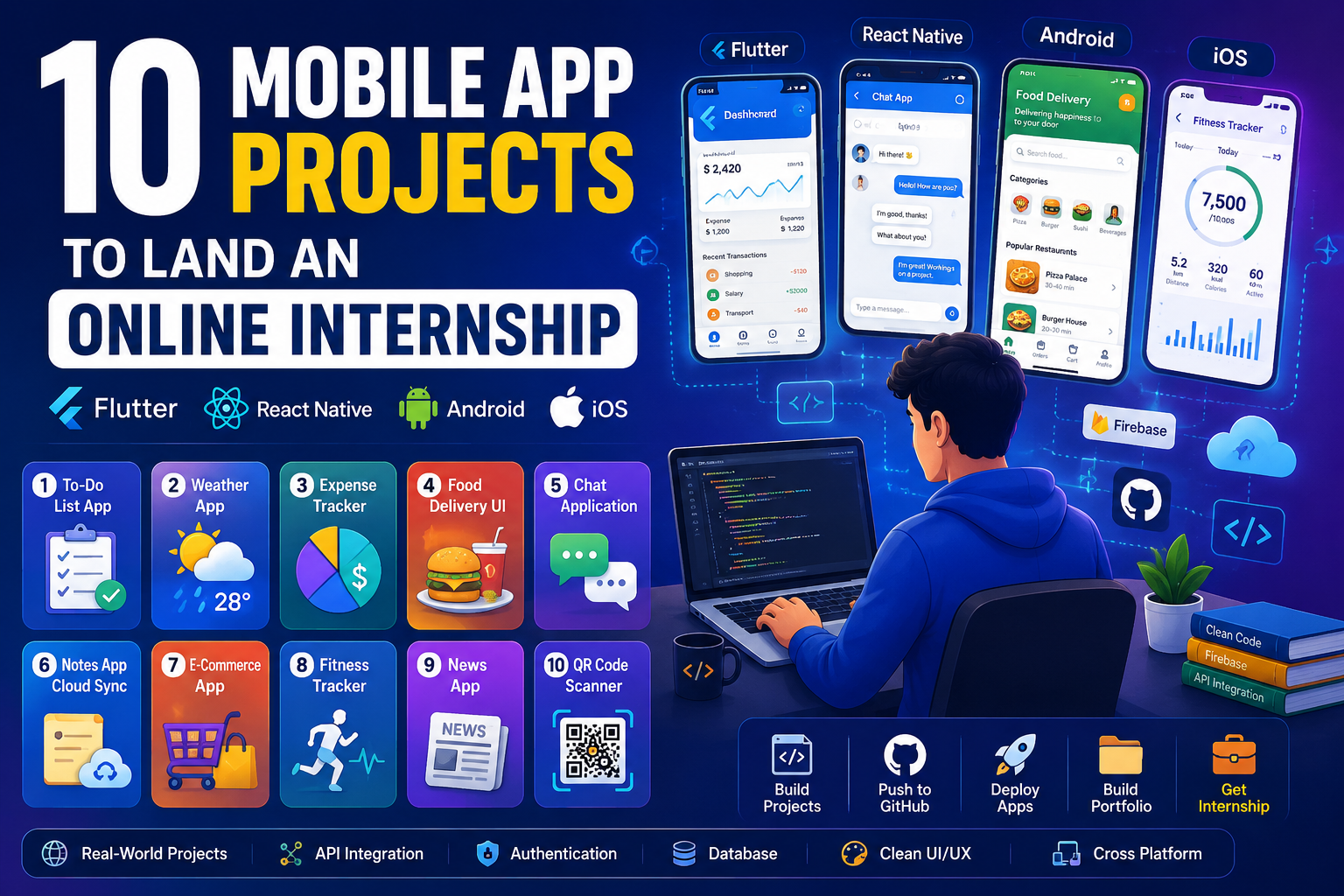
8 Projects Every Student Should Build
1. To-Do List Application
This is the perfect beginner project.
Features to include:
- User authentication
- Create, edit, and delete tasks
- Categories
- Due dates
- Dark mode
- Local storage
This project teaches application architecture and state management.
2. Weather Application
Use a public Weather API.
Features:
- Search by city
- Current weather
- 5-day forecast
- Weather icons
- GPS location
- Refresh functionality
You’ll learn API integration and JSON parsing.
3. Expense Tracker
One of the most impressive beginner projects.
Features:
- Add income and expenses
- Monthly reports
- Charts
- Categories
- Export reports
Skills learned:
- Local database
- Data visualization
- CRUD operations
4. Food Delivery UI
Focus on design and user experience.
Include:
- Home screen
- Restaurant listing
- Product page
- Cart
- Checkout screen
- Profile page
Recruiters appreciate clean UI implementation.
5. Chat Application
Build a real-time messaging app.
Features:
- Login
- One-to-one chat
- Online status
- Image sharing
- Push notifications
Technologies:
- Firebase
- Socket APIs
- Cloud Messaging
6. Notes Application
Go beyond a simple notes app.
Add:
- Rich text editing
- Images
- Voice notes
- Search
- Tags
- Cloud synchronization
This project demonstrates complete mobile development skills.
7. E-Commerce Application
A favorite among recruiters.
Modules:
- Authentication
- Product listing
- Search
- Wishlist
- Cart
- Payments (Demo)
- Order history
This project combines multiple concepts into one application.
8. Fitness Tracker
Build something practical.
Features:
- Daily workout tracking
- Water reminder
- BMI calculator
- Step counter
- Progress charts
This showcases hardware integration and data visualization.
Make Every Project Look Professional
Many students stop after building the application.
That is a mistake.
Every project should include:
- Clean folder structure
- README documentation
- Screenshots
- Installation guide
- GitHub repository
- Demo video
- Proper commit history
These small details make a huge difference.
Learn Git and GitHub
Almost every company expects interns to know version control.
Practice:
- Creating repositories
- Branching
- Pull requests
- Merge conflicts
- Meaningful commit messages
Your GitHub profile becomes part of your portfolio.
Publish Your Apps
Don’t keep your projects on your laptop.
Share them.
Options include:
- GitHub
- Google Play (Internal Testing)
- TestFlight (iOS)
- Firebase App Distribution
A live project creates a stronger impression than screenshots alone.
Build Quality, Not Quantity
You don’t need twenty unfinished applications.
Three or four polished projects are far more valuable.
Recruiters prefer:
- Working applications
- Clean code
- Good UI
- Proper documentation
- Real-world features
Focus on solving actual user problems.
What Companies Look for During a Mobile App Internship
Recruiters generally evaluate:
- Programming fundamentals
- Problem-solving ability
- UI implementation
- API integration
- Database knowledge
- Debugging skills
- Git usage
- Communication skills
- Willingness to learn
Your projects should demonstrate these abilities.
Common Mistakes Students Make
Avoid these mistakes:
- Copying projects without understanding them
- Uploading incomplete code
- Ignoring documentation
- Poor UI design
- No GitHub activity
- Building only tutorial applications
- Never deploying the app
Original projects always stand out.
Final Thoughts
Getting a mobile app online internship is not about having the highest grades. It is about proving that you can build real applications and solve practical problems.
Start with one framework, complete meaningful projects, document your work, and keep improving your portfolio. Every application you build adds to your confidence and increases your chances of getting shortlisted.
Remember, your first internship doesn’t begin with an interview. It begins with the portfolio you create today.
Frequently Asked Questions (FAQs)
1. Which technology is best for a mobile app online internship?
Flutter and React Native are excellent choices because they allow you to build applications for both Android and iOS using a single codebase. Native Android (Kotlin) and iOS (Swift) are also valuable if you want to specialize.
2. How many projects should I include in my portfolio?
Aim for 3–5 well-documented, fully functional projects instead of many incomplete ones. Quality matters far more than quantity.
3. Do I need to publish my apps?
While not mandatory, publishing your apps on platforms like Google Play (Internal Testing) or Firebase App Distribution shows initiative and gives recruiters confidence in your practical skills.
4. Is GitHub important for internship applications?
Yes. A GitHub profile with clean code, regular commits, documentation, and project history demonstrates professionalism and collaboration skills.
5. Can beginners get a mobile app internship?
Absolutely. Many companies hire students based on their learning attitude and project portfolio. If you can showcase practical skills through real applications, you have a strong chance of securing an internship.