
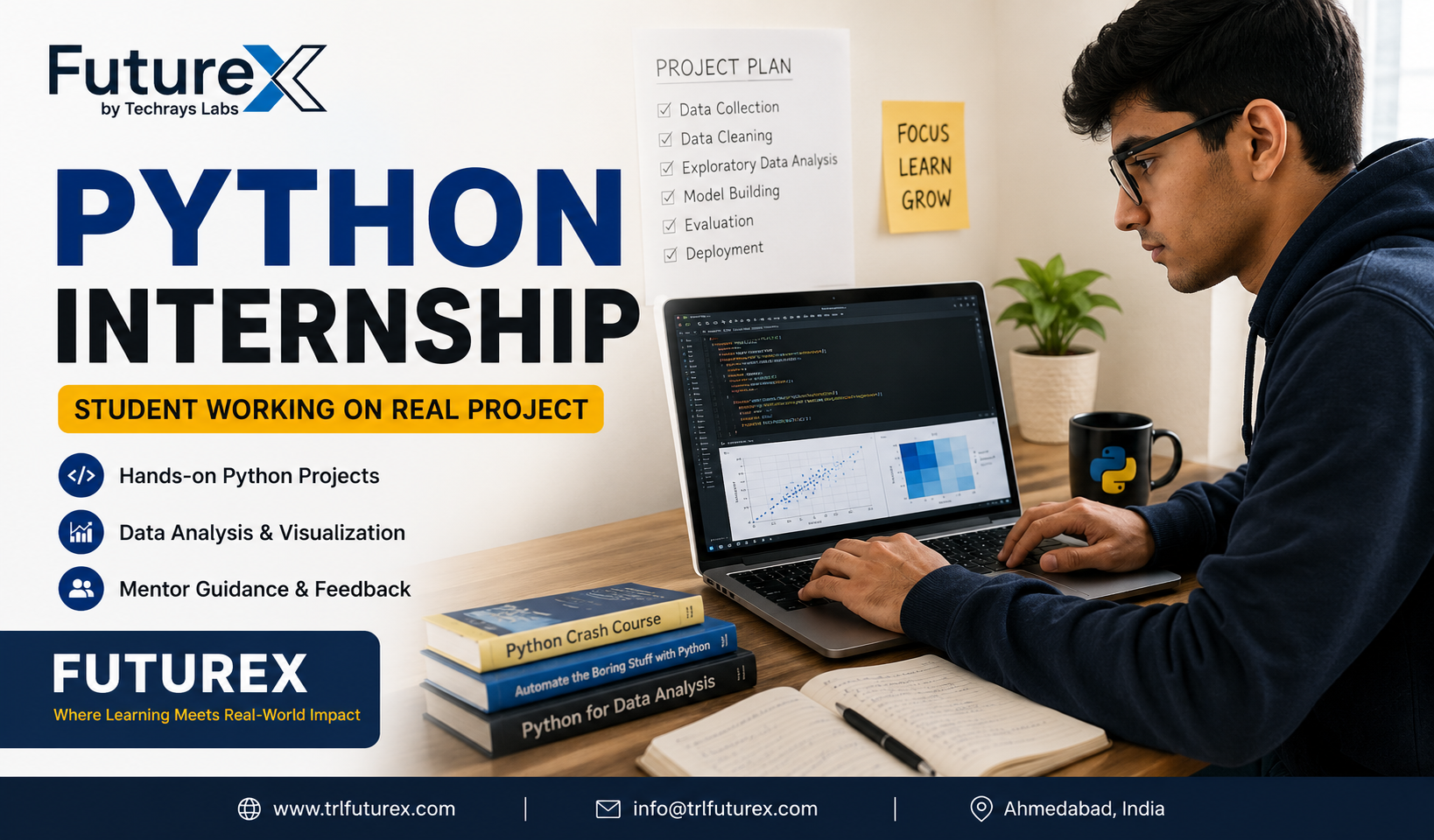
So you’ve heard the word “internship” thrown around a lot. Maybe a senior did one. Maybe your professor keeps mentioning it. And now you’re wondering: what’s actually in it for me?
Here’s the simple version. A Python internship is a chance to use Python on real problems — not just homework questions — with someone experienced checking your work and helping you get better. By the end, you walk away with actual projects you built, a certificate, and a much better answer the next time someone asks, “so what can you actually do with Python?
What’s in This Guide
- What a Python internship really is
- Why it’s actually worth your time
- What you’ll learn
- Real things you’ll build
- Who this is for
- What one student said about it
- How it works, step by step
- Quick questions, answered
So What Exactly Is a Python Internship?
Think about how you learned Python in class. Probably something like: “write a program that reverses a string” or “find the largest number in a list.” Useful, but a little… dry. You finish it, you move on, and a week later you’ve forgotten you ever did it.
An internship flips that around. Instead of small made-up exercises, you get a real, messy problem — like a pile of real data that needs cleaning up, or a pattern that needs to be found and explained. You write the code, someone with real experience looks at it, and you fix it up until it’s actually good. That’s the whole idea.
Okay, But Does It Actually Help?
Fair question. Here’s what changes when you do one, in plain terms:
1. You stop just “knowing” Python and start using it
There’s a big difference between knowing what a for-loop does and actually using one to solve a problem nobody handed you the answer to. An internship is where that switch happens.
2. You get something to show, not just something to say
“I know Python” is just a sentence. Anyone can say it. But a finished project — something you actually built — is proof. That’s the difference recruiters notice.
3. Someone actually checks your work
When you learn alone from YouTube, nobody tells you when you’re doing something the hard way, or the wrong way. A mentor will. That feedback is worth more than another ten tutorials.
4. You build your portfolio before you even graduate
Imagine showing up to your first job interview with two or three real projects already done, while everyone else only has class notes. That’s a pretty good position to be in.
5. It fits around your actual life
You’re still in college. You still have exams. The good news is online internships like this one come in 1, 2, 3, or 6-month options, so you pick what fits your schedule — not the other way around.
What You’ll Actually Learn
Every program is a little different, but a solid Python internship should teach you:
- The real basics done right — writing clean code that actually makes sense later
- NumPy and Pandas — the tools real data people use every single day
- How to turn boring numbers into charts people actually want to look at
- How to clean up messy data (because real data is always messy)
- A first taste of machine learning — teaching a program to make predictions
- How data actually moves from “raw mess” to “useful answer”
- Git basics, so your work is saved and easy to share
Real Things You’ll Build
Forget made-up textbook problems. Here’s the kind of stuff you’ll actually work on:
- Taking a real dataset (think: sales numbers, weather records, survey answers) and digging out what it’s really telling you
- Building a simple model that predicts something or sorts things into categories
- Making a dashboard or chart that shows your findings clearly, at a glance
- Writing a script that automates something boring and repetitive, so a computer does it instead of a person
And here’s why that matters: in an interview, instead of saying “I know Python,” you get to say, “I built this. Here’s how. Here’s what it does.” That lands very differently.
Who’s This Actually For?
You don’t need to already be good at this. Seriously. This is meant for:
- College students, any year, who want real experience alongside their classes
- Beginners who know a little bit of logic or coding and want real guidance, not guesswork
- Students from non-tech backgrounds (commerce, science, anything) who are curious about switching into data or tech
- Anyone who’s done a few tutorials but never actually finished a real project or earned a certificate for it
What a Real Student Said
“The Python Internship at TRL FutureX helped me understand how Python is actually used in real projects, not just in theory. The tasks were practical and the guidance from mentors made a real difference.”
— Priya Nair, Python Internship, TRL FutureX
How the TRL FutureX Python Internship Works
- Pick your track — Choose the Python / Data Science internship, and pick how long you want it to run: 1, 2, 3, or 6 months.
- Learn and build — Go through the lessons, then immediately put them to use on real project tasks.
- Get mentored — Send in your work and get honest feedback so you actually improve, not just repeat mistakes.
- Get certified — Finish your projects and evaluation, and you’ll get an Industry-Recognized Certificate to put on LinkedIn and your resume.
Quick Questions, Answered
Is this internship fully online?
Yes, completely. You can do it from home, your hostel, anywhere — around your regular college schedule.
Do I need to already know Python well?
Nope. A little basic logic helps, but the whole program is built to teach you from the ground up through real, guided projects.
How long does it actually take?
That’s up to you — pick 1, 2, 3, or 6 months depending on how much time you have and how deep you want to go.
Do I get a certificate at the end?
Yes. Once you finish your project tasks and evaluation, you get an Industry-Recognized Internship Completion Certificate from TRL FutureX.
What can I actually do once I’m done?
You’ll be able to clean up real data, build basic prediction models, make clear charts and dashboards, and talk through real projects in an interview — instead of just listing Python as a “skill” with nothing behind it.
Ready to Actually Start?
Stop just reading about Python and start building with it. Apply to the TRL FutureX Python & Data Science Internship and see what you can make.